




We all know that the sky is blue, but many of us take this fact for granted. Have you ever wondered why the sky is blue? Well, you’re not alone! It’s a question that lots of children and adults have (and one that has left many a parent stumped…).
In this blog, we take a close look at one of the most fascinating and beautiful natural phenomena – the blue sky. Think of it as a cheat sheet for when your little one starts asking what is a difficult and somewhat scientific question! From the science behind its colour to the different ways it can change, we’ll explore the many mysteries of the sky and how it has captivated people for centuries. So why is the sky blue? How does it change colour? And is the sky the same colour everywhere in the world? Let’s find out!
Little Scholars provides an attractive and safe environment to children in South East Queensland while giving you total peace of mind while your children are in our care. Learning areas include well-equipped playrooms and landscaped outdoor spaces for maximum learning opportunities. Book a tour today if you are looking for a childcare centre in South East Queensland.
Have you ever heard of something called “Rayleigh scattering”? It’s a fancy scientific word, but it’s actually a really cool phenomenon that helps explain why the sky is blue!
Rayleigh scattering is a type of light scattering that happens when light waves hit very small particles, like the tiny particles in the Earth’s atmosphere. The Earth’s atmosphere is made up of different things, like water vapour and tiny dust particles and pollen. When sunlight hits these particles, the light is scattered, or spread out, in all directions.
What is a particle? Well, a particle is just a really, really small piece of something, like air, dust, or water. When light waves hit these particles, they can bounce off in different directions. This is called “scattering” – think of rolling a marble into a group of other marbles. They all bounce off of each other and go every which way.
Did you know that this is also similar to how blue eyes get their colour? That’s right, blue eyes don’t have any blue colour in them at all. Instead, they get their colour from the way they reflect light. Just like the sky and the ocean look blue because they reflect blue light!
So, as you can see, Rayleigh scattering is a really cool scientific phenomenon that helps explain why the sky is blue and why our eyes are blue. It’s just one of the many fascinating things about light and the world around us.
But the sky isn’t always blue! Sometimes, it can be other colours, like orange, pink, or red. This can happen at sunrise or sunset, or just when the sun is low in the sky. Depending on where the sun is in the sky its light might have to travel through more of the Earth’s atmosphere to get to us, which means it has more time to be scattered. This can make the sky look orange, pink, or red. Have you ever seen a beautiful sunrise or sunset? Those colours in the sky are caused by the same process that makes the sky blue.
The sky can also change colour because of things like clouds, pollution, and even the weather. Clouds can block the sunlight, making the sky look grey or white. Pollution can also make the sky look hazy or yellow. And different types of weather, like thunderstorms or dust storms, can change the colour of the sky too.
According to an article by National Geographic Kids, the sky was actually orange until about 2.5 billion years ago. This is because the Earth’s atmosphere was very different back then, and it was filled with a lot of methane and other gases that made the sky look orange.
But about 2.5 billion years ago, something called the “Great Oxygenation Event” happened. This was when the Earth’s atmosphere started to fill up with oxygen, which is a gas that most animals need to breathe. The oxygen in the atmosphere caused methane and other gases to disappear, and this made the sky start to look blue like it does today.
One interesting example to look at is the Northern Lights, also known as the Aurora Borealis. The Northern Lights are a beautiful light show that can be seen in the sky in the Northern Hemisphere, near the North Pole. They are caused by charged particles from the sun that enter the Earth’s atmosphere and collide with gases like oxygen and nitrogen. These collisions create colourful light displays in the sky. The Northern Lights can be different colours, like green, red, yellow, and even purple.
You can also see something similar right here in Australia! These are called the Southern Lights, or Aurora Australis, which can be seen in the sky near the South Pole in places like Tasmania. Just like the Northern Lights, the Southern Lights are caused by charged particles from the sun colliding with the Earth’s atmosphere.
So, as you can see, the sky can be different colours in different parts of the world because of the different gases and particles in the Earth’s atmosphere. But no matter where you are, the sky is always an amazing and beautiful thing to look at.
At Little Scholars, located on the Gold Coast, we prioritise creating a warm and welcoming environment for children to grow and thrive. Since opening in 2014, we have offered educational programs and activities in a fun and nurturing atmosphere, including access to a spacious outdoor play area.
Our early learning campuses are designed to be both attractive and safe, with well-equipped playrooms and landscaped outdoor areas that provide ample opportunities for learning and exploration. We aim to give parents peace of mind while their children are in our care. Book a tour today to find out more.
The easiest slime recipe you will ever read. There is something so nostalgic about gummy bears as they’ve been around for years! I’m sure many of us older ‘kids’ can recall eating a gummy bear or five so it’s safe to say, making this slime will bring you back to your childhood. We had a blast making this slime but we must pre-warn you before you get to the slime makin‘ – be prepared to wash your hands multiple times because slime is seriously sticky.
Place the gummy bears in a microwave-safe bowl and heat for 30 seconds. Stir well and reheat as needed to make the mixture completely smooth. Once melted stir well to help the mixture cool down! Combine cornstarch and icing sugar together and place half on a cutting baked or clean surface. Pour the gummy mixture onto the cornstarch and when cool enough to touch, knead in the remaining cornstarch mixture.
TIME TO PLAY. WARNING ⚠️ THIS SLIME IS SO STICKY, YOU MAY HAVE TO WASH YOUR HANDS TWICE. 🤪

Becoming a foster parent is not all rainbows and butterflies, it is a wholehearted decision which requires dedication and effort. It is a commitment that you choose and one that can helps provide a safe and caring environment for children and young people in our community. As a foster parent there are incredible opportunities presented in so many different forms, however, it is vital you have an insight into what is involved in becoming a foster parent so that you feel totally equipped and prepared for your journey.
What we are going to share with you is all based from personal experiences from our regional manager, Skye Ible, and we know many of you who are looking to foster a child or are in the process currently will be able to relate to Skye’s experiences entirely.
If you are not aware, becoming a foster parent is a lengthy and complex process, but if you are aware of that before going into your application, it will take away the overwhelming feelings of wow, this is a lot to take in. Do not let the complex application haunt you, we have been told that once you find the right organisation that fits right with you, you will have endless support from the agency, and this will impact your fostering experience in a tremendously positive way.
It is helpful you know there are expectations that the agency will require of you when you start your application. You will be asked to attend an initial training – these are normally at night and then at nigh- time you are given workbooks to complete in the comfort of your home. There are also safety checklists you need to complete of your home environment, as well as making the necessary changes if needed. The support workers will visit your home for an assessment, and it is vital you are prepared to talk about everything from throughout your life which entails good and bad from childhood until present. It is super important to go through this assessment period as the agencies need to know if the children are going into a safe and supportive environment, and if you have children of your own or a partner, they will always assess whether your child can handle the fostering of other children.
The foster agency will always ask for at least two references to contact and if you are approved, they will call within 24 hours offering you a child. One piece of advice from talking with our own foster parent is, to be prepared and compile a list of questions ready to talk through with your support person just so you can decide if the child is a suitable match for your family. Do not be afraid to speak up if the placement isn’t working as it is about the foster child’s needs as well as your own, and most of the time there will always be another family out there suited to this child.
During the journey of being a new foster parent, keep in mind that some children crave love and attention but don’t always know how to ask for it. Some children may say ‘ I love you’ or call you ‘mum or dad’ within a few months and some might not feel comfortable letting another person in. All you can do is remind yourself that this child has gone through more than imaginable, and all you can do is open up your hearts and home to show them that they are loved and safe. If you have a strong family unit and strong support system in place, this will help you get through any hick ups that come up along the way.
Whether you are a single person, married, same sex or dating you are eligible to foster a child but remember you must have a spare room in your home to allow for privacy for the child, and everyone must attend a training session as a requirement of being a foster parent. Life is to be lived to the fullest and knowing that a child’s life can be lived to their fullest with another person’s love, devotion and care is nothing short of extraordinary, so we truly commend all the amazing families who do everything in their will to make sure these children are given a second chance at life.
Thank you so much to Skye for sharing such personal and incredible insights with us, you are an inspiration to us all. Every child deserves a chance at a better life.
If you want to find out more about becoming a foster parent within Queensland, please refer to the resources shared with us below.
Many of you might be familiar with the Abecedarian approach if you are a parent, however, if you’re not that’s okay, because we are here to share everything we know about this incredible learning approach. There are countless benefits of this learning approach which is what led us to adopting the Abecedarian approach at all our campuses. In fact, we have a qualified coach on our team, so it made sense to bring this approach into Little Scholars’ learning lives.
Did you know that a research study found children who participate in the Abecedarian approach have a brain capacity 30-40% greater? Pretty amazing right? One of the main focuses of the Abecedarian approach is language, because it gives children a way to structure their thoughts and explain their ideas, and the opportunity to express their feelings and the tools required when interacting with peers and adults. One of the obvious benefits that come with the Abecedarian approach is children gain more interaction and have a chance to widen their use and understanding of vocabulary. They also develop memory, understand number concepts, and learn shapes and colours.
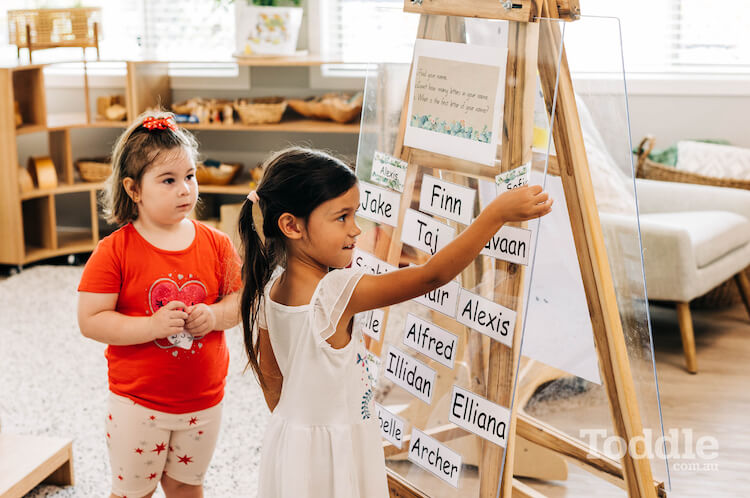
There are four main elements that make up the Abecedarian approach and these are language priority, conversational reading, enriched caregiving and learning games. If you want to incorporate any of these strategies at home with your little one(s), there are many simple ways you can do this. To build on the language you use language priority or conversational reading strategies with your child. Conversational reading could be pointing out an object in a book, asking your child if they can show you that object, and then asking what it is called? Or during story time, for example, you can talk to your child and say ‘I can see a red ball on this page, can you point to the red ball? Amazing, what is this next to the ball?’
When it comes to language priority, this approach presents an opportunity to show your child what words mean, as well gives parents or educators a chance to use rich and interesting language when talking with a child. You can use numbers when you talk and play and say something like ‘I notice you’re looking at the green stem’. It is incredible what your language can tell a child, whether it’s telling a child about feelings, time, colours, shapes, textures, tastes, and honestly, so much more.
With enriched caregiving, you can simply add educational content around routine times. Bath time would be the perfect time to take on this approach because rather than just sitting and supervising, you can talk to your child about objects in the bath. This could be colours, shapes, objects they see, body parts and anything that your child can visualize.
Okay, finally there are learning games! There is a wide list of simple games you can use with your child, to teach them about ideas and concepts. These games may include letting your child match colours or shapes and colours, the list of games is endless and at Little Scholars we have a vast range of games available at all our campuses which are available to borrow for all our families.
All the strategies from the abecedarian approach work best with individual children or maybe just two children at a time – not large groups, which is why is it beneficial for families to use. At Little Scholars we send out several family booklets to promote these strategies, so if you are a parent at one of our campuses and you want to learn more about the abecedarian approach, please feel free to contact any of our wonderful educators.
To read more about why Little Scholars adopts The Abecedarian approach, go to Little Scholars adopts Abecedarian approach to increase children’s brain development (thesector.com.au)
Sand Rainbows. Try this super simple Kinetic Sand recipe at home. You would be surprised, you probably already have all the ingredients in your pantry. This is a super fun, vibrant activity you can do at home at anytime!
Okay, make sure all of your dry ingredients are ready to go before you start your recipe, it will make the process a lot simpler. Firstly start by mixing all your dry ingredients together and then gradually mix in the coloured water bit by bit. You may not need to add in all the water, so have a look at the consistency and decide for yourself! Enjoy making rainbow mountains’ out of your very own taste safe kinetic sand.
Spoooky Slime. The easiest slime recipe you will ever read. Who loves Halloween?! We sure do! So, we thought it was only necessary to share our favourite Halloween inspired Hocus Pocus Slime! This is a super simple recipe to make and so much fun!!! Oh, and a handy tip! Don’t forget the Saline Solution must have Boric Acid in it otherwise it won’t work. (We are talking from experience.)
Simply follow these steps. Pour ½ Elmer’s washable glue into a bucket and add in the Baking Soda! Pour in White Vinegar and Saline Solution and with your spatula, give your recipe a good ol’ mix! Add in your desired food colouring and add in the rest of your White Vinegar and Saline Solution and mix your heart away!
Frozen Dreams. The easiest slime recipe you will ever read. We have a fun activity for you to try at home, particularly for all the Elsa fans! Dreams really do come true with this Frozen-inspired homemade playdough.
Simply add them all together, and remember go to town with the blue food colouring as this is when the Frozen dreams come to life.
Simply follow these steps! Pour 1 cup of water in a large bowl and then add in 1 teaspoon of blue colouring and mix it together. Add in 1 tablespoon of cream tartar, then add in 1 cup of flour along with the 1/2 cup of salt. Mix together all the ingredients and start kneading! You will then have the consistency of playdough, if you want to loosen the texture, add in a little oil. Feel free to add sparkle!
Christmas Dough Cinnamon goodness. The easiest slime recipe you will ever read.
Make your house smell just like Christmas and allow the children to really get into the festivities. You can be as creative as you like with this recipe! Think of everything that smells and looks like Christmas.
Simply add them all together, and remember don’t be shy on the cinnamon. It is the main component in this recipe!
Simply mix all the ingredients together till it forms a dough. Add some flour if the mix is too wet. Oh, and don’t skimp on the cinnamon. Make it rain cinnamon!!! This is the part where you can add whatever Christmas props and edible goodness you want! We would suggest adding in chocolate cookies and nibbles for more deliciousness. Now it’s time to PLAY!
Red Velvet Edible Deliciousness. The easiest slime recipe you will ever read.
For all of you who have a real sweet tooth, we have a super delicious Red Velvet edible slime recipe. We had a blast making this one, now it’s your turn to make (and eat) it. Simply add them all together, mix and hours of fun.
WARNING best to do on an outside table because this stuff can get everywhere.
Simply combine 1/4 cup of the instant choccy goodness and 1/2 cup of cornstarch and mix well with a whisk. Be sure to break up all the clumps, because once you add the water it is harder to dissolve them. Now stir in 1/3 cup of very warm water until you can no longer mix it with the whisk!
Add in another 1/2 cup of cornstarch and start kneading the ooey, choccy slime with your hands until it is smooth and all the cornstarch is incorporated.
The consistency of this slime mixture comes up somewhere between a playdough and a slime, and just a little tip from the edible slime experts themselves (that’s us) add in a little oil to loosen up the texture.
Icky Sticky Fluro Goo. The easiest slime recipe you will ever read. Next time you are at the supermarket simple grab some of the Elmers Clear Glue.
Simply add them all together, mix and hours of fun.
WARNING best to do on an outside table because this stuff can get everywhere.
Let us hold your hand and help looking for a child care centre. Leave your details with us and we’ll be in contact to arrange a time for a ‘Campus Tour’ and we will answer any questions you might have!
"*" indicates required fields
Let us hold your hand and help looking for a child care centre. Leave your details with us and we’ll be in contact to arrange a time for a ‘Campus Tour’ and we will answer any questions you might have!
"*" indicates required fields
Fill in the form to join your local Pram Pals mums and bubs walk
