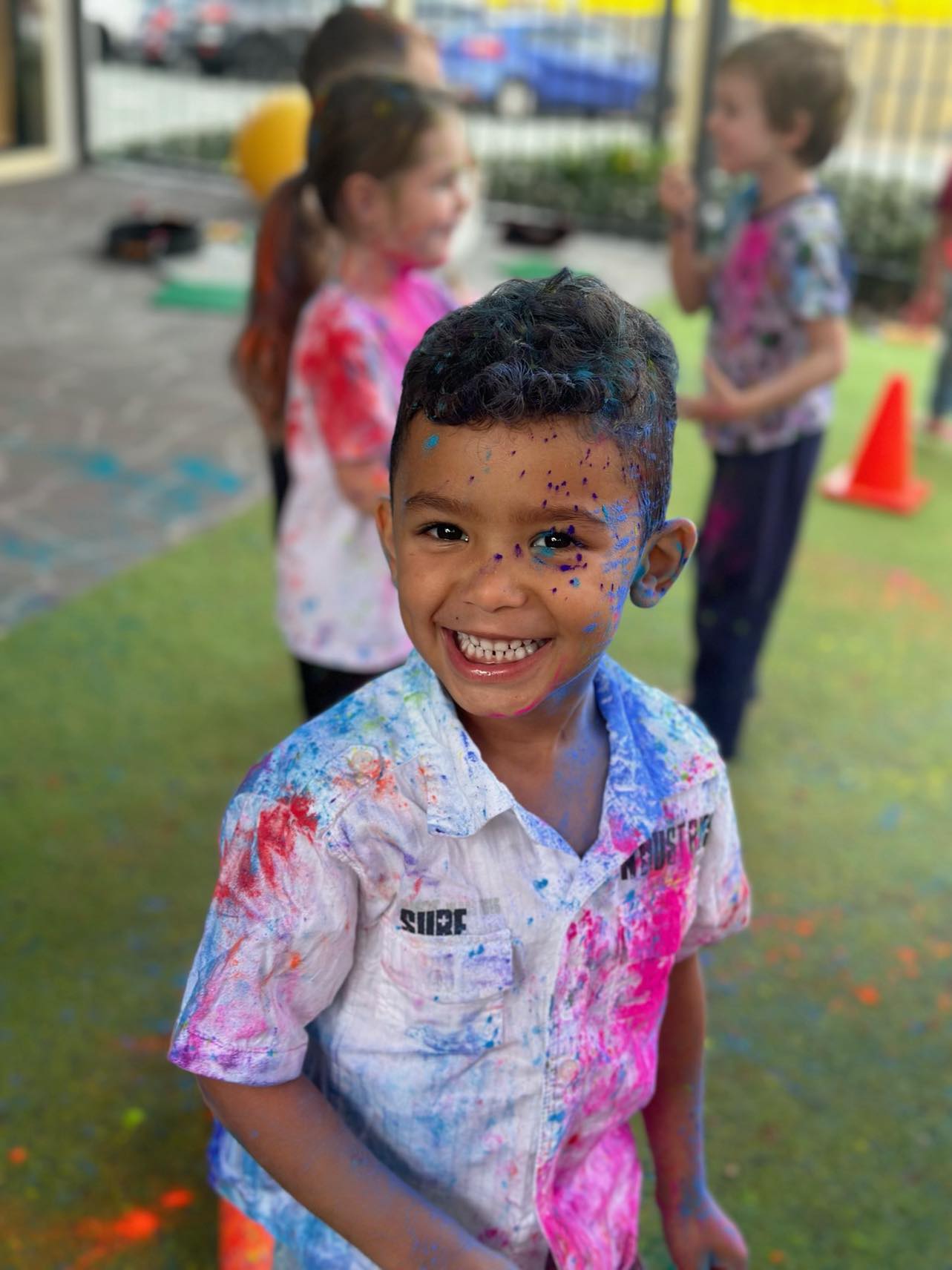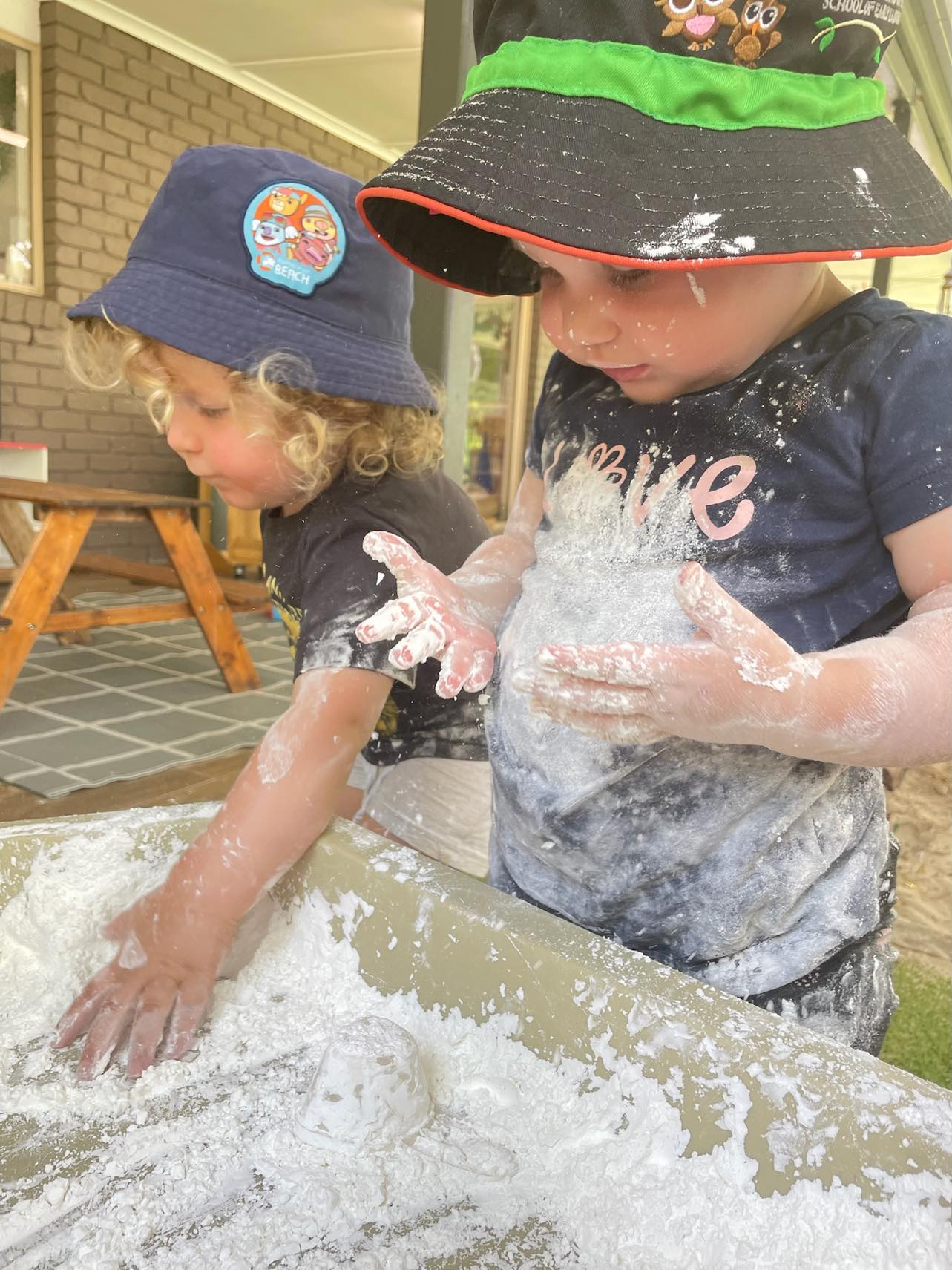


Does your little one ask “but why?” about everything? Good news, science has the answers, and your kitchen has the ingredients.
Welcome to Little Scholars easy at-home science experiments: five magical, hands-on, mess-approved experiments designed to spark curiosity and sneak in a little learning while your kids are too busy having fun.
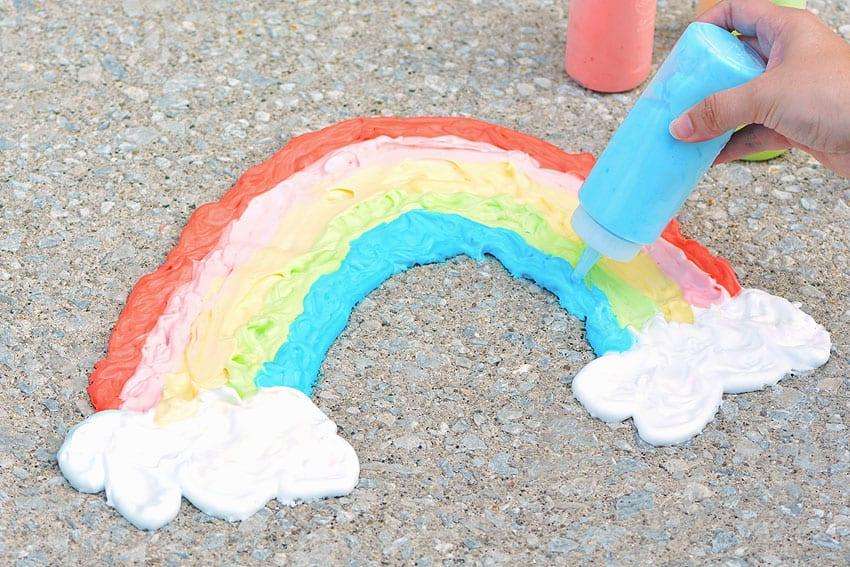
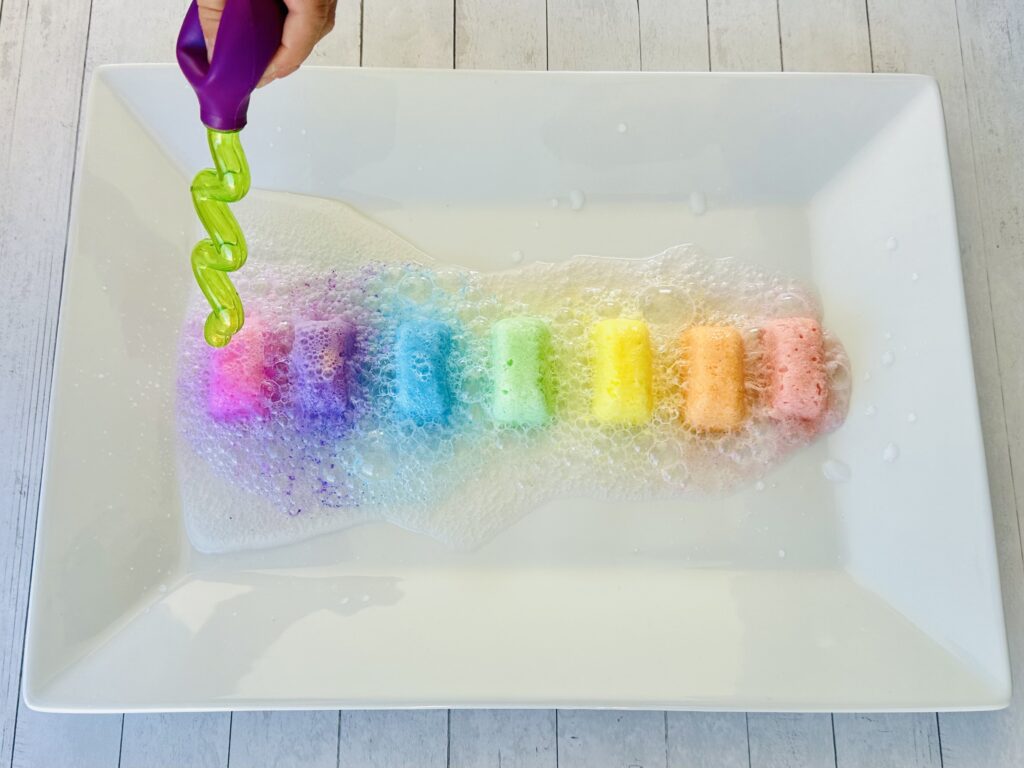
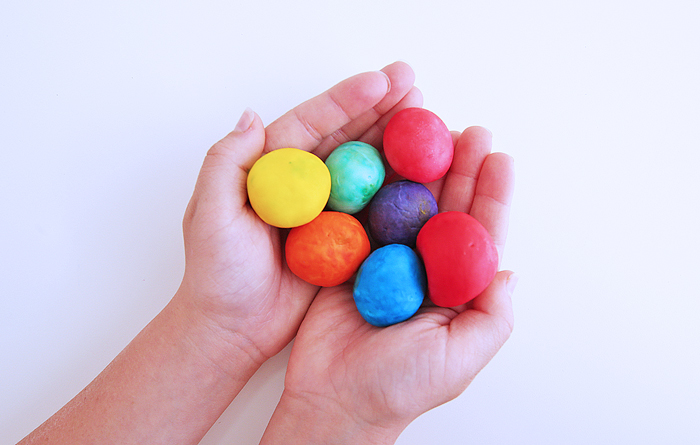
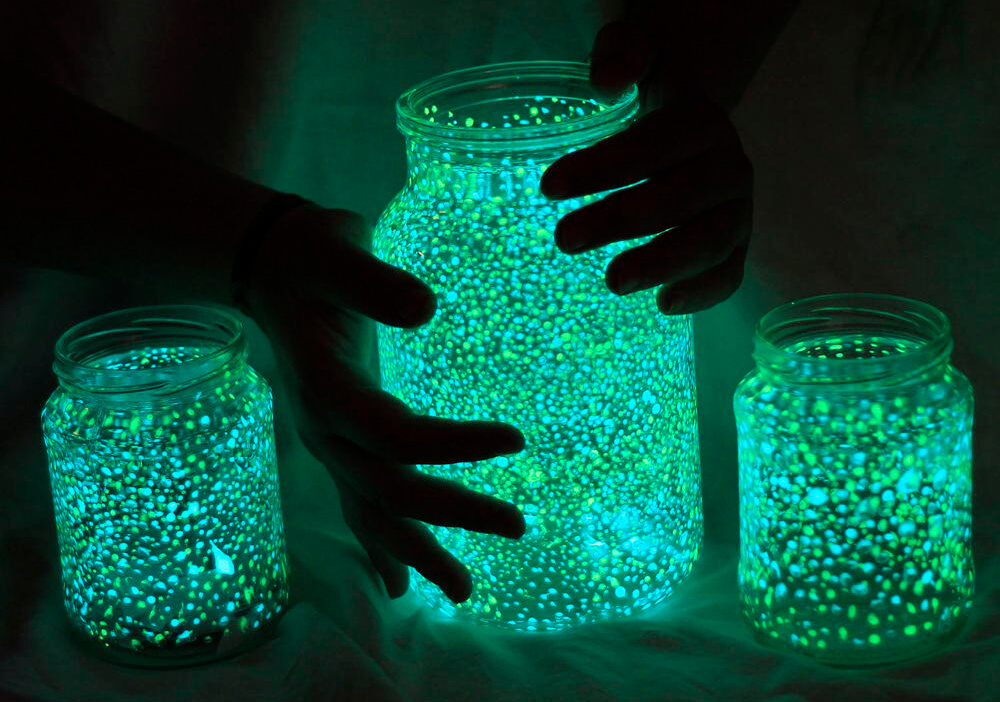
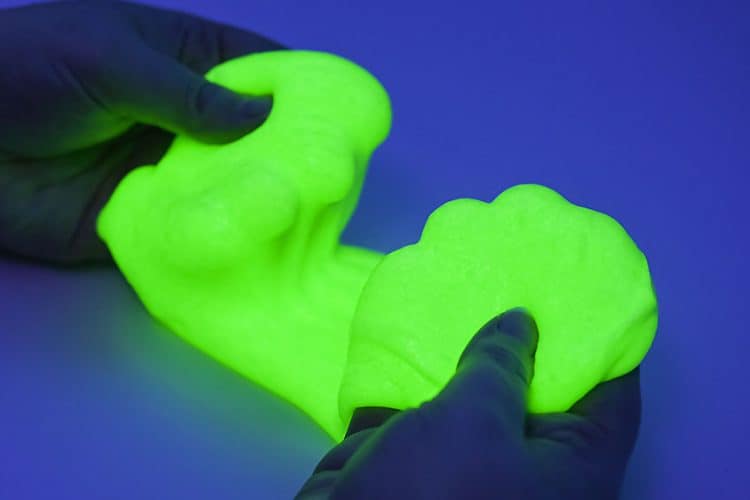
Bringing science into your home doesn’t just create a fun afternoon activity, it lays the foundation for a lifetime of curiosity and problem-solving. At Little Scholars, we love seeing our children make these big discoveries every single day. Our STEM program is designed to transform this natural curiosity into real-world skills, guiding our little scholars as they explore, experiment, and understand the world around them. Try these experiments at home this week, and watch your child’s inner scientist truly come alive!
Come visit your nearest Little Scholars campus and discover how our hands-on, play-based approach helps children learn through joy, exploration, and discovery.
Book a tour today and see why families love being part of the Little Scholars community!
As a parent, you want your child to love learning, feel confident, and explore the world safely. At Little Scholars School of Early Learning, we believe the best way to achieve this is through play-based learning, the heart of our philosophy that guides everything we do for children aged 0–5 years.
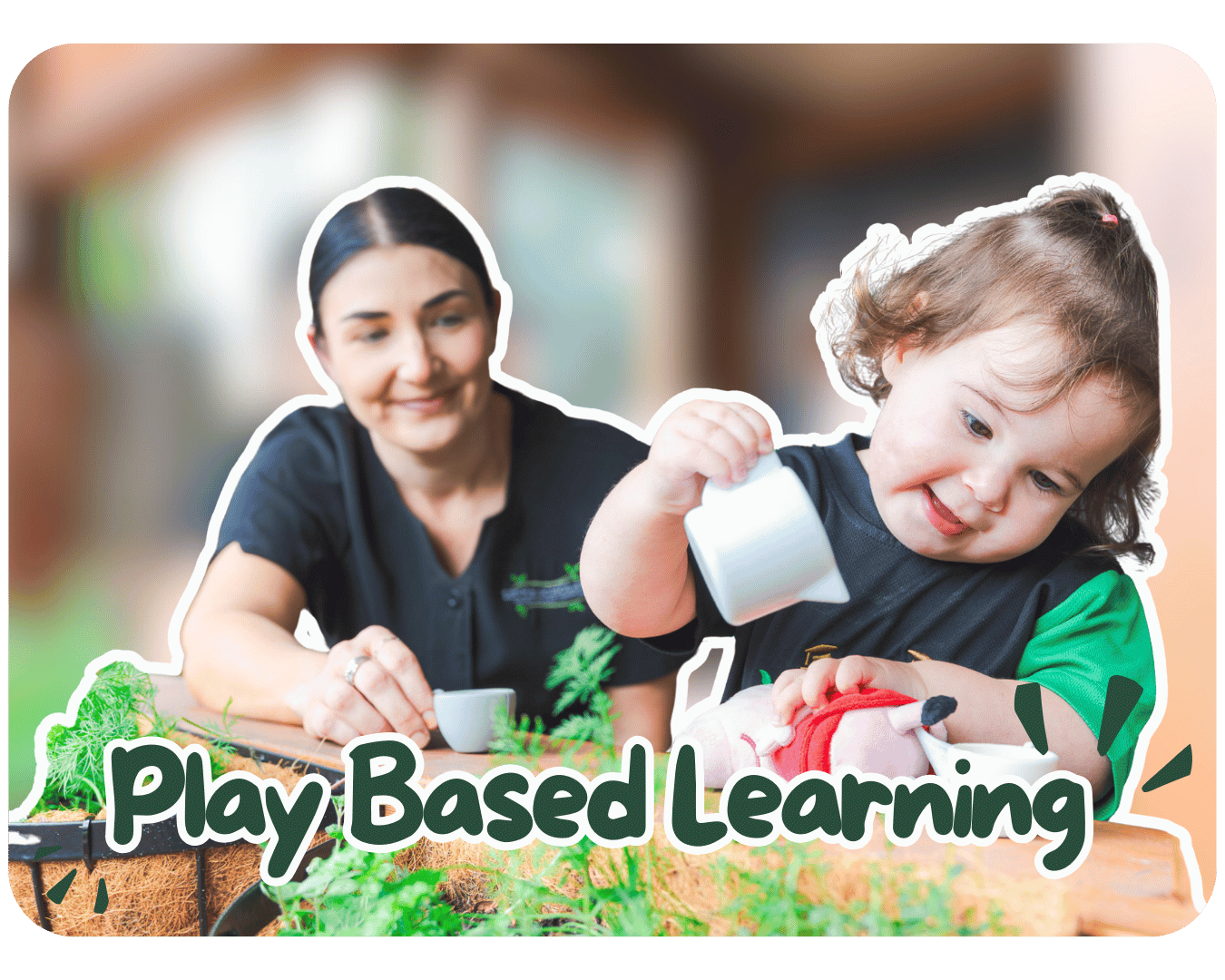
Play-based learning is more than just fun. It’s a research-backed approach where children learn by exploring, experimenting, and engaging with their environment. Through play, children develop essential skills that lay the foundation for lifelong learning, including:
Problem-solving, creativity, and curiosity
Communication, collaboration, and empathy
Self-regulation, confidence, and resilience
Fine and gross motor development
Play allows children to take charge of their learning, following their interests and building confidence as capable learners.
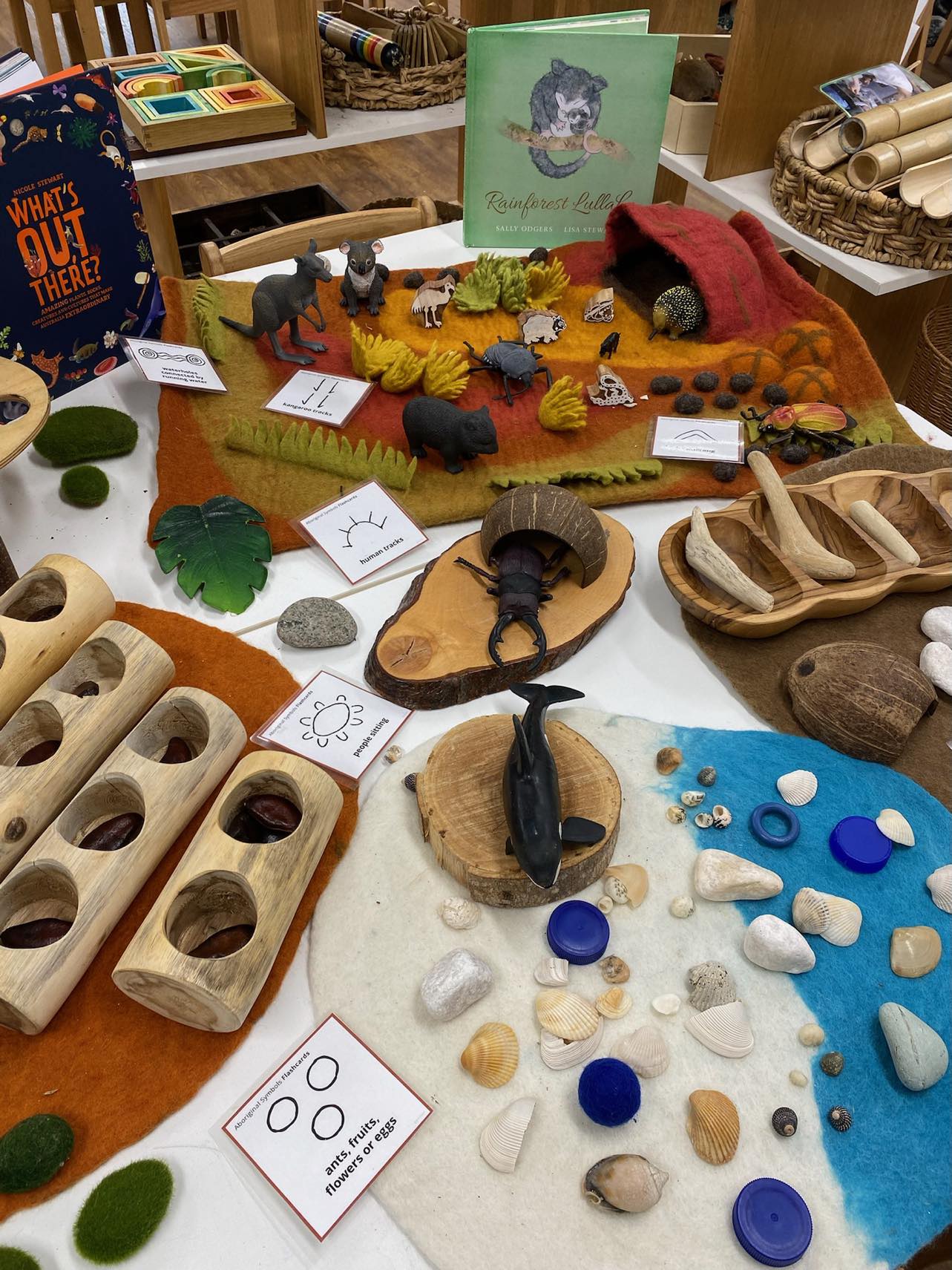
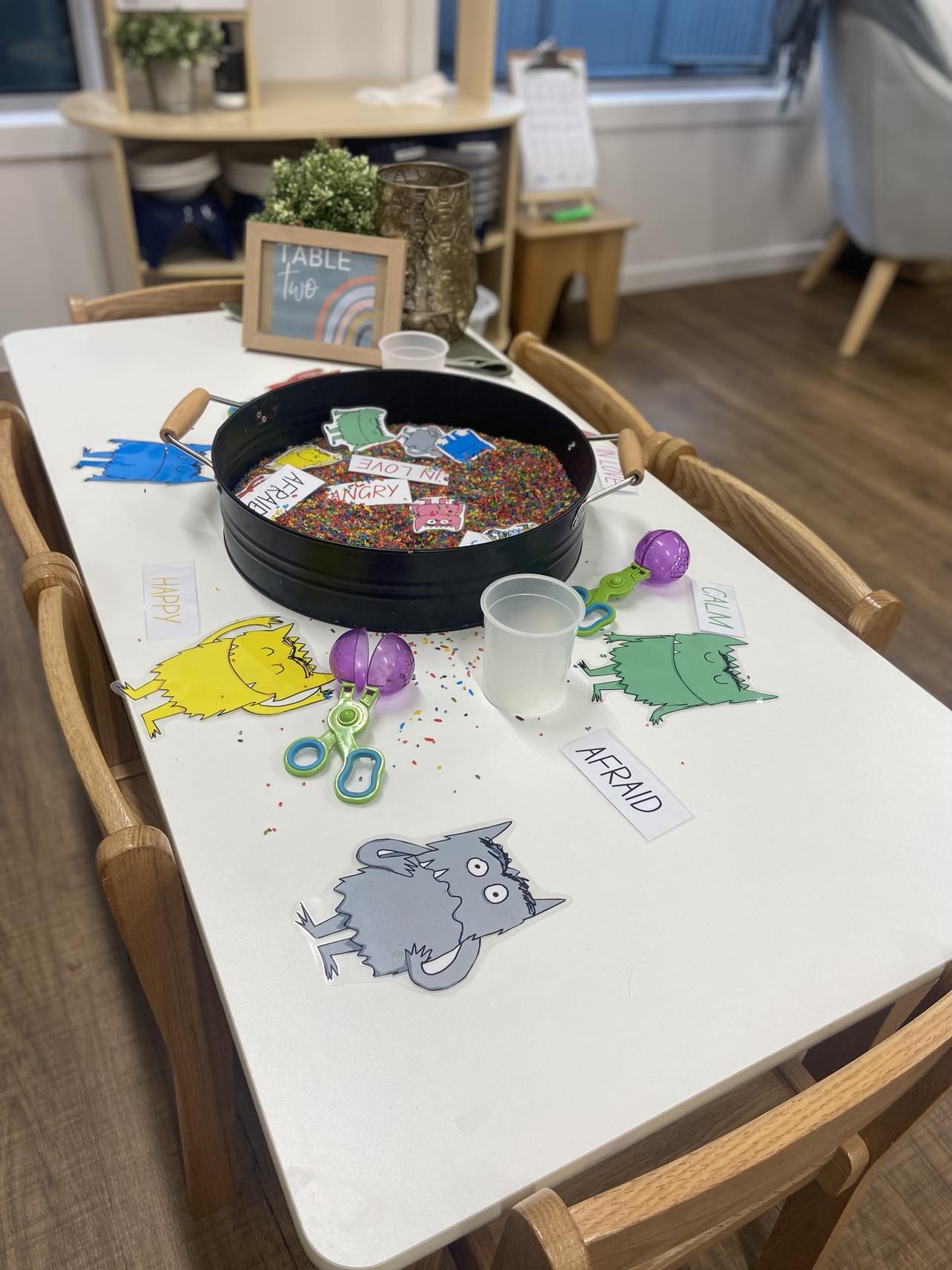
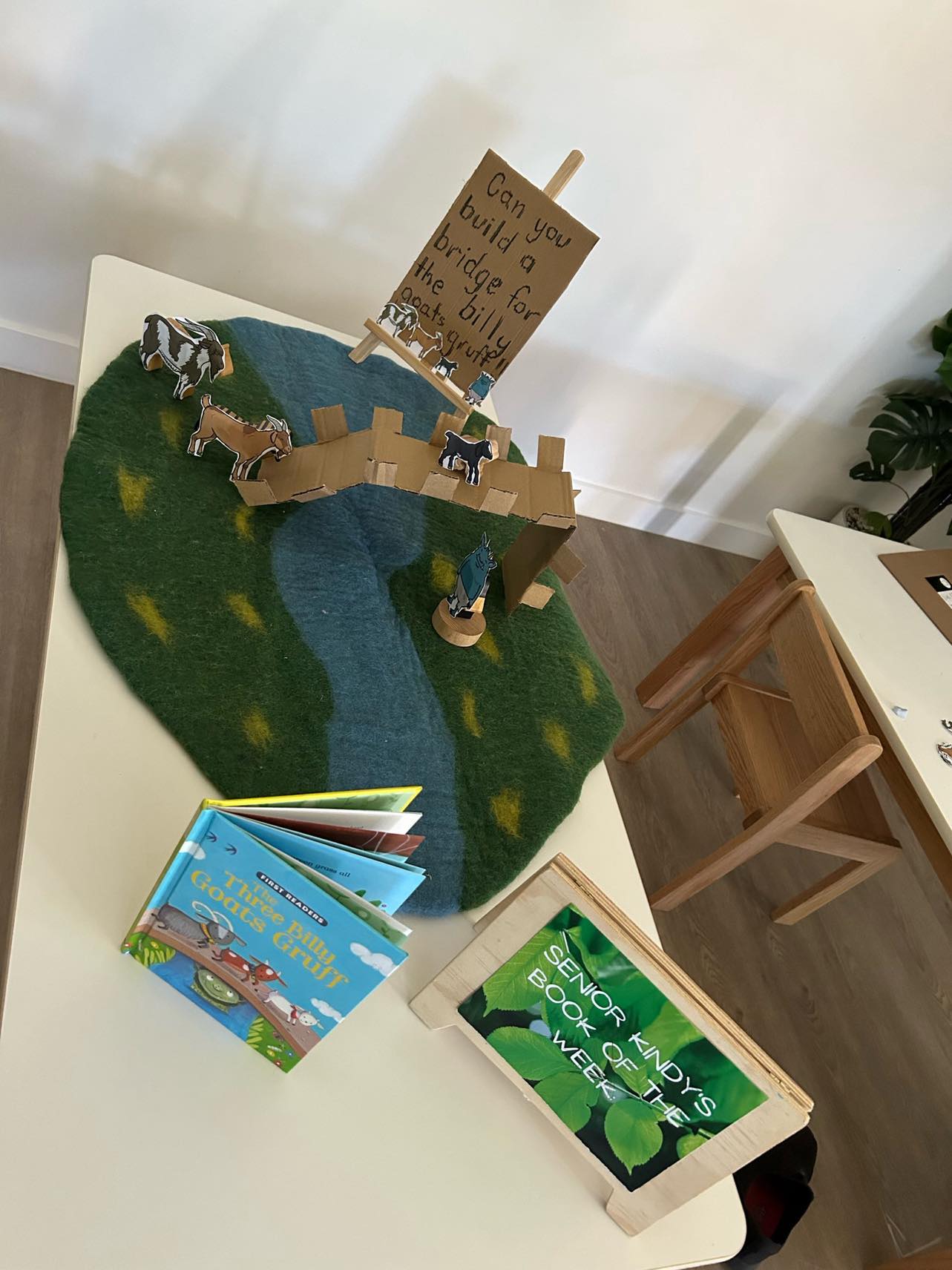
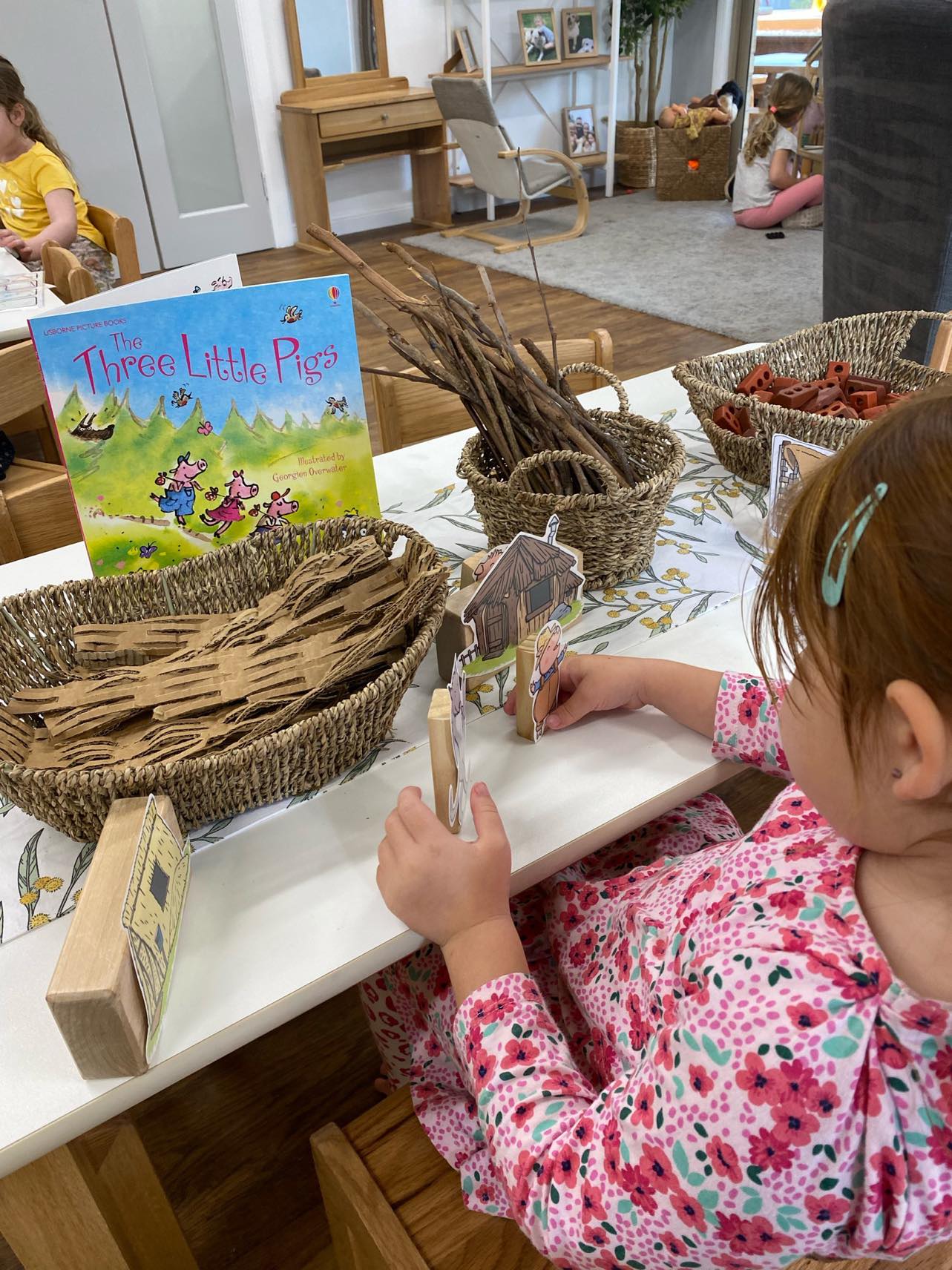
At Little Scholars, our educators create rich, stimulating environments that encourage exploration and discovery. Every activity is designed to connect with child development while keeping learning fun and hands-on.
Children can:
Our approach blends guided play with child-led discovery, allowing children to learn at their own pace while reaching developmental milestones.
Unlike traditional early learning settings, we view children as active contributors to their own learning. Instead of passive instruction, we encourage children to ask questions, experiment, and solve problems, fostering independence and curiosity from a young age.
Our educators act as partners in exploration, observing interests, asking open-ended questions, and providing materials that extend learning naturally. This ensures that every moment of play is also a meaningful learning experience.
Children who engage in play-based learning develop:
At Little Scholars, we’re proud to offer an environment where play and learning go hand in hand, shaping curious, capable, and joyful children.
Give your child the gift of exploration, curiosity, and confidence. Book a tour and visit your local Little Scholars School of Early Learning campus to see how our play-based philosophy helps children aged 0–5 grow, learn, and thrive.
At Little Scholars School of Early Learning, we believe sport in early childhood education plays a vital role in helping children thrive beyond the classroom. For children under five, movement, play, and physical activity aren’t just fun—they’re essential building blocks for healthy development, both physically and mentally.
Whether it’s running on the grass, kicking a ball, playing group games, or exploring the outdoors, physical activity lays the foundation for so many important life skills.
Here’s how sport and movement shape young learners:
For little ones, physical activity helps build essential gross motor skills like balance, coordination, and strength. These are the building blocks for everything from climbing and jumping to writing and self-care. Encouraging movement early on sets children up for physical confidence and lifelong health.
Sport is a powerful tool for brain development. Activities that involve movement also engage memory, attention, and cognitive flexibility. By learning to follow instructions, stay focused, and solve problems through play, children sharpen their thinking skills in natural, joyful ways.
Sport teaches children how to take turns, cooperate with others, and manage big emotions—like frustration, excitement, and even disappointment. Through group games and team play, young children learn empathy, communication, and how to build positive relationships.
Each little achievement—whether it’s catching a ball or trying something new—boosts a child’s self-esteem. Physical play provides ongoing opportunities to succeed, fail, try again, and grow. This builds resilience and a healthy mindset for the challenges ahead.
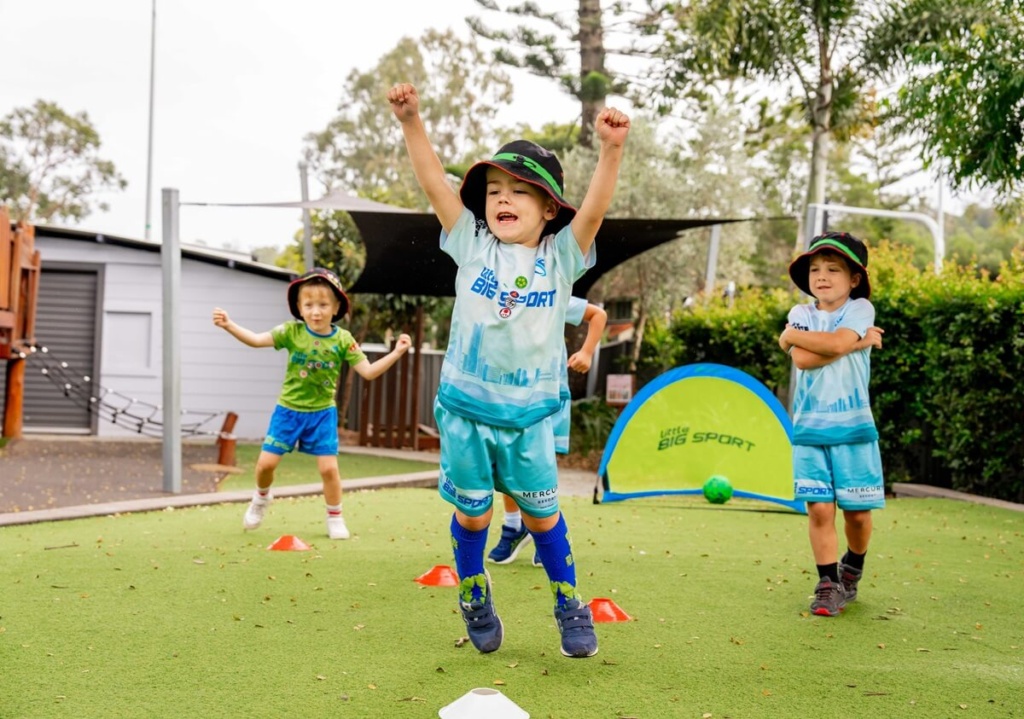
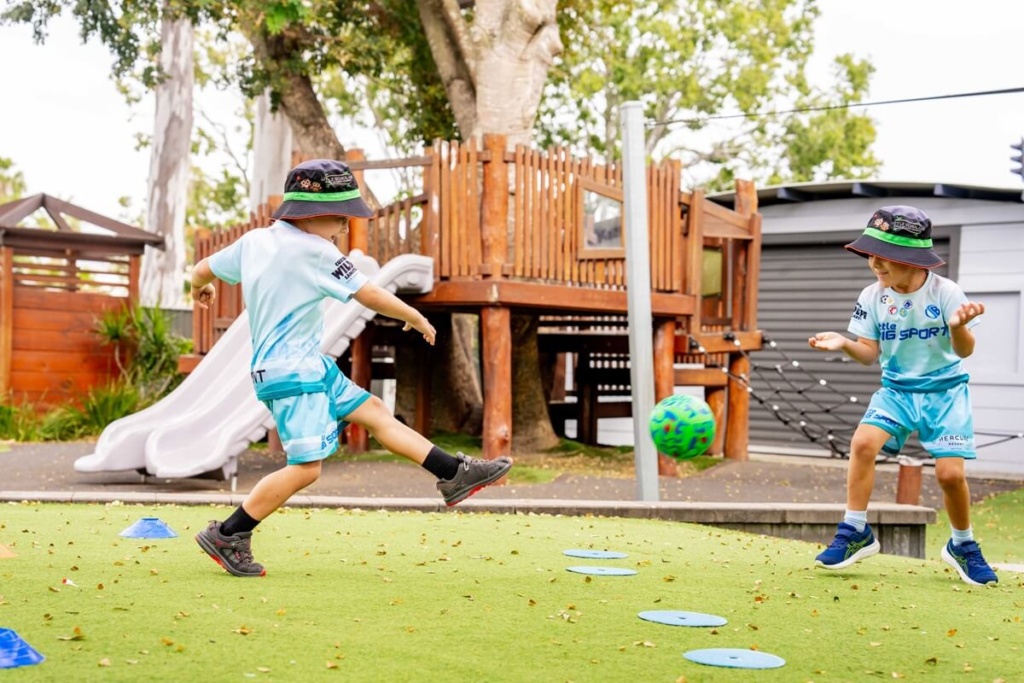
At Little Scholars, movement and sport are a vital part of our play-based curriculum. We also offer a diverse range of exciting extra-curricular activities that enhance learning, creativity, and physical development including dance, soccer, swimming, and more.
These programs are integrated into your child’s week, offering them diverse opportunities to explore their interests, stay active, and develop new skills—all while having fun.
At Little Scholars, our love for active learning goes beyond our centres. We’re proud sponsors of local sporting clubs including the Ormeau Bulldogs AFL and Gold Coast North Netball, supporting grassroots sport and the families in our communities.
With 17 purpose-built campuses across the Gold Coast, Brisbane, Redland Bay and Ipswich, Little Scholars offers environments designed to inspire curiosity, confidence, and growth – both in the classroom and on the playground.
Ready to learn more? Book a tour today and discover how our programs support whole-child development from the very beginning.
At Little Scholars, we believe that the magic of science starts early – and for good reason. From bubbling volcanoes to magnetic wonders and curious critters, science sparks a unique kind of joy in children: the joy of discovery.
But beyond the “oohs” and “aahs,” there is a deeper purpose behind these moments. Science isn’t just fun; it’s foundational.
STEM – short for Science, Technology, Engineering and Mathematics – is more than a buzzword. It’s a gateway to essential skills that prepare children for a fast-changing world. Here’s why STEM education for early childhood is crucial:
We don’t save science for special occasions – it’s woven into everyday learning, and we enhance it further through our extracurricular program. Here’s how we bring STEM education to life:
Extra Curricular Program with Lab Kids
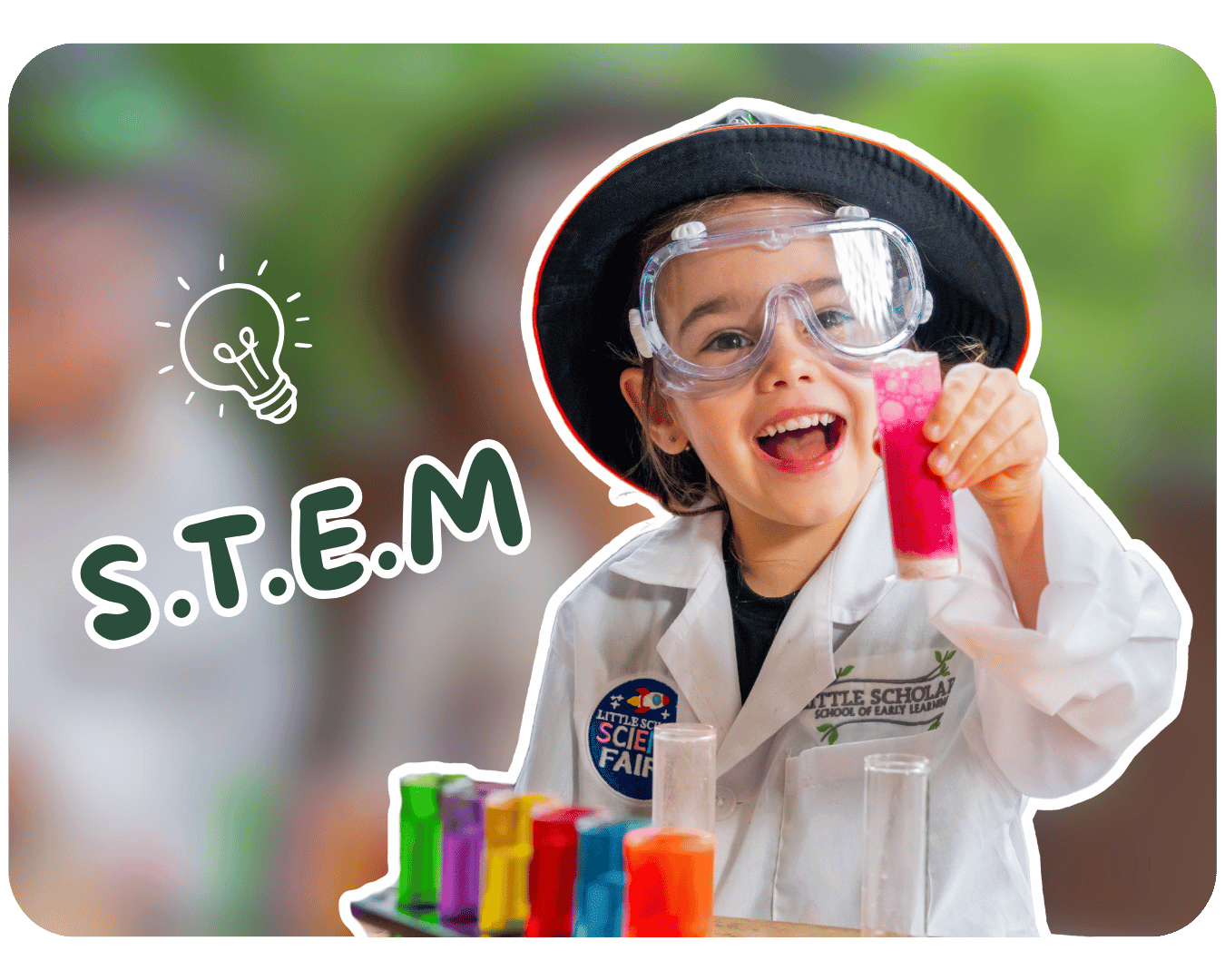
Did you know that Little Scholars offers an exciting STEM program for our kindergarten children? In collaboration with our friends at Lab Kids, we provide an incredible educational STEM program that aligns with the Early Years Learning Framework and the Australian National Curriculum. Through hands-on activities and age-appropriate scientific exploration, our Little Scholars explore topics like motion and states of matter, to learning about light, sound and chemical reactions.
Excursions and Events:
This August, Little Scholars are excited to host our biggest celebration of curiosity yet, our much-anticipated Little Scholars Science Fair! Children, parents, and curious souls in between from all 17 campuses across South East Queensland are coming together for a day jam-packed with serious fun.
Expect hands-on experiments, whizz-bang demonstrations, and STEM games and challenges (your little scholars won’t even realise they’re learning!) It’s science, play, and community all rolled into one unforgettable event.
Everyday Learning!
As part of our everyday curriculum, children are regularly invited to participate in science-based activities, such as:
Our role as early childhood educators is to lay the foundation for a lifetime of curiosity. By embracing STEM from the start, we’re not just teaching science – we’re raising confident, capable, and inquisitive young minds. To learn more about our extracurricular programs at Little Scholars or to book at tour at your local campus, call our team on 1800 732 926 visit https://mylittlescholars.com.au/book-a-tour/.
Because we offer a transition to school program through our kindy and pre-kindy studios, from time to time, our educators and early childhood teachers are asked, ‘when are you going to teach my child to read?’ to which our answer is, we already are! But perhaps, not in the way parents expect.
The expectation from parents sometimes seems to be that your child will finish their time with Little Scholars and walk into prep knowing how to read, but that’s not exactly our aim.
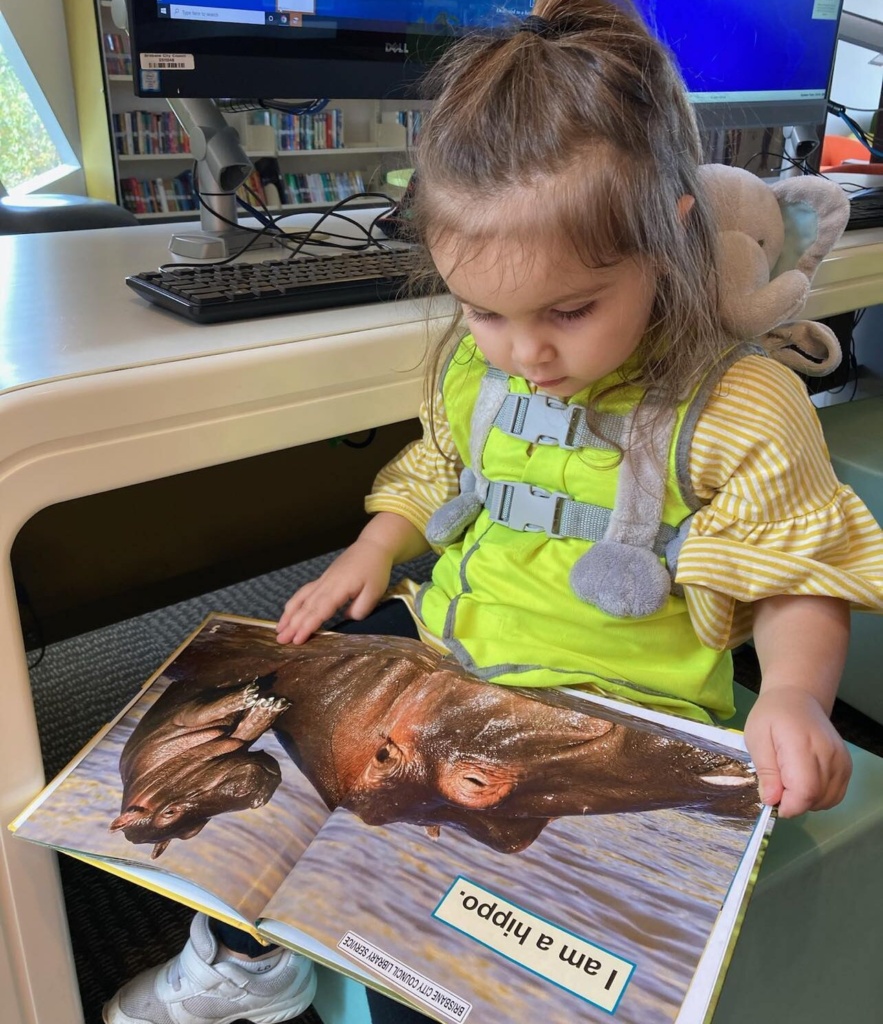
Learning to read really starts from infanthood, and is a big process. In fact, research has found newborns’ brains are prewired to be receptive to seeing words and letters. This means babies are already getting ready to read at birth. The relevant part of the brain, known as the “visual word form area” (VWFA), is connected to the language network of the brain, and was discovered by researchers at Ohio State University, who analysed the brain scans of 40 one-week-old babies, as part of the Developing Human Connectome Project.
Researchers compared these to similar scans from 40 adults who participated in a separate Human Connectome Project. The VWFA is next to another part of visual cortex that processes faces, and it was reasonable to believe that there wasn’t any difference in these parts of the brain in newborns. Because as visual objects, faces have some of the same properties as words do, such as needing high spatial resolution for humans to see them correctly.
But the researchers found that even in newborns, the VWFA was different from the part of the visual cortex that recognises faces, primarily because of that connection to the language processing part of the brain.
Lead researcher Zeynep M. Saygin’s team is now scanning the brains of three and four-year-old children to learn more about what the VWFA does before children learn to read.
Research has also showed babies can differentiate their native language from another language when they’re only hours old, which means they begin processing language in the womb. And, amazingly, studies have also found that at birth, the infant brain can perceive the full set of 800 or so sounds, called phonemes. Phonemes form every word in every language.
People can’t learn to read without understanding language, so your child has been working on learning to read since birth!
We encourage language development in many ways understanding that oral language is a significant aspect of early literacy, educators engage in song, rhyming and make use of picture books, to tell a story. Through our discussions and interactions with the children, and observations watching children play and what they’re interested in, we extend on their interests as part of our educational and intentional approach. So, for example, if educators see two children playing with toy dinosaurs, they may chat with them about why they’re interested. Then, they may have a conversation with the class about who else might be interested in dinosaurs. Based on the conversation, if many of the children are, they may set up sensory experiences, art opportunities and get relevant books on the topic of dinosaurs and read them together.
We also use words visually for many of our activities, even if they aren’t book-related, so that children begin to recognise words and associate them. Our environments place great emphasis to embed literacy print across all play spaces, this supports rich language experiences. Educators model words through children’s play, for example, when a child is engaged in block play, the educator will discuss the activity with them, exposing children to words, such as ‘you are putting a block on the top,’ (or underneath, or on the side.) These elements of language are also known as ‘positional language’ and introduce children to literacy and elements of numeracy at the same time.
At Little Scholars, we have a specific approach to learning to read. It’s called the 3a Abecedarian Approach Australia to reading. This is where children are active in conversational reading.
A long 1970s study in the US was the basis for the now well-adapted approach. The Abecedarian Project was a controlled scientific study of the potential benefits of early childhood education for disadvantaged children. Children born between 1972 and 1977 were randomly assigned as babies to either the early educational intervention group or the control group.
Children in the experimental group received full-time, high-quality educational intervention in an early learning setting from infancy through age five.
At the age 30 follow-up study, the treated group was more likely to hold a bachelor degree, hold a job, and delay parenthood, among other positive differences from their peers.
The 3a Approach encourages the adult and child to go ‘back and forth’ in conversation. There are three main levels to try – the first level is seeing, then showing, then saying.
Make it a conversation by asking your child to do something and not always following the words in a book.
“Can you see an owl? “Can you say owl?” “Can you show me an owl?”
At Little Scholars, we start with comprehension when looking at books – the thinking and talking about and enjoying the books we read together either in a group or one-on-one. Once children have a connection to books and reading, that’s when we can start teaching the ‘word parts’ of being a reader.
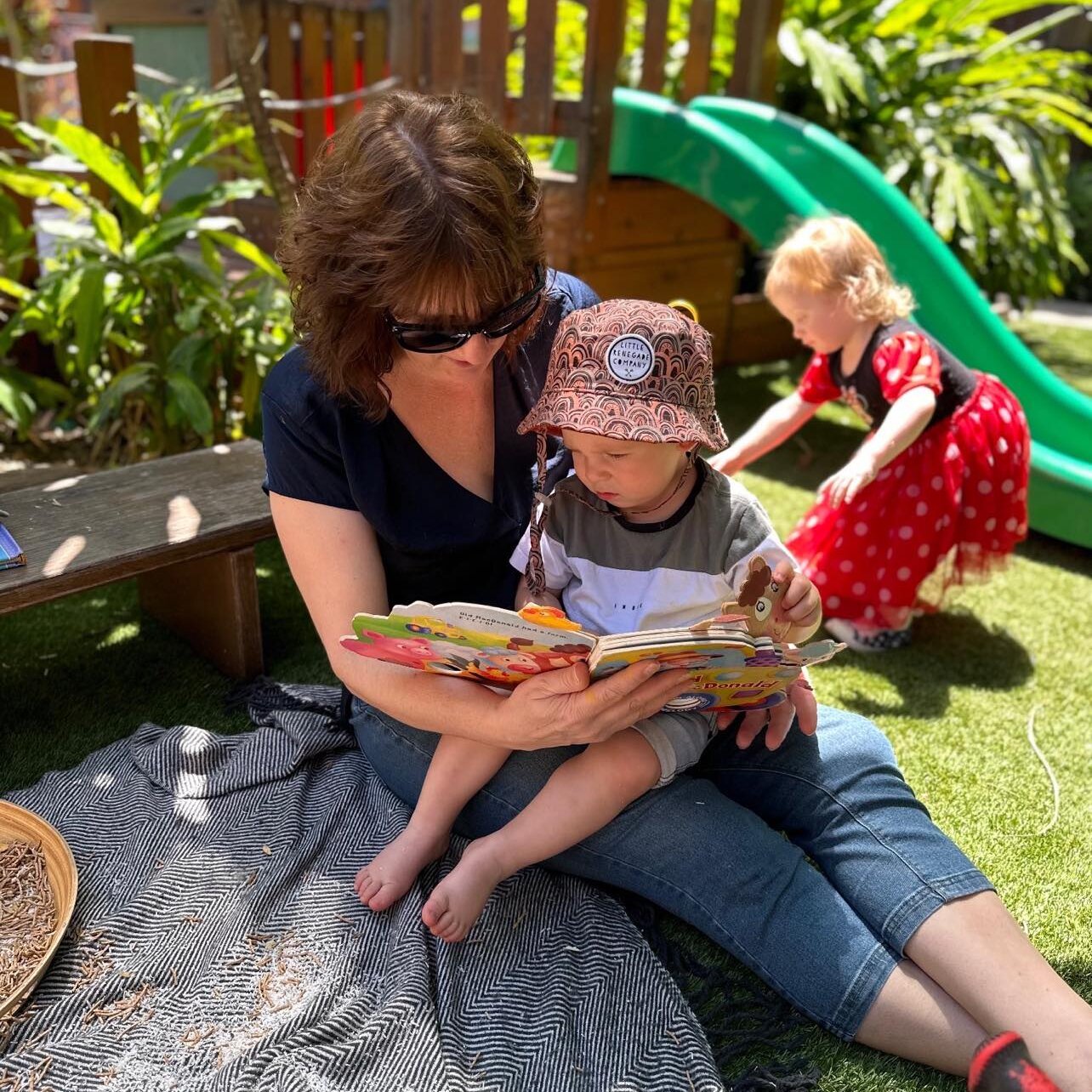
This is also something parents can and should do at home. Working with families is a core part of the Abecedarian approach! Parents are their children’s first educators, so we believe it’s to support families to grow in confidence as their children’s first educator, and reading together daily supports successful young readers. If you’d like to learn more, talk to your children’s educators or your campus manager for more information.
Read more:
Over the past couple of months, we have started to launch woodworking stations at our campuses! But why, you may ask. It’s dangerous! They could get hurt! At Little Scholars, we actively guide children through ‘risky’ activities to build up their skills, confidence, and resilience. Engaging in woodworking helps children learn to assess and manage risks, develop fine motor skills, and boost their creativity and problem-solving abilities. By introducing these activities in a controlled and supervised environment, we ensure they gain valuable life skills while staying safe.
Woodworking is an excellent way for children to exercise their creative, practical and critical thinking skills. It allows them to express their ideas and figure out solutions to their projects.
As they measure, cut, and assemble pieces of wood, they enhance their hand-eye coordination and fine motor skills. These activities require precision and control, which are crucial for writing, drawing, and other tasks. Furthermore, using tools like hammers, saws, and sandpaper teaches them how to handle and manipulate objects with care and accuracy.
Guiding children through woodworking activities helps build their confidence and resilience. Completing a woodworking project, no matter how simple, gives children a sense of accomplishment and boosts their self-esteem. They learn that they can create something tangible and useful with their own hands. Additionally, the process often involves overcoming challenges and solving problems, which teaches persistence and resilience. These qualities are essential for tackling academic challenges and life’s obstacles.
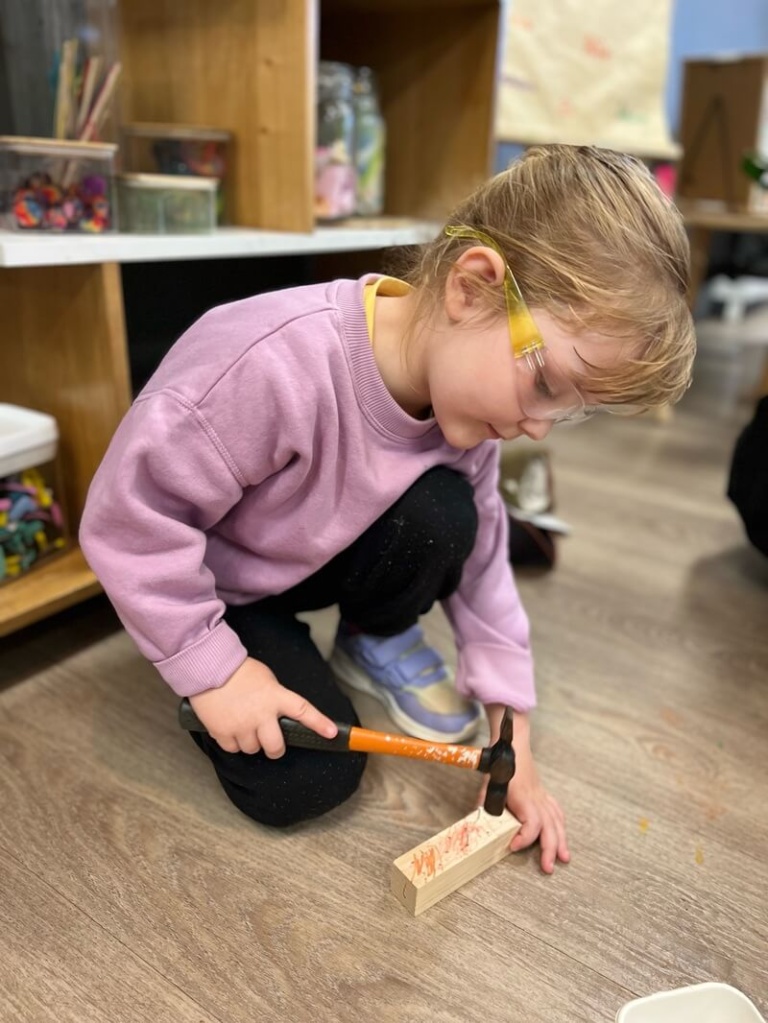
Our little scholars begin their woodworking projects by making a plan. This may look like drawing out their project, or making a model out of cardboard or building blocks, discussing with their friends and educators what they’d like to build, how they’d like it to look, what tools they need in order to make their design come to life, and figure out any risks there may be and how to reduce chances of hurting themselves.
Introducing woodworking in a controlled environment allows children to learn about risk management. They are taught how to use tools safely, understand the potential dangers, and take appropriate precautions. This hands-on experience with ‘risky’ activities helps them develop a healthy respect for safety and risk assessment. They learn to think ahead, plan their actions, and make informed decisions to minimise risks, which are valuable skills both in and out of the workshop.
Some of their documented conversations with educators have included:
How can we make sure we are safe when using the tool table?
“You have to wear safety glasses.”
“If you step on a nail you can hurt your feet.”
“It can’t be too busy, I might knock something over or into someone and hurt them.”
What do you do at the tool table?
“I can measure the wood.”
“When I’m at the table I use the screwdriver.”
“I use nails to put in the wood.”
How does it make you feel when you build at the tool table?
“I like tools because I can screw something in.”
“I feel happy because I can make something.”

Woodworking supports creativity and problem-solving skills. As children design and build their projects, they must think creatively to overcome design challenges and find solutions. This process encourages them to experiment, explore new ideas, and think outside the box. The ability to approach problems creatively and develop innovative solutions is a real skill in today’s world, where adaptability and innovation are highly valued.
In addition to the practical skills, woodworking integrates educational concepts such as maths and science. Measuring pieces of wood, calculating dimensions, and understanding geometric shapes are all part of the woodworking process. Children also learn about the properties of different materials and the principles of mechanics and engineering. This hands-on application of academic subjects helps to reinforce their learning and makes these concepts more tangible and understandable.
By providing children with the opportunity to engage in woodworking, we are equipping them with a wide range of skills and experiences that will benefit them throughout their lives. Through careful supervision and guidance, we ensure that they can enjoy the benefits of this fun activity safely.
As the year draws to a close, our thoughts eagerly turn to the holiday season—a time for rest, cherished moments with family, and often, travel adventures with our little ones in tow.
Travelling with young children, whether by car or plane, can sometimes be a challenge for parents. But fear not, we’ve curated a list of our top activities to keep your little scholars engaged and happy on the journey! To keep the excitement alive, we’ve taken a leaf out of seasoned parents’ books: consider keeping these activities hidden and, for an added touch of magic, wrap them up like gifts to be unveiled en route.
At Little Scholars, we emphasise the importance of parental supervision for these activities. While we champion supporting local businesses, we must note that we cannot vouch for the compliance of their products with Australian safety standards. So while some of our suggestions may include links to Amazon, a third-party retailer, we also include reputable brands known for their strict adherence to safety regulations.
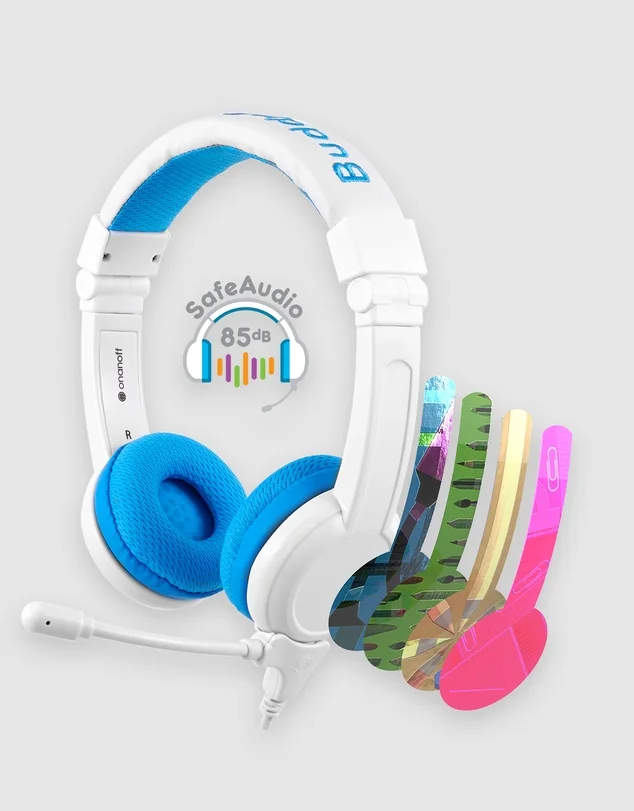
We’re putting this at the top of the list, because they can fit on children of most ages. And, many parents might consider children’s headphones a necessity after a few hours of Cocomelon or The Wiggles on repeat. For children, specially designed ones for their small heads can help block out a bit of outside noise and help them enjoy their music, or children’s audiobooks or podcasts. Parents should look for ones that limit volume to no more than 85 decibels, and there are plenty of wireless or wired options and colours.
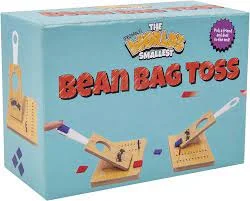
This fun and challenging game is perfect for ages 3 and up. The set includes two launch pads and targets, six mini bean bags, two pegs to keep score, and all of the fun that comes with it. Get ready for some friendly competition!
You can find versions of this at Kmart, and Target for $10-$15.
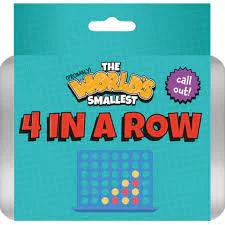
Connect 4 on the go with this compact version of the classic Connect 4 game! You and your opponent get 21 checkers apiece and the chance to get 4 in a row. But you both get the chance to block the other’s attempts to connect with your own checkers.
You can find this online at Amazon, Catch.com.au,
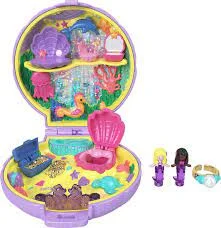
Bring your childhood nostalgia to the next generation with Polly Pocket. Though heavily marketed at a girl’s toy, we think this is a great sized travel toy for any imaginative child, and the range of options are nearly endless, though the same can be said for the price point, which can start around $20 and go up.
Found in stores such as Kmart, Big W, Toymate and online at Amazon
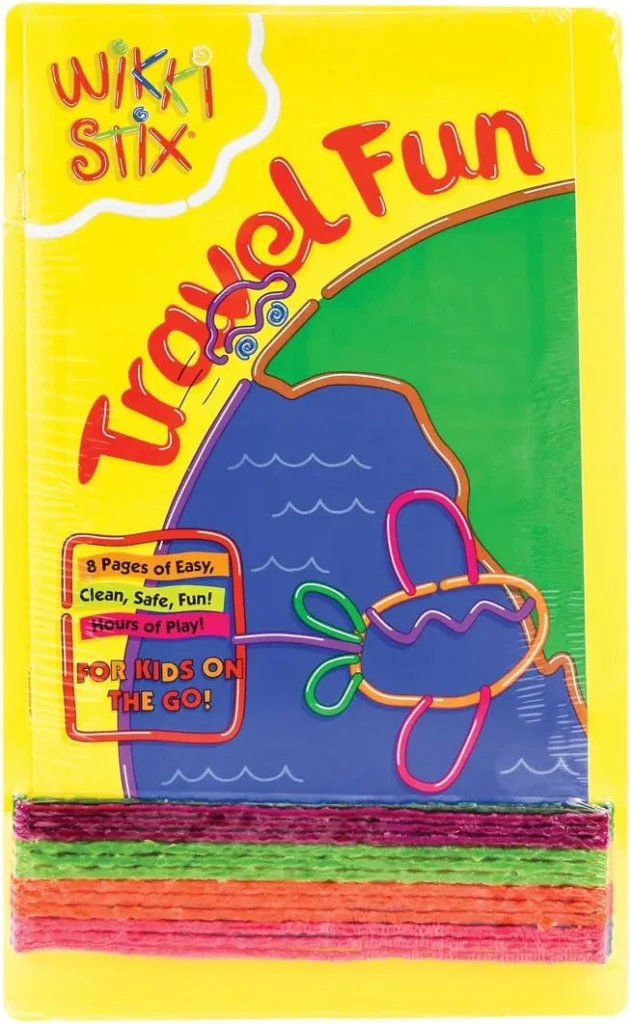
Children can play with these bendable sticks anywhere — on airplane tray tables, in the car, at restaurants, and more.
The individual packs come with a puzzle or shape for the little ones to make with the Wikki Stix. You can also buy kits, like the Wikki Stix Traveler playset that comes with even more activities.
Found in a variety of packs online on Amazon
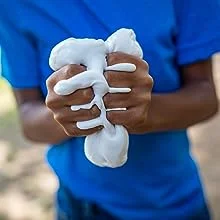
Also known by other names by various brands, such as ‘Model Magic’, essentially it’s a children’s modelling clay, a slightly different texture to playdough, but its non-crumbling texture makes it less messy than playdough, perfect for driving or flying and keeping mess to a minimum.
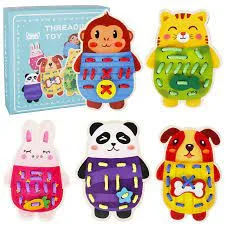
Wooden threading toys are a great way to practice fine motor skills, problem solving, creativity, mindfulness and more!
You can find them for less than $10 at Kmart or Officeworks.
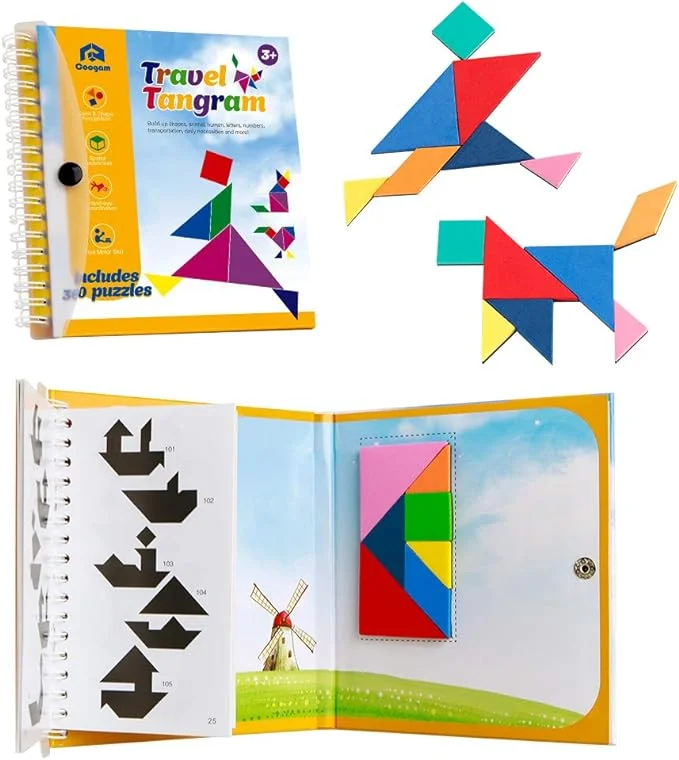
The tangram is a challenging puzzle consisting of seven magnet flat shapes, called tans, which are put together to form shapes. The objective of the puzzle is to form a specific shape (given only an outline or silhouette) using all seven pieces, which may not overlap.
You can find a lot of options of these at online stores such as Amazon, Temu, for about $12 and up
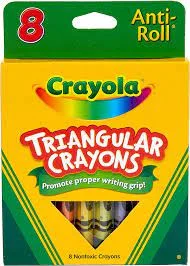
Colouring is always a great activity for children, and these triangular crayons are perfect for flights! You can put them on the tray table with confidence, knowing they won’t fall off and go rolling down the aisle.
They’re also great for helping young ones practice their writing grip!
Find them on catch.com.au, Officeworks, and triangular coloured pencils at Kmart
A classic child’s activity!
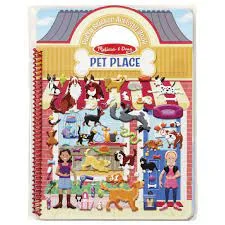
Some great ones include puffy sticker activity books, but children will love any of them, and the variety is endless. You can find them in your child’s favourite characters, including Bluey, Peppa Pig and Paw Patrol.
These are easily found in Target, Big W, Kmart and online stores.
Another idea! Sometimes, the frustrating thing about stickers generally is that once they’re stuck the first time, they’re not likely to stick again. And children love to peel them off and try to stick them again. In the car or on a plane, reusable stickers are great so children can create new play while buckled in.
You can find them at Amazon, Officeworks
Gel window clings are a great activity for babies or young toddlers. Those who are deep in their repetitive schema phase will love to peel these off and replace them again and again. They can be found in a massive variety of styles, and a variety of places in shops and online, Big W, Dymocks, Amazon and more!

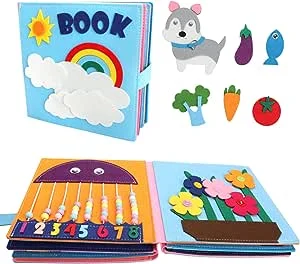
These are great for toddlers, as they enhance fine motor skills in toddlers. As little ones engage with the various features of the board, they develop their hand-eye coordination, fine-tune their dexterity, and build finger strength. These skills are crucial for everyday activities such as fastening buttons and handling cutlery. And, these generally have enough to keep them busy for a while!
Find them on Amazon, Kmart, Temple & Webster, Target
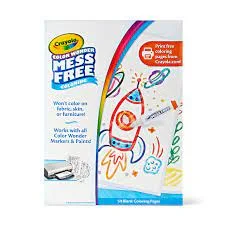
These come in a variety of options, from invisible ‘ink’ markers to water brushes, these mess-free colouring books are great for little ones!
For the water brush colouring books, by using the refillable water brush you can watch bright images and activities appear right before your eyes using nothing but water! After bringing these scenes to life you can let them dry and enjoy the mess-free magic again.
Found at Target, Amazon, Big W, Kmart, Officeworks and more!
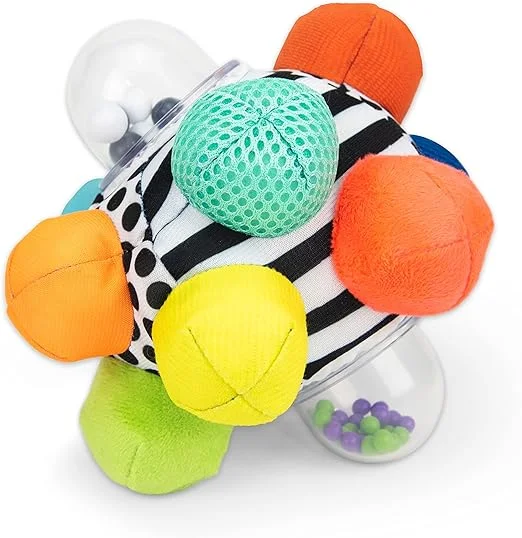
Ok, we know this is a pretty broad spectrum, even for babies, but it’s worth sharing a few ideas.
These toys can bring a lot of interest to babies, exposing them to various textures, colours and patterns, and sounds. We’d suggest bringing out one they haven’t seen before to really draw their interest.
We love this one from Baby Bunting, which is a truly physical toy by promoting pulling and pushing, it also would be nice for aching chompers.
These Playgro animals, which can be found at a number of retailers from Big W to Target to Baby Bunting, are a hit with babies, are generally compact enough to be stored in a nappy bag or carry-on, and can often be hung from other objects, like car head rests.
These toys are great for any age, but they probably work as a slightly longer pass time for younger children.
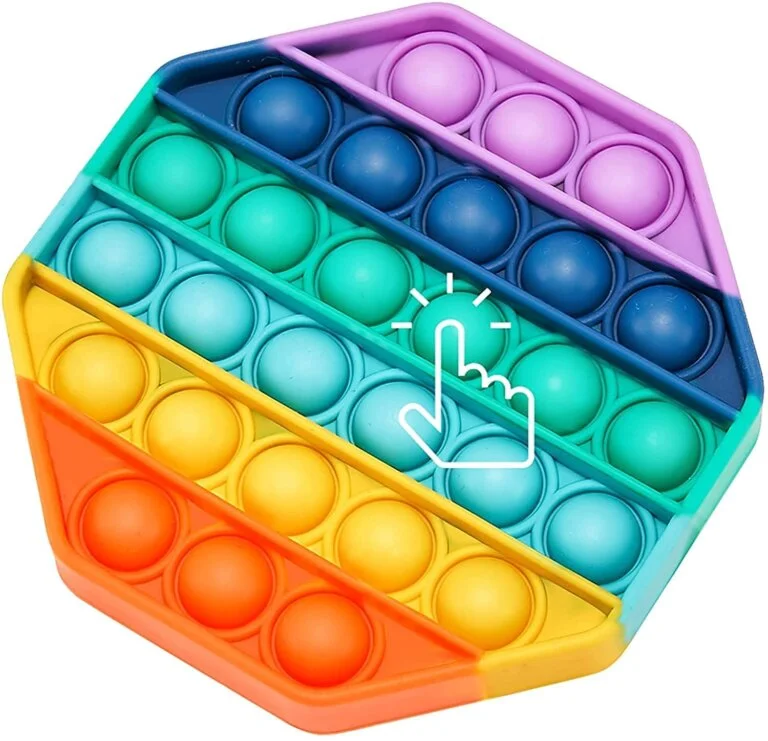
These pop-its can go from simple design to ones that have games built in, such as ones that light up telling you where to touch next. They can be found in most department stores, online stores and often shopping centre kiosks.
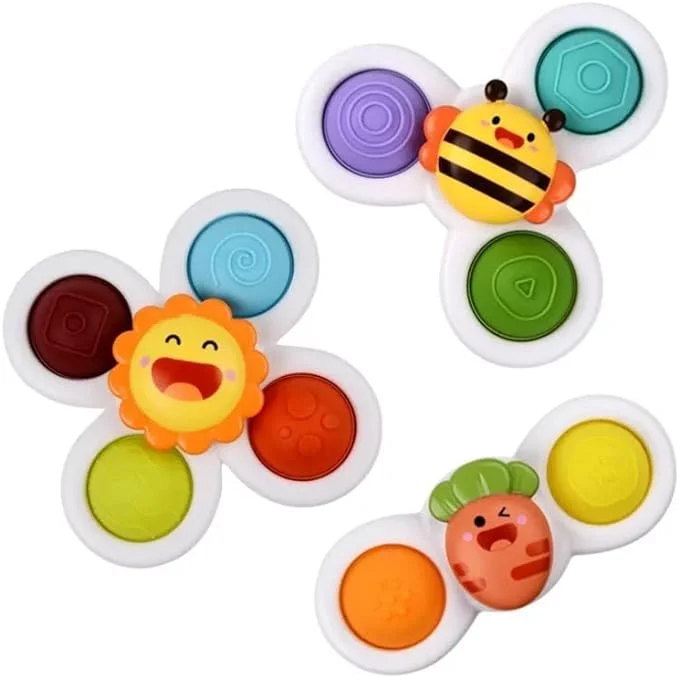
Babies love things that spin, so getting a few different fidget spinners that you can stick to windows or table trays are sure to be a winner!
Find them at Kmart, catch.com.au, Baby Bunting and more!
Fear not parents, we are also including some creative, budget-friendly travel activities:
We know it can be hard to come up with easy, quick things to do with your children, so we thought we’d share a favourite of our little scholars. Learn how to make your own moon sand in minutes with a few of these kitchen staples!
Preparation Time: 5 minutes
Cooking Time: None

Did you know that clay is not only a fun material for children to play with but also incredibly beneficial for their development?
What’s fantastic about clay is its open-ended nature. There’s no right or wrong way to play with it, giving children the freedom to explore and express themselves. Whether they’re rolling it into balls, flattening it into pancakes, or creating intricate sculptures, each action reveals something unique about them. It could be their level of focus, their creativity, or even how they approach problem-solving.
Benefits include:
These are all important skills for children, especially as they prepare to move into formal education. The benefit of using clay is that it’s a natural, moldable medium that can be used as a cement, an adhesive and even a paint.
Paul R White, an American clinical social worker, has been using clay as a therapeutic tool for over 30 years. In his book, CLAYtherapy, he talks about how clay play can naturally facilitate meaningful conversations between children and adults. He developed numerous unique aids and techniques that have assisted him in teaching children to cope with stress, express feelings and to solve problems, including through the use and manipulation of clay. White also presented a paper on clay therapy to the World Congress of Child Play Therapy and Child Psychotherapy in London, England.
He has used clay in his practice as an ice breaker, as an aggression reliever and as a primary tool in treatment.
In his book, White says “Through mutual clay play, a conversation between child and counselor automatically emerges. Dialogue doesn’t have to be forced or fabricated, but happens naturally when the counselor is revealing, demonstrating and teaching this dynamic and engaging clay process and the child is asking, learning and experiencing his or her own trial and error. This manner of interaction links the adult with the child through a hands-on, verbal, nonintrusive, problem-solving counselling process.”
Lisa Terreni, a senior lecturer in early childhood education, also champions the use of clay. She believes it gives children another language for expressing their thoughts and ideas.
“From many anecdotal observations of children using clay I feel strongly that, apart from teaching young children the physical skills required to use the medium successfully to create three dimensional artworks, using clay gives children another language for expressing their thoughts, ideas and emerging working theories about their world,” she said in a blog post for Early Arts.
Marvin Bartel, a professor of art at Goshen College in the United States, says in a blog post on his website that ‘clay is so fascinating that some children work for long periods without any adult motivation to maintain their interest. It can be a great way to extend the attention span of some children.’
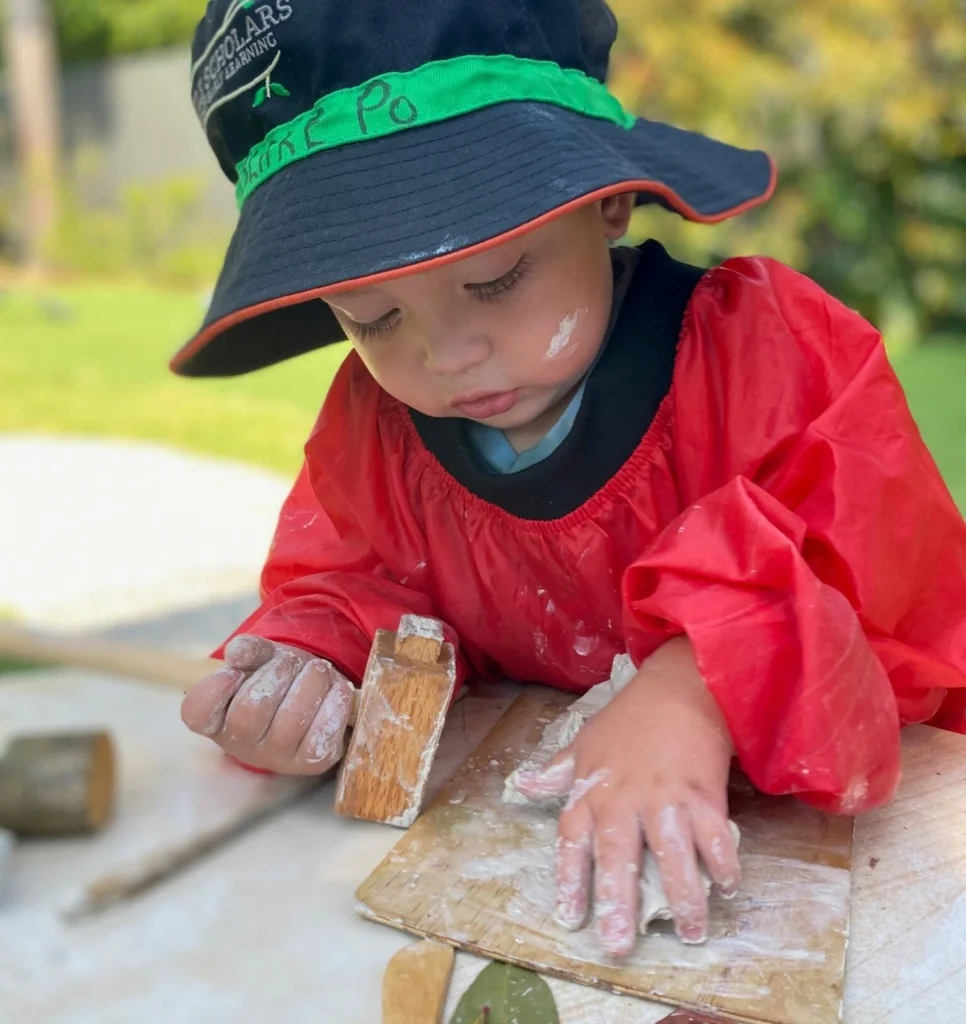
According to experts from Pennsylvania State University, children will show many parts of themselves through clay experiences:
One of the lesser-known but incredibly important benefits of clay play is muscle development. When children manipulate clay, they’re actually engaging both fine and large muscles, which is crucial for their physical development.
Anxiety
One study in Iran aimed to examine the impact of clay therapy and narrative therapy on reducing anxiety levels in pre-school children. The study involved 30 kindergarten children who were divided into three groups: 10 in the clay therapy group, 10 in the narrative therapy group, and 10 in the control group. The study found significant differences in anxiety levels among the groups. Both the clay therapy and narrative therapy groups showed a reduction in anxiety compared to the control group. The clay therapy group had a mean score of 3.63, and the narrative therapy group had a mean score of 2.83, both of which were significantly different from the control group’s mean score of -0.71. However, there was no significant difference between the clay therapy and narrative therapy groups in terms of anxiety reduction.
The study concludes that both clay and narrative therapies are effective in improving self-esteem, school performance, and sociability of the children, as reported by the parents.
Psychosocial Wellbeing
Another study out of Kenya, looked at how clay play supported children who lost access to schools during the pandemic, affecting children’s right to education and their psychosocial wellbeing.
The study, published in the East African Journal of Arts and Social Sciences, looked into the psychosocial effects of the COVID-19 pandemic on children and how play, particularly with painting and clay modelling, can be a therapeutic and educational tool. The paper argues that these forms of play can help children cope with the stresses and traumas induced by the pandemic, while also promoting cognitive and social learning.
The study argues that play with art forms like painting and clay modelling can be powerful tools for cognitive and social learning. They can also serve as therapeutic activities to counter depression and violent behaviour. Activities such as clay modelling and painting are described as non-serious activities that free the mind and are excellent for expression. Clay is described as a malleable material that can be easily manipulated, while painting offers a colourful medium for expression.
The study suggests that these art-based activities should be integrated into the curriculum, especially for children aged four to six, to enhance their psycho-motor and creativity development.
Fine Motor Skills
An Indonesian study investigated the impact of constructive play with clay on children’s fine motor skills. The small study by researchers from STKIP Kusuma Negara included two groups of 11 children each, one as the experimental group and the other as the control group. The study used test observation techniques for data collection and employs both descriptive and nonparametric statistical analysis. The results indicated a significant difference between the two groups, suggesting that constructive play with clay positively impacts children’s fine motor skills.
In the study, the authors highlight the physical aspects of working with clay.
“Working with clay fosters large muscle and fine motor control. Clay is fairly resistant and will need to be kneaded and worked to make it pliable. Children can stand or sit while using clay. Standing provides the advantage of a whole-body muscular reaction to the clay. Hard clay provides solid resistance the child must overcome. This will involve using the shoulders, arms, hands, and fingers. Playing with clay develops large muscles and fine motor control because the clay is quite resistant and kneaded to make it soft.”
The benefits of clay play in early childhood development are supported not only by expert opinions but also by a growing body of scientific research. From fostering creativity and social skills to enhancing both fine and large muscle development, clay play serves as a multifaceted educational tool.
References:
Learning to write. Learning to read. Learning to count. There is a certain set of expectations of things children are expected to learn around the time they are about to start school, but what about other equally important things, things that will give children just as many future benefits, but make parents cringe? What are we talking about?
Getting messy.
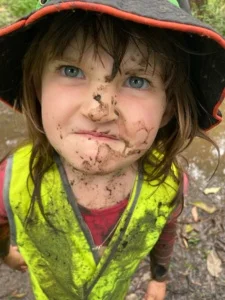
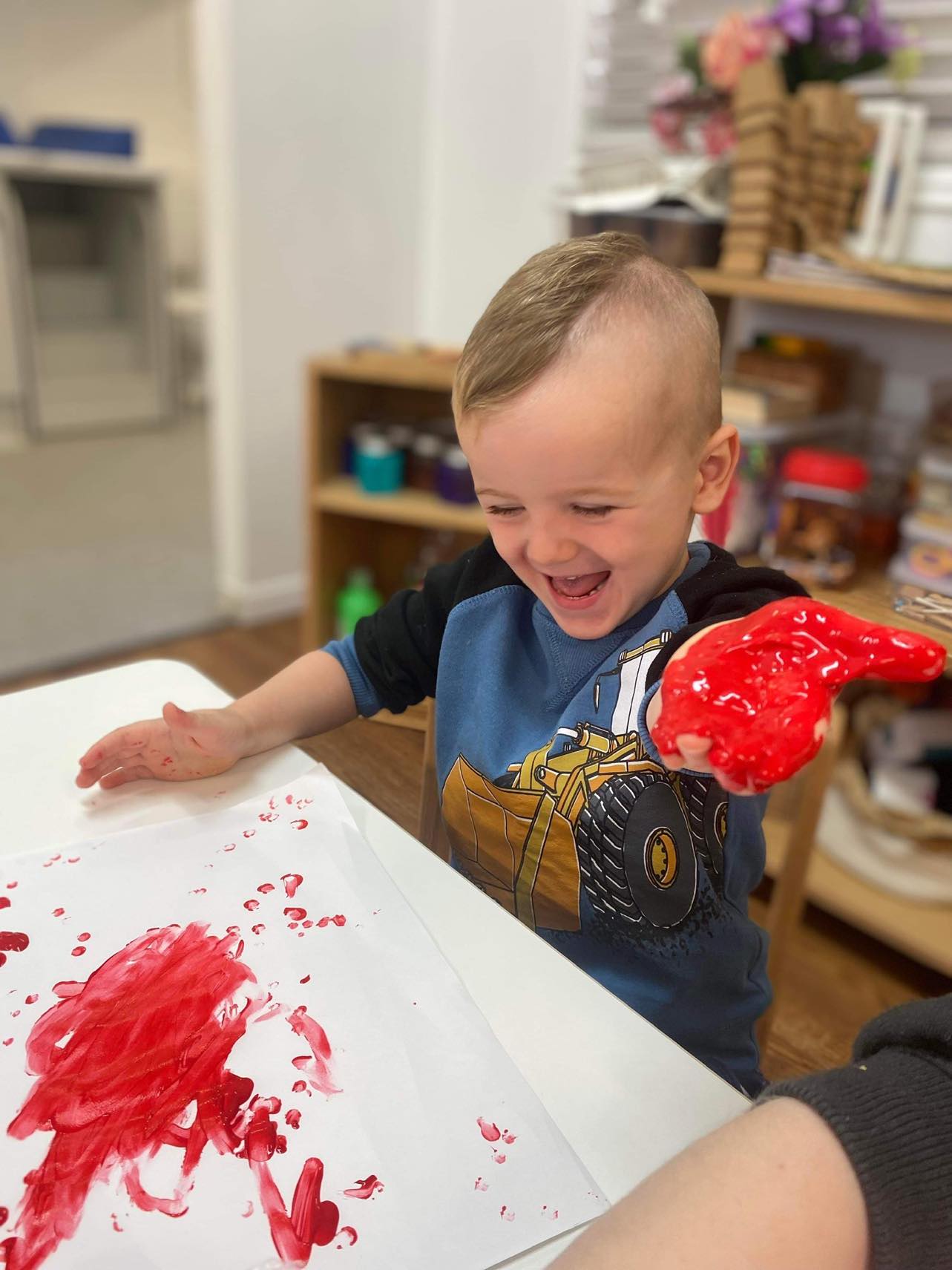
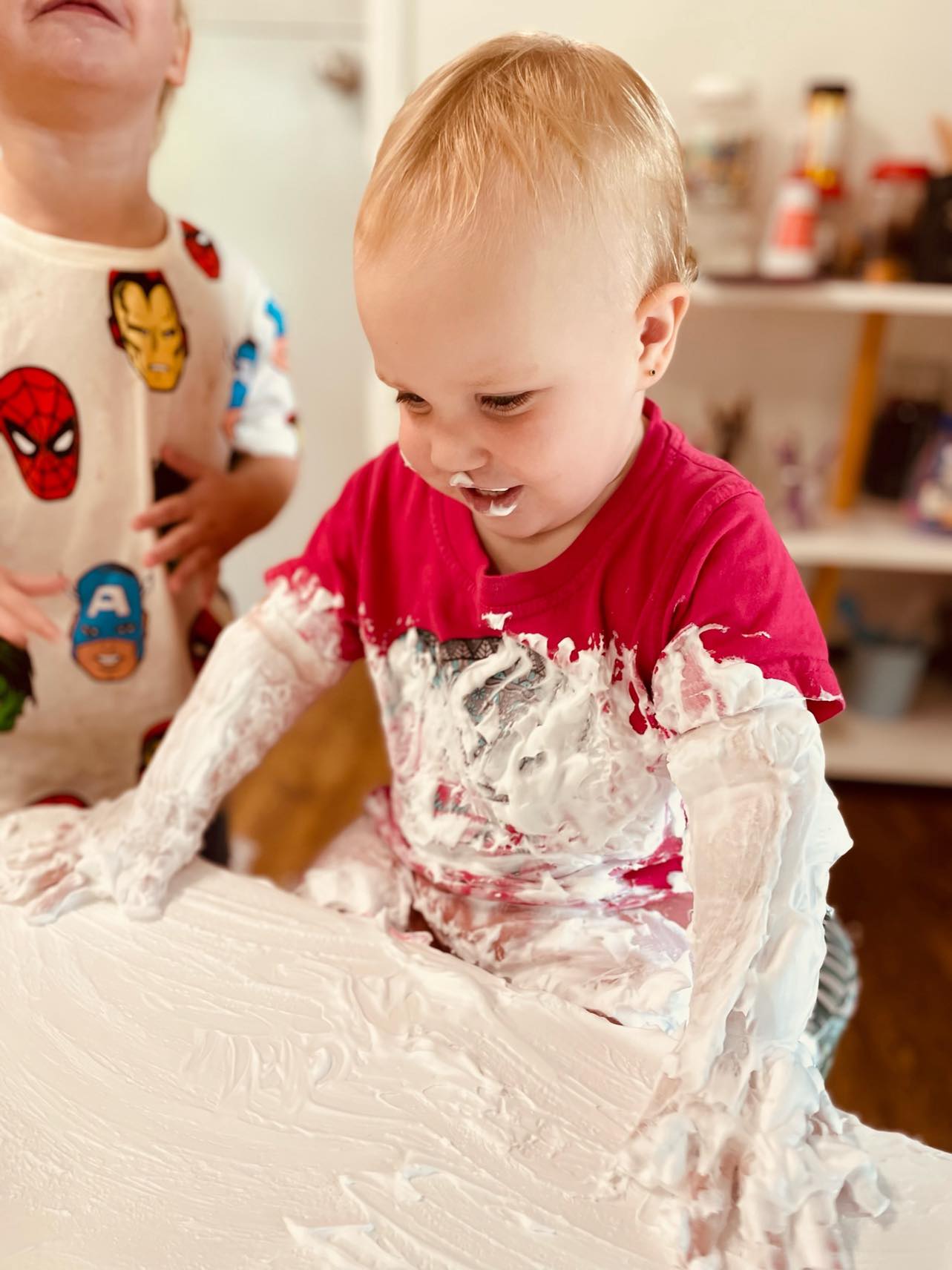
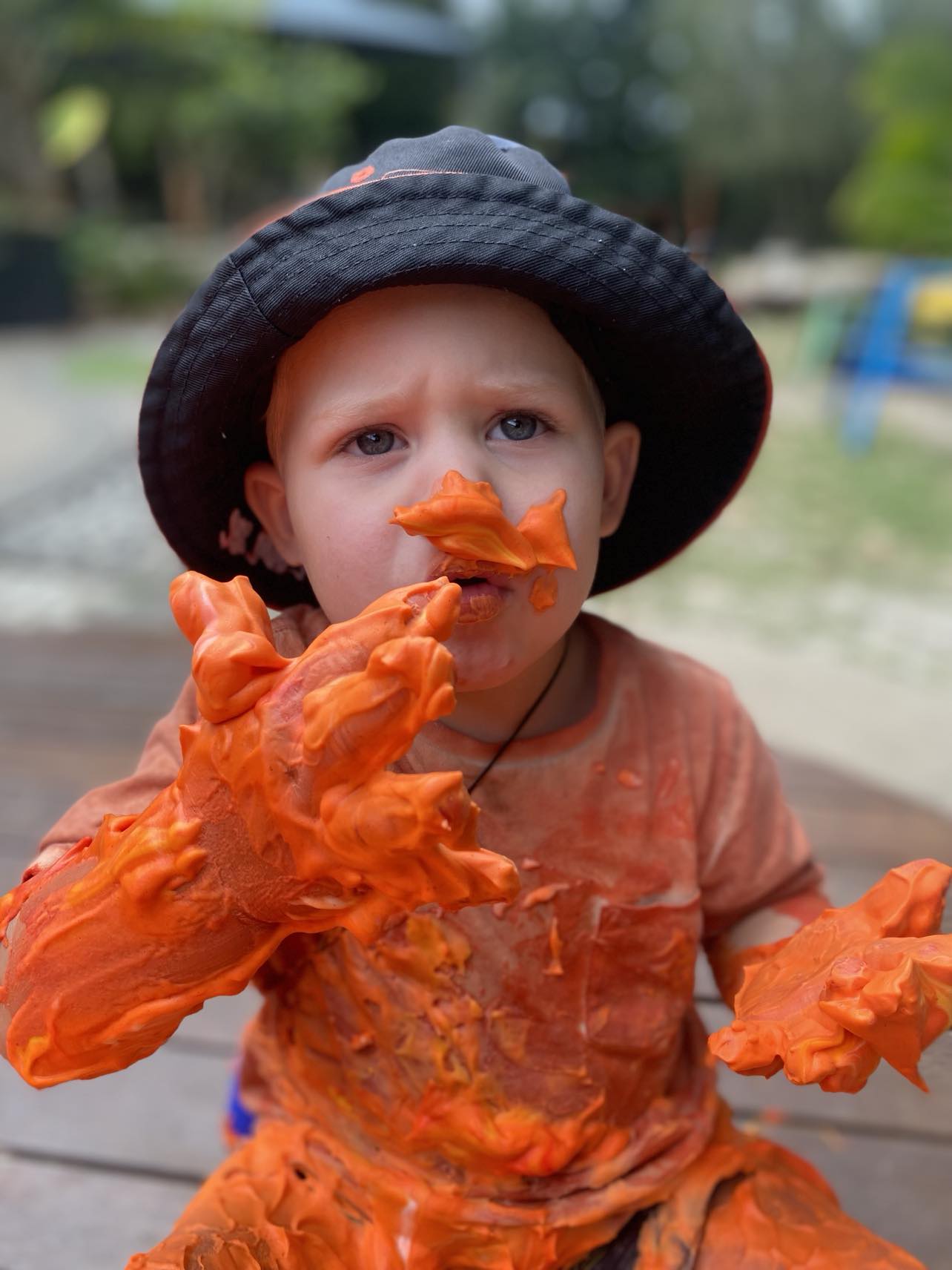
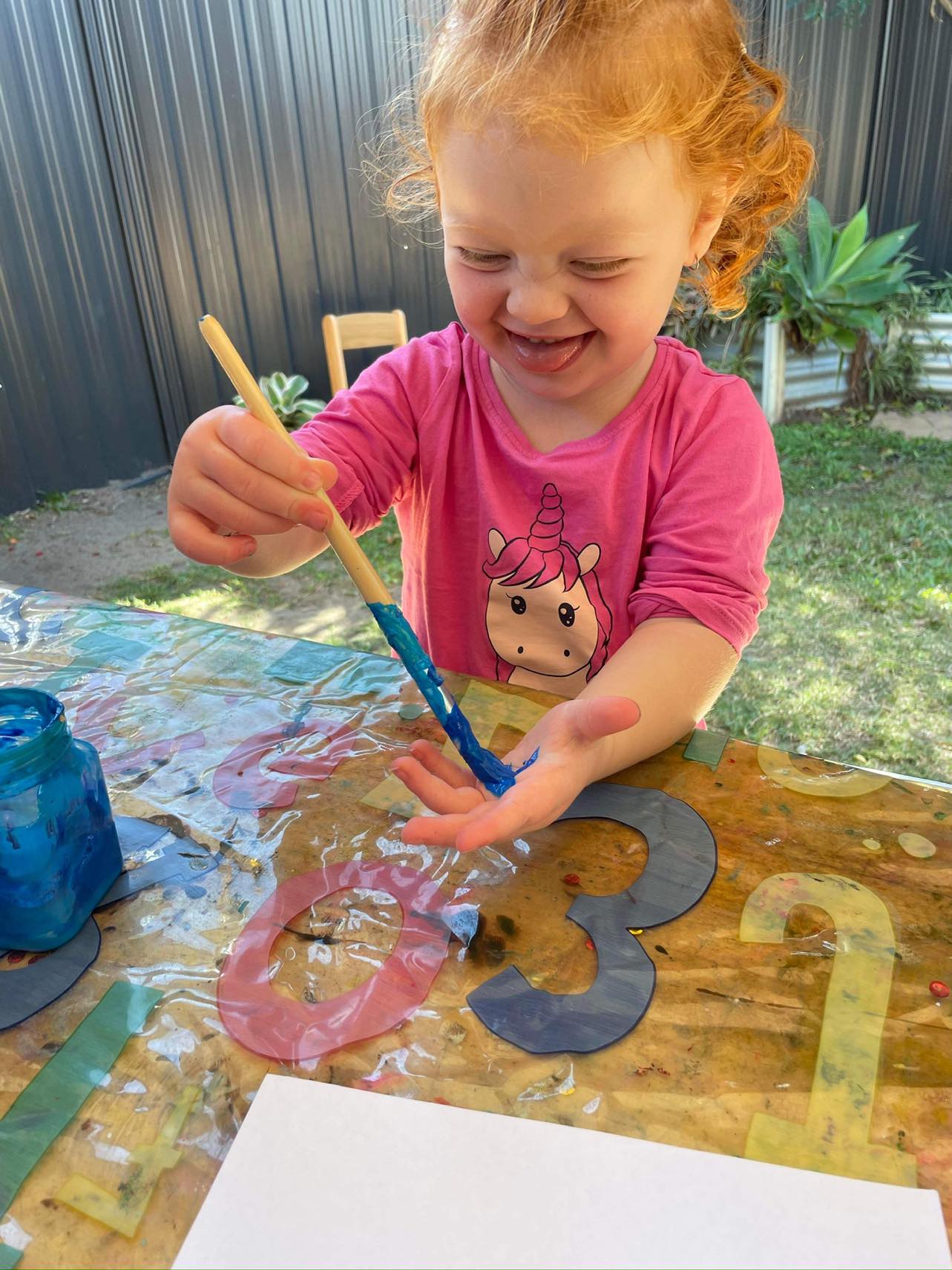
For a number of reasons, getting messy is an important part of childhood learning and development. While many parents understand the benefits of being out in nature, they may be less comfortable with the idea of getting messy while outside. Or inside, for that matter! Some of the reasons for parental discomfort in messy play could include:
Messy play can help children develop their fine motor skills, problem-solving skills, creativity and sensory awareness. It can also help them learn about cause and effect, and even how to manage their emotions.
A recent study by the University of South Australia (UniSA) looked at comfort of parents and early educator when it comes to messy and risky play in early education. Dr Margarita Tsiros, Senior Lecturer in Paediatric Physiotherapy at UNISA, said that given that nearly half of all Australian children ages 0-5 are in some sort of early education setting, further education and training for both early childhood educators and parents could help overcome some of the challenges that might be linked with nature play, which often involves both getting messy and taking risks.
This study explored the perspectives of parents and early childhood educators on unstructured nature play for young children. Participants were interviewed about their views on the benefits, barriers, and facilitators of nature play, and the researchers’ findings suggest that parents and educators value the benefits of nature play for children’s physical, social, emotional, and cognitive development. However, participants also identified a number of barriers to nature play, including time constraints, lack of access to nature play spaces, and concerns about safety and mess. The study also found that adults can play a gatekeeper role in nature play, by either facilitating or restricting children’s access to nature.
The findings of this study suggest that parents and educators need additional resources and guidance on how to engage with nature play and how to overcome barriers within early childhood settings and the home environment.
Messy play is of course, not limited to playing in nature, though there are plenty of opportunities outside to get a little dirty. But messy play is everywhere, from when a baby is exploring food in those early days, learning to feed herself, learning cause and effect when dropping food, that’s just one aspect.
As well, children are creative beings, and parents can attest to the fact that their little ones are directly drawn to arts and crafts that include glitter. OK, we kid a little, but art and creativity are a large part of the childhood experience, and will likely require sweeping, wiping and washing in the end.
Messy play is of course, not limited to playing in nature, though there are plenty of opportunities outside to get a little dirty. But messy play is everywhere, from when a baby is exploring food in those early days, learning to feed herself, learning cause and effect when dropping food, that’s just one aspect.
As well, children are creative beings, and parents can attest to the fact that their little ones are directly drawn to arts and crafts that include glitter. OK, we kid a little, but art and creativity are a large part of the childhood experience, and will likely require sweeping, wiping and washing in the end.
Specifically about messy outdoor play, a 2021 study by Melike Kandemir and Serap Sevimli-Celik, from the Department of Elementary & Early Childhood Education, Middle East Technical University, Ankara, Turkey, found that parents and educators believe that it can provide a number of benefits for children, including:
The study found that teachers and parents value the benefits of outdoor play for children’s development, but that they also have concerns about safety, messiness, and lack of resources.
The study also found that teachers and parents have different views on the role of outdoor play in children’s learning. Teachers were more likely to see outdoor play as a way for children to learn about the natural world, while parents were more likely to see outdoor play as a way for children to burn off energy.
The study also found that teachers and parents are concerned about the messiness of outdoor play. They worry about children getting dirty, tracking mud into the house, or ruining their clothes.
The study concludes by arguing that there is a need to better support teachers and parents in providing opportunities for children to engage in outdoor play.
Another study looked explicitly at vulnerable children and getting messy in play.
The study, “Patterns and attributes in vulnerable children’s messy play” by Sue Gascoyne, et al., explores the patterns and attributes of messy play in vulnerable children.
The study defines vulnerable children as “children who are at risk of social, emotional, and/or developmental difficulties.” It used a mixed-methods approach, including interviews with parents and practitioners, and observations of children’s messy play.
Researchers found that vulnerable children engage in messy play in a variety of ways, but that there are some common patterns. For example, vulnerable children often use messy play to explore their emotions, to develop their relationships with others, and to learn about the world around them.
The study also found that there are some specific attributes of messy play that are particularly beneficial for vulnerable children, such as, messy play can help children to develop their sensory awareness, their problem-solving skills, and their self-confidence.
But researchers also found that vulnerable children often use messy play to express their emotions. For example, children might use messy play to express anger, sadness, or joy. As often vulnerable children are facing hardship other children might not be, this was important.
The study also found that messy play can help children to develop their relationships with others. For example, children might play together with messy materials, or they might help each other to clean up after messy play.
The study concludes by arguing that messy play is an important part of the development of vulnerable children, and that it should be encouraged.
Observing the babies experience this source of joy, excitement, relaxation and total presence, I can’t help but feel a sense of wonder and awe.
-Jodie, lead educator
Jodie Dzarir is the lead educator in the nursery studio at Little Scholars Burleigh campus. She agrees there’s a multitude of benefits when it comes to allowing children to get messy while they explore their world.
“My favourite would have to be the social and emotional development encountered, and the creative/imaginative stimulation it provides,” she says.
“Messy play allows babies the freedom to convey their emotions, experimenting different forms of self-expression. It stimulates their imagination and creativity as they engage in open-ended activities with no predetermined outcomes.
Observing the babies experience this source of joy, excitement, relaxation and total presence, I can’t help but feel a sense of wonder and awe. Witnessing their endless curiosity, laughter and the genuine connections they form with one another is heart warming,” Jodie continues.
For parents who cringe at the idea of their young child coming home filthy, she encourages an open mind and a trust in the process.
“For parents, messy play is an important part of your child’s development and can be vastly beneficial to their learning journey, as it allows them to explore, learn and develop essential skills. Rest assured, we prioritise safety and hygiene during these activities to provide a controlled and enriching experience for your child,” Jodie adds. “Investing in a few basic outfits for messy play could be one of the best purchases you make.”
Susan Cooper, group pedagogical leader for Little Scholars, agrees that messy play is an important vessel for play for young children.
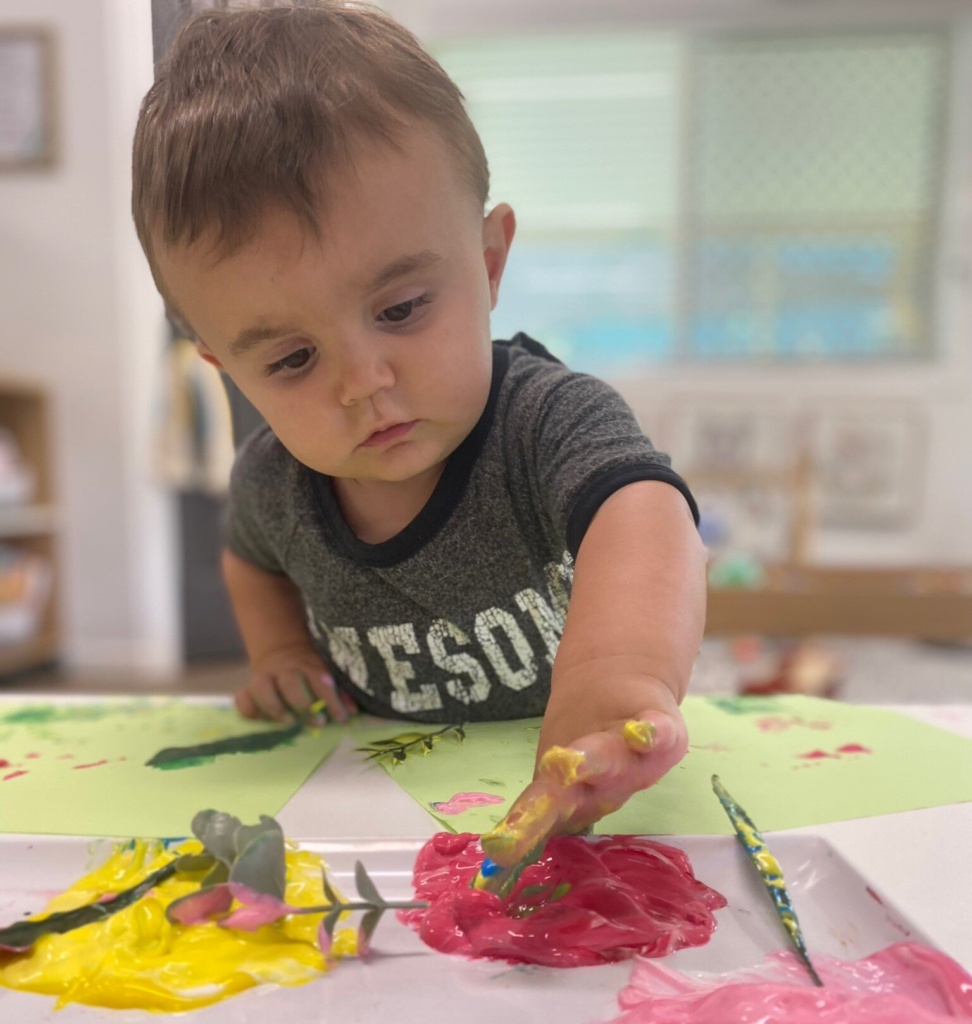
I have seen through my travels how messy play can act as an emotional outlet for many children, they’re able to verbally express themselves, it’s engaging, enjoyable and most importantly fun, interactive, hands-on learning, ultimately encouraging the love for learning, says Susan.
“While we provide these experiences within our curriculum, there is an element to planning around messy play experiences, planning for management to risk, management to supervision and ensuring that children are able to engage within the experiences that is developmentally age-appropriate, meeting their needs and supporting an inclusive environment for all children.”
Although some parents may initially hesitate at the prospect of cleaning up after a lively outdoor romp or an exuberant indoor painting session, (we understand, you’re busy enough!) the abundant benefits of messy play far outweigh any temporary inconveniences. As both parents and educators, we should actively seek out opportunities to provide children with the enriching sensory experiences and learning opportunities that messy play offers.
Yes, messy play might require a deep breath followed by the use of brooms, vacuums, and mops, but let’s not forget to focus on the incredible outcomes that emerge from these seemingly chaotic moments. We wholeheartedly encourage parents and educators to embrace the magic of messy play. It’s in these moments that we witness the spark of imagination ignite, where education and career trajectories may take shape, and lifelong passions may be kindled.
Remember, every single fun and messy experience can pave the way for a world of endless possibilities. The memories created through messy play will remain etched in the hearts of children, shaping their growth and development in ways that extend far beyond the spills and splatters. Join us at Little Scholars, embrace the mess and the extraordinary potential it holds blossom before our very eyes.
References:

Let us hold your hand and help looking for a child care centre. Leave your details with us and we’ll be in contact to arrange a time for a ‘Campus Tour’ and we will answer any questions you might have!
"*" indicates required fields
Let us hold your hand and help looking for a child care centre. Leave your details with us and we’ll be in contact to arrange a time for a ‘Campus Tour’ and we will answer any questions you might have!
"*" indicates required fields
Fill in the form to join your local Pram Pals mums and bubs walk