
Everything you need to know about how Australia’s early childhood framework guides the way your child learns, grows, and thrives, explained in plain English.
The Early Years Learning Framework or EYLF is Australia’s national standard for early childhood education and care. Its full name is Belonging, Being and Becoming: The Early Years Learning Framework for Australia.
Developed by the Australian Government and released in 2009 (with a major update to V2.0 in 2022), the EYLF applies to all approved childcare and early education settings for children from birth to five years of age. It sits under Australia’s National Quality Framework (NQF) and is the foundation against which services are assessed by ACECQA.
The framework doesn’t dictate a specific program or curriculum. Instead, it gives educators a shared foundation of principles, practices, and learning outcomes to guide the experiences, environments, and relationships they create for children. The goal is a consistent, high-quality early education across every approved childcare centre in Australia.
The 2022 update expanded the EYLF's principles from 5 to 8, strengthened language around sustainability, critical reflection, and collaborative leadership, and updated practices to reflect contemporary research in early childhood pedagogy. If your child's centre was enrolled before 2023, their approach has been updated to reflect V2.0.
At the heart of the EYLF are three interconnected concepts that describe how children experience the world. These pillars aren’t stages, they exist simultaneously in every child’s life.
Children develop a sense of belonging through their relationships — with family, educators, peers, and the broader community. When children feel they belong, they feel secure, confident, and connected enough to learn and explore. Belonging is the foundation all other development is built on.
Being recognises that childhood is a valuable time in its own right — not just preparation for school. Children deserve time to simply be: to play, to wonder, to form friendships, and to experience the present moment fully. High-quality early childhood education honours this.
Becoming is about growth, change, and the development of identity over time. Every experience a child has — every relationship, challenge, and discovery — shapes who they are becoming. The EYLF asks educators to see and support each child’s unique developmental journey.
EYLF principles are the core beliefs that underpin everything educators do. They reflect contemporary research, ethical practice, and what we know about how children learn best. EYLF V2.0 expanded these from 5 to 8 principles.
Children learn best when they feel safe, valued, and emotionally connected. Warm, consistent relationships with educators are the single most important factor in quality early learning. This principle places relationship-building at the centre of every interaction.
Educators and families share responsibility for children’s learning and development. Genuine partnerships — built on communication, trust, and mutual respect — strengthen outcomes for children. Parents are considered the first and most important educators in a child’s life.
Every child has the capacity to succeed. This principle calls on educators to hold high expectations for all children regardless of background, ability, or circumstance, and to actively work to remove barriers to participation and achievement.
Australia’s children come from diverse families, cultures, and communities. Educators respect and value this diversity including Aboriginal and Torres Strait Islander ways of knowing and being, and reflect it in their programs and environments.
High-quality educators are always learning. This principle commits educators to continuous professional development, critical self-reflection, and staying current with early childhood research. It’s what separates good care from exceptional early education.
Added in EYLF V2.0, this principle encourages educators to examine their own assumptions, values, and practices with rigour. Critical reflection goes beyond routine self-assessment — it challenges educators to question why they do what they do and whether it truly serves every child.
Also new in V2.0, this principle recognises that children’s futures are shaped by the health of the planet and their communities. Educators integrate sustainability into everyday learning — helping children develop a sense of environmental responsibility from the earliest years.
Quality early education is a shared endeavour. This principle values leadership at every level — from the director to each educator — and recognises that when teams learn and grow together, children’s outcomes improve. A collaborative culture underpins a high-performing centre.
If principles describe what educators believe, practices describe what they do. These are the pedagogical strategies and teaching approaches that bring the EYLF to life in the learning environment every day.
Children’s development across physical, social, emotional, and cognitive domains can’t be separated. Educators take a whole-child approach — recognising that a child who feels loved and safe learns more than one who doesn’t, and that physical play builds cognitive skills as much as desk-based activities.
Skilled educators read children closely — their moods, interests, cues, and emerging ideas — and adapt in real time. Responsiveness builds trust, deepens engagement, and ensures each child’s experience is attuned to who they are right now, not a one-size-fits-all program.
Play is the primary vehicle for learning in the early years. Through play, children experiment, imagine, problem-solve, build social skills, and develop language. The EYLF recognises both structured and unstructured play as essential — leisure and downtime are as valuable as directed learning.
Great early childhood educators don’t just supervise — they teach with purpose. Intentional teaching means making deliberate decisions about experiences, language, questions, and provocations to extend children’s thinking and scaffold their development toward meaningful goals.
The physical and emotional environment of a centre is itself a teacher. Educators design spaces — indoors and outdoors — that invite curiosity, support risk-taking, reflect children’s identities, and promote independence. A well-designed learning environment makes quality learning happen more naturally
Educators actively incorporate children’s cultural backgrounds, languages, and family practices into their programs. Cultural responsiveness goes beyond celebrating events — it means genuinely embedding diverse ways of knowing, being, and doing into everyday learning experiences.
Transitions — between rooms, between services, and into school — can be unsettling for children. Educators work proactively to ensure these transitions are smooth, supported, and built on shared knowledge of each child’s learning journey, reducing disruption and building confidence.
Ongoing observation, documentation, and assessment help educators understand where each child is in their learning, what’s working, and where to go next. Assessment in the EYLF is not about testing, it’s a reflective practice that informs planning and celebrates children’s progress.
Learning outcomes are the broad goals that the EYLF guides educators toward for every child aged birth to 5. They’re not milestones or checklists — they’re holistic developmental destinations that shape how educators plan, observe, and document learning.
Children develop confidence in who they are their strengths, their feelings, their family, and their place in the world. This outcome includes developing resilience, a positive sense of self, and the ability to make choices and act with increasing independence.
Children develop a sense of connection to their communities, the natural environment, and the wider world. They learn about their rights and responsibilities, develop empathy, and begin to understand their role as active participants in society.
Physical health, emotional wellbeing, and a sense of safety and comfort all contribute to this outcome. Children who feel well are better equipped to learn, form relationships, and navigate challenge. Wellbeing is both an outcome and a precondition for all other learning.
Children develop dispositions for learning, curiosity, creativity, persistence, and enthusiasm. They become willing to take on challenges, try new things, and engage deeply with experiences. This outcome lays the cognitive and motivational foundations for lifelong learning.
Communication encompasses verbal language, non-verbal expression, literacy, numeracy, and digital literacy. Children learn to express themselves, listen and respond, engage with stories and symbols, and use a growing range of tools and technologies to communicate and create.
Common questions about the EYLF from parents, educators, and childcare students.
At Little Scholars, the EYLF isn’t just compliance — it’s the foundation of everything we do across our 17 South East Queensland campuses. Our educators are trained to bring all 8 principles and 8 practices to life every day, in environments designed for children to genuinely thrive.
Everything you need to know about how Australia's early childhood framework guides the way your child learns, grows, and thrives — explained in plain English.
Quick Reference
The Early Years Learning Framework — or EYLF — is Australia's national standard for early childhood education and care. Its full name is Belonging, Being and Becoming: The Early Years Learning Framework for Australia.
Developed by the Australian Government and released in 2009 (with a major update to V2.0 in 2022), the EYLF applies to all approved childcare and early education settings for children from birth to five years of age. It sits under Australia's National Quality Framework (NQF) and is the foundation against which services are assessed by ACECQA.
The framework doesn't dictate a specific program or curriculum. Instead, it gives educators a shared foundation of principles, practices, and learning outcomes to guide the experiences, environments, and relationships they create for children. The goal is a consistent, high-quality early education across every approved childcare centre in Australia.
At the heart of the EYLF are three interconnected concepts that describe how children experience the world. These pillars aren't stages — they exist simultaneously in every child's life.
Children develop a sense of belonging through their relationships — with family, educators, peers, and the broader community. When children feel they belong, they feel secure, confident, and connected enough to learn and explore. Belonging is the foundation all other development is built on.
Being recognises that childhood is a valuable time in its own right — not just preparation for school. Children deserve time to simply be: to play, to wonder, to form friendships, and to experience the present moment fully. High-quality early childhood education honours this.
Becoming is about growth, change, and the development of identity over time. Every experience a child has — every relationship, challenge, and discovery — shapes who they are becoming. The EYLF asks educators to see and support each child's unique developmental journey.
EYLF principles are the core beliefs that underpin everything educators do. They reflect contemporary research, ethical practice, and what we know about how children learn best. EYLF V2.0 expanded these from 5 to 8 principles.
Children learn best when they feel safe, valued, and emotionally connected. Warm, consistent relationships with educators are the single most important factor in quality early learning. This principle places relationship-building at the centre of every interaction.
Educators and families share responsibility for children's learning and development. Genuine partnerships — built on communication, trust, and mutual respect — strengthen outcomes for children. Parents are considered the first and most important educators in a child's life.
Every child has the capacity to succeed. This principle calls on educators to hold high expectations for all children — regardless of background, ability, or circumstance — and to actively work to remove barriers to participation and achievement.
Australia's children come from diverse families, cultures, and communities. Educators respect and value this diversity — including Aboriginal and Torres Strait Islander ways of knowing and being — and reflect it in their programs and environments.
High-quality educators are always learning. This principle commits educators to continuous professional development, critical self-reflection, and staying current with early childhood research. It's what separates good care from exceptional early education.
Added in EYLF V2.0, this principle encourages educators to examine their own assumptions, values, and practices with rigour. Critical reflection challenges educators to question why they do what they do and whether it truly serves every child.
Also new in V2.0, this principle recognises that children's futures are shaped by the health of the planet and their communities. Educators integrate sustainability into everyday learning — helping children develop environmental responsibility from the earliest years.
Quality early education is a shared endeavour. This principle values leadership at every level — from the director to each educator — and recognises that when teams learn and grow together, children's outcomes improve.
Want to see these principles in action? Visit one of our 17 South East Queensland campuses.
Book a tourIf principles describe what educators believe, practices describe what they do. These are the pedagogical strategies and teaching approaches that bring the EYLF to life in the learning environment every day.
Children's development across physical, social, emotional, and cognitive domains can't be separated. Educators take a whole-child approach — recognising that a child who feels loved and safe learns more, and that physical play builds cognitive skills as much as anything else.
Skilled educators read children closely — their moods, interests, cues, and emerging ideas — and adapt in real time. Responsiveness builds trust, deepens engagement, and ensures each child's experience is attuned to who they are right now.
Play is the primary vehicle for learning in the early years. Through play, children experiment, imagine, problem-solve, and build social skills. Both structured and unstructured play are essential — leisure and downtime are as valuable as directed learning.
Great early childhood educators teach with purpose. Intentional teaching means making deliberate decisions about experiences, language, questions, and provocations to extend children's thinking and scaffold development toward meaningful goals.
The physical and emotional environment of a centre is itself a teacher. Educators design spaces — indoors and outdoors — that invite curiosity, support risk-taking, reflect children's identities, and promote independence.
Educators actively incorporate children's cultural backgrounds, languages, and family practices into programs. This means genuinely embedding diverse ways of knowing, being, and doing into everyday learning experiences.
Transitions — between rooms, services, and into school — can unsettle children. Educators work proactively to ensure transitions are smooth and built on shared knowledge of each child's learning journey.
Ongoing observation, documentation, and assessment help educators understand where each child is and where to go next. Assessment in the EYLF is not about testing — it's a reflective practice that informs planning and celebrates children's progress.
Learning outcomes are the broad goals that the EYLF guides educators toward for every child aged birth to 5. They're not milestones or checklists — they're holistic developmental destinations that shape how educators plan, observe, and document learning.
Children develop confidence in who they are — their strengths, their feelings, their family, and their place in the world. This includes developing resilience, a positive sense of self, and the ability to make choices and act with increasing independence.
Children develop a sense of connection to their communities, the natural environment, and the wider world. They learn about their rights and responsibilities, develop empathy, and begin to understand their role as active participants in society.
Physical health, emotional wellbeing, and a sense of safety and comfort all contribute to this outcome. Children who feel well are better equipped to learn, form relationships, and navigate challenges. Wellbeing is both an outcome and a precondition for all other learning.
Children develop dispositions for learning — curiosity, creativity, persistence, and enthusiasm. They become willing to take on challenges, try new things, and engage deeply with experiences. This outcome lays the cognitive and motivational foundations for lifelong learning.
Communication encompasses verbal language, non-verbal expression, literacy, numeracy, and digital literacy. Children learn to express themselves, listen and respond, engage with stories and symbols, and use a growing range of tools to communicate and create.
Common questions about the EYLF from parents, educators, and childcare students.
At Little Scholars, the EYLF isn't just compliance — it's the foundation of everything we do across our 17 South East Queensland campuses. Our educators bring all 8 principles and 8 practices to life every day, in environments designed for children to genuinely thrive.
These days, life feels busier, more rushed, more overwhelming, so the need for bringing calm into our bodies and minds has never been more welcome.
We introduced our Little Scholars Mindfulness Program back in 2021, a time when the world was chaotic, and the early learning sector was facing its own unique challenges. While thankfully we’ve moved through that period and the world has adjusted, the importance of mindfulness, yoga, and meditation in early learning remains significant. These practices continue to play a crucial role in helping children develop focus, emotional resilience, and a sense of inner peace that supports their overall growth and wellbeing. But that’s not all these practices offer children.
We’ll share all the benefits mindfulness practices provide children, and we get to speak with Annette Hartland, a former Little Scholars educator who now teaches yoga and meditation full time to young children, including our little scholars.
Annette once worked as an educator in our Ashmore campus, leaving to follow her passion of becoming a yoga instructor. However, achieving her dream meant she actually returned to us in a different capacity, she now leads yoga and meditation practice at several of our campuses and our support office.
We asked Annette how she got started practicing yoga, and what she saw as the benefits of mindfulness practices for children.
How did you get involved in yoga and what is it like to mix your passion for yoga with your great affection for young children?
It’s been so long that I don’t remember a time in my life when I haven’t practised some type of yoga/meditation. The short story is that my sister asked me to attend classes with her just after my second child was born. I’ve attended regularly ever since. My daughter’s almost 30 years old! Cliche as it sounds, Children are the future. They are inquisitive, flexible in mind and body and are ready to learn. It is vital to nurture this love of learning and develop a discipline of moving within their own space and taking time to be calm and think.
What are the emotional benefits of the practice?
Yoga and meditation practice take you inside yourself to be more aware of the movement of your breath, your body and your mind. We use the breath to be able to deal with situations calmly. One deep inhalation and a long exhalation remind us to pause to consider all the possibilities. Yoga teaches that all living beings are connected. This has a positive benefit for all living creatures. The children feel the difference between moving, being still and being relaxed.
What are the physical benefits?
Move it or lose it is the simplest answer. Children become aware of how much space they like at particular times eg. resting by themselves, partner poses, time to move with wide arms and stance or just a little space around their body. They develop concentration to maintain balance, they strengthen their muscles and become more flexible. We love moving rigorously and then freezing – the difference between effort and ease, mobile and relaxed.
What have you witnessed after teaching yoga with the children?
After teaching certain breathwork or postures, which I learned through the Zenergy yoga therapy course, the children settle more easily and are able to participate with more awareness. Some children are more aware of others and volunteer to be giving of themselves.
Do you have any advice for parents on bringing more mindfulness at home?
Take the time to be present to your children for a while each day, at least 10 minutes. No TV or telephones or music – just you and your child. Take a walk in nature, gaze at the stars, sit with a pet, cuddle on the couch and chat or be silent or breathe together. Listen, smell, taste, touch, feel … connect. This makes precious memories with your children.
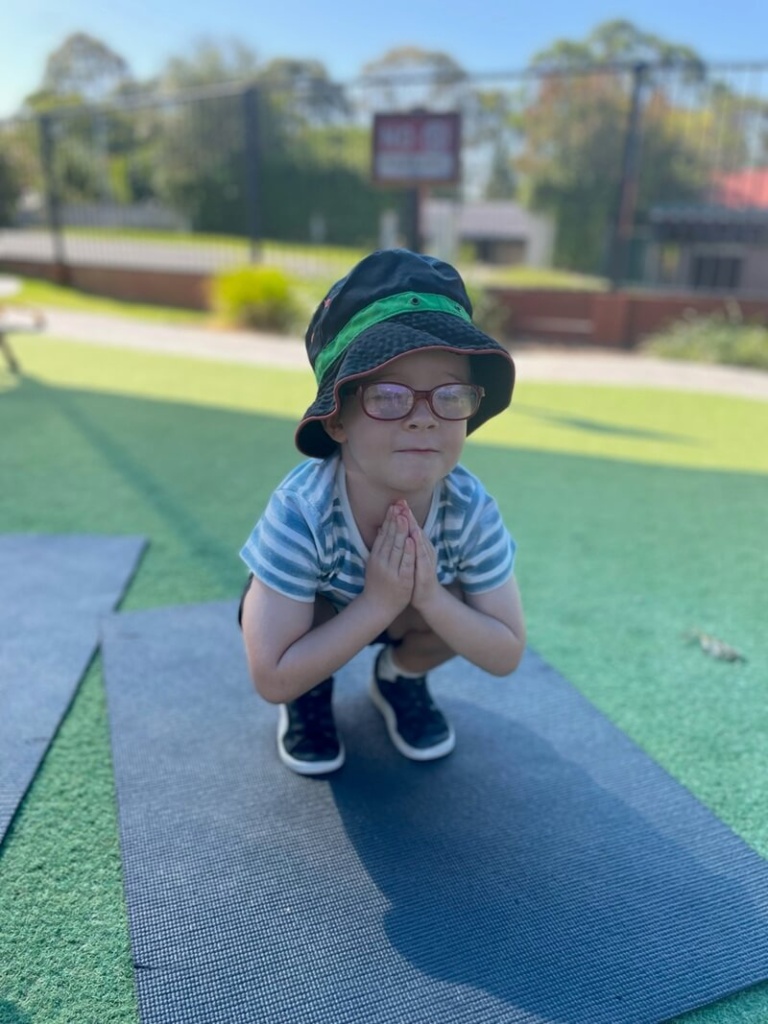
As mentioned, one facet of our mindfulness program is offering our little scholars yoga sessions delivered by experts like Annette, and as she says, yoga offers a multitude of benefits for emotional and physical development, backed by research.
On the physical side, yoga enhances flexibility, coordination, balance, and posture. Yoga requires our full attention, requiring us to focus on the present and be fully aware of what our body is doing at any one time. It also helps develop fine and gross motor skills, guiding us to learn to control breathing, our stance and where we’re putting our weight, and flowing through to the next posture.
On the emotional side, by focusing on movement, balance, breathing and everything else that yoga requires of us means that we’re fully present in the moment, practicing self-awareness and mindfulness, reducing stress and any outside ‘noise’, promoting relaxation, bringing a sense of calm and wellbeing. In turn, this means we’re developing emotional regulation and resilience.
For children who are just learning how to interpret and manage their emotions, this is a fantastic way for them to deal with life’s challenges big and small.
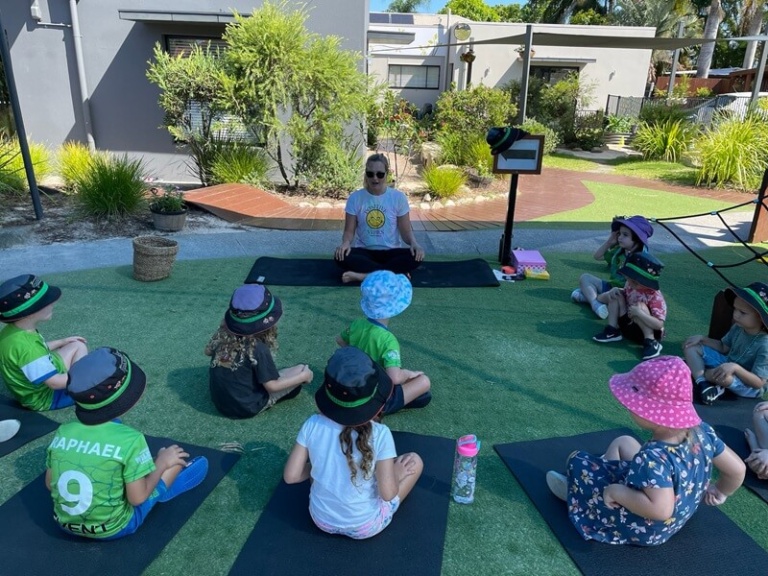
Another and even easier way to bring more mindfulness to our day-to-day that anyone, including children, can do is practice breathing techniques to calm the mind and body. Here are some of our favourite breathing techniques for children.
1. Ask children to lie on the floor and place a small object, such as a soft toy or bean bag on their belly. Get them to place their hands by their side and breathe normally, watching the object go up and down. You could count as they inhale and exhale ‘breathe in 1, 2, 3, breathe out 1,2,3.’
2. Print or cut out some square, rectangle or triangle shapes and give one to each child. Ask the children to trace their finger around the shape, breathing in while moving their finger along one edge of the shape, hold their breath for a few seconds before breathing out, while tracing around the next side of the shape. Repeat this a number of times.
Children can also use their own hand as the shape, using a finger on the other hand to trace up the side of a finger while breathing in and down the other side of the finger while breathing out, before moving on the next finger.
3. While sitting comfortably, model for the children how to create a circle shape with their hands and ask them to imagine that inside the circle is a mug of hot chocolate. Ask the children to breathe in slowly to smell the hot chocolate, and then blow out slowly to cool it down, repeating this a number of times.
Yoga for Children and Young People’s Mental Health and Well-Being: Research Review and Reflections on the Mental Health Potentials of Yoga: Ingunn Hagen and Usha S. Nayar, Department of Psychology, Norwegian University of Science and Technology, NTNU, Trondheim, Norway New School University, New York, USA
The effects of yoga on mental health in school-aged children: A Systematic Review and Narrative Synthesis of Randomised Control Trials, Kirti Khunti, Sadie Boniface, Emma Norris, Cesar M De Oliveira, and Nicola Shelton, University College London (UCL), London, UK, Kings College London, London, UK,
Brunel University, London, UK
Scoping Review of Yoga in Schools: Mental Health and Cognitive Outcomes in Both Neurotypical and Neurodiverse Youth Populations, Niamh Hart, Samantha Fawkner, Ailsa Niven, Josie N Booth, University of Edinburgh
Children’s positive views of themselves as learners are more important than being told they are clever.
This insight from Nathan Wallis’s talk at the Australian Childcare Alliance (ACA) conference resonated with us, and we believe it’s valuable for parents to hear. Our intention isn’t to make parents feel guilty for praising their children’s intelligence. We understand that parents aim to foster a strong sense of self and ability in their children, and we fully support this. However, Wallis emphasises that before the age of seven, children don’t need to prove their intelligence. Instead, they need to develop learning skills through play and believe in their ability to learn. According to Wallis, more play and less structured learning before age seven leads to better outcomes in adulthood.
“To put it simply, before seven, it doesn’t matter how clever your child is. What matters is how clever your child feels and their disposition towards themselves as learners,” Wallis, an educator who focuses on neuroscience, explained on the Future Focus podcast.
“You’re better off having a six-year-old who can only count to 20 but thinks they’re a good learner than a six-year-old who can count to 100 but doubts their cleverness.”
Wallis highlights that free play boosts creativity and problem-solving, which are essential for intelligence. Letting children freely build, create, and explore supports flexible thinking and a positive learning mindset.
At the conference, which attracted hundreds of early childhood educators, Wallis offered advice on how to support children in their confidence and ability to learn:
Experts at Early Childhood Australia agree that children learn about themselves, others, and the world around them through play.
“If you provide your child with plenty of opportunities for playing, exploring, discovering their interests, solving problems, and tackling challenges, then you’ll be laying a strong foundation for building self-confidence,” says David Lyons, CEO of Nido Early School, in a post on ECA’s The Spoke blog.

According to Be You, the national mental health and wellbeing initiative for learning communities in Australia, praise is most effective when adults are mindful of how and when they use it.
When praising children, Be You suggests focusing on their efforts and achievements.
“Praise that’s specific and acknowledges the process of completing an activity or solving a problem helps develop children’s learning and motivation. For example, you might say, ‘You put away your toys so nicely,’ ‘I noticed you were really trying hard at building that block tower,’ or ‘You’ve used so many bright colours in your painting.’ Children can then use this learning when they have similar experiences in the future.”
Lyons agrees and cautions against overpraising.
“Children need to discover and learn those things that give them personal enjoyment and fulfilment, not just do things to please their parents. Similarly, comparing a child to others can be detrimental to their confidence and self-esteem.”
Dealing with disappointment is also crucial for developing confidence.
“Everyone fails to achieve their goals sometimes – and this isn’t a bad thing. You can build children’s ability to deal with challenges by responding sympathetically and with encouragement, helping children focus on what they can change, and challenging ‘I can’t’ thinking by showing and saying you believe in them and reminding them of their achievements,” says Be You.
Wallis reinforces that play enables children to develop social, cognitive, and emotional skills through their own interests and in creative and innovative ways.
“Play-based learning teaches creativity, which is fundamental to growing intelligence and the ability to problem-solve. When children can take their time and make multiple attempts before achieving success, they build resilience and other important skills needed later in life,” says Wallis.
Supporting children in developing a positive self-view as learners is crucial, especially in their early years. Emphasising the importance of play over structured learning fosters creativity, problem-solving, and resilience. By providing nurturing relationships, paying attention to their efforts, and creating flexible learning environments, we can help children build the confidence they need to thrive.
As Nathan Wallis and other experts highlight, the goal is to make children feel capable and enthusiastic about learning. This foundation will benefit them not only in school but throughout their lives. At Little Scholars, we encourage our little ones to play, explore, and believe in themselves – because how they see themselves as learners today will shape their success tomorrow.
Over the past couple of months, we have started to launch woodworking stations at our campuses! But why, you may ask. It’s dangerous! They could get hurt! At Little Scholars, we actively guide children through ‘risky’ activities to build up their skills, confidence, and resilience. Engaging in woodworking helps children learn to assess and manage risks, develop fine motor skills, and boost their creativity and problem-solving abilities. By introducing these activities in a controlled and supervised environment, we ensure they gain valuable life skills while staying safe.
Woodworking is an excellent way for children to exercise their creative, practical and critical thinking skills. It allows them to express their ideas and figure out solutions to their projects.
As they measure, cut, and assemble pieces of wood, they enhance their hand-eye coordination and fine motor skills. These activities require precision and control, which are crucial for writing, drawing, and other tasks. Furthermore, using tools like hammers, saws, and sandpaper teaches them how to handle and manipulate objects with care and accuracy.
Guiding children through woodworking activities helps build their confidence and resilience. Completing a woodworking project, no matter how simple, gives children a sense of accomplishment and boosts their self-esteem. They learn that they can create something tangible and useful with their own hands. Additionally, the process often involves overcoming challenges and solving problems, which teaches persistence and resilience. These qualities are essential for tackling academic challenges and life’s obstacles.
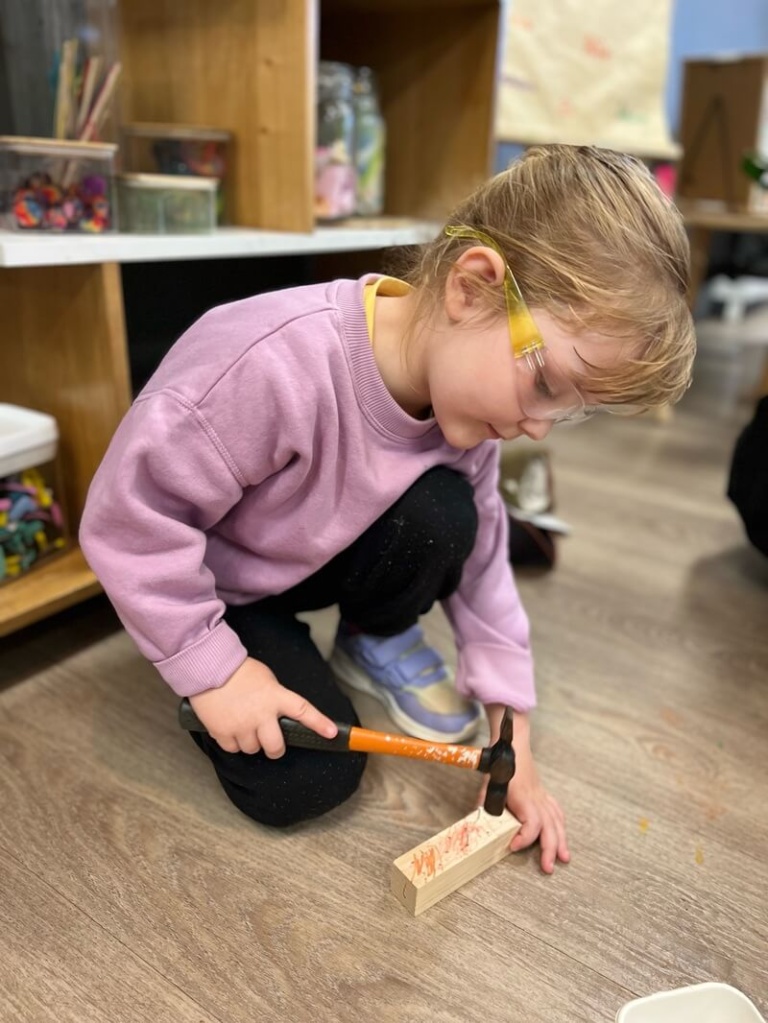
Our little scholars begin their woodworking projects by making a plan. This may look like drawing out their project, or making a model out of cardboard or building blocks, discussing with their friends and educators what they’d like to build, how they’d like it to look, what tools they need in order to make their design come to life, and figure out any risks there may be and how to reduce chances of hurting themselves.
Introducing woodworking in a controlled environment allows children to learn about risk management. They are taught how to use tools safely, understand the potential dangers, and take appropriate precautions. This hands-on experience with ‘risky’ activities helps them develop a healthy respect for safety and risk assessment. They learn to think ahead, plan their actions, and make informed decisions to minimise risks, which are valuable skills both in and out of the workshop.
Some of their documented conversations with educators have included:
How can we make sure we are safe when using the tool table?
“You have to wear safety glasses.”
“If you step on a nail you can hurt your feet.”
“It can’t be too busy, I might knock something over or into someone and hurt them.”
What do you do at the tool table?
“I can measure the wood.”
“When I’m at the table I use the screwdriver.”
“I use nails to put in the wood.”
How does it make you feel when you build at the tool table?
“I like tools because I can screw something in.”
“I feel happy because I can make something.”

Woodworking supports creativity and problem-solving skills. As children design and build their projects, they must think creatively to overcome design challenges and find solutions. This process encourages them to experiment, explore new ideas, and think outside the box. The ability to approach problems creatively and develop innovative solutions is a real skill in today’s world, where adaptability and innovation are highly valued.
In addition to the practical skills, woodworking integrates educational concepts such as maths and science. Measuring pieces of wood, calculating dimensions, and understanding geometric shapes are all part of the woodworking process. Children also learn about the properties of different materials and the principles of mechanics and engineering. This hands-on application of academic subjects helps to reinforce their learning and makes these concepts more tangible and understandable.
By providing children with the opportunity to engage in woodworking, we are equipping them with a wide range of skills and experiences that will benefit them throughout their lives. Through careful supervision and guidance, we ensure that they can enjoy the benefits of this fun activity safely.
Our Parkwood little scholars are not only a part of our newest intergenerational program, they’re helping contribute to important research that looks at how intergenerational bonds support children’s emotional wellbeing as well as that of older people who often experience feelings of loneliness in their later years. This latest study by Griffith University will run over 24 weeks in three eight-week pairings with eight children and eight grandfriends.
Researchers at Griffith University, led by Professors Gaery Barbery and Anneke Fitzgerald, are evaluating the intergenerational program, proudly hosted by Bupa Agedcare Group Limited at Bupa Runaway Bay.
“The program is all about making connections,” according to Professor Barbery, project lead for Griffith University.
The project will measure loneliness, resilience and general wellbeing of the aged care residents using the De Jong Scale of Loneliness, he says.
Isolation and feelings of loneliness are a serious threat for older people, because they’re more likely to live alone, lose family members and friends, suffer from chronic illness and hearing loss. Statistically, one in four older (over 65) Australians live alone. Of those who live alone, according to a 2015 Australian Bureau of Statistics survey, about 12 per cent didn’t receive visitors in a three-month period, and older men were reported to be less likely to have been visited, at 17 per cent.
From the viewpoint of the children, their educators will mark and monitor the project feedback and how it measures against set parameters using the Leuven scale.
“It measures children’s wellbeing and involvement based on observations from staff. There’s also a reflection manual for staff (educators) to offer their perspective of the program, along with a program evaluation survey,” according to Professor Barbery.
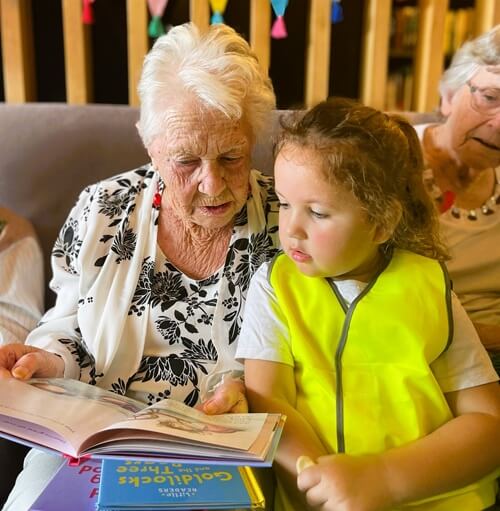
The Bupa residents were delighted to join the research project, all having different reasons for wanting to be a part of the program.
“To see the little ones again, because my grandchildren are all grown up, and all littler ones who’ve been born are overseas, so it’s nice to see little people again,” says Lorette.
“I like little children, and I’ve got a baby great-granddaughter but she’s in New Zealand. So this is a way to spend time with small children. They’re so cute, they’re gorgeous!” Pam says.
Being a half a world away from her family has been hard for Beverley.
“I was a teacher in preschool. I just love kids,” she says. “I have two grandchildren in England, I miss having my family nearby, they come but it’s so far away and a lot of money.”
For Joan, who turned 95 the day before the research project kicked off, she hadn’t considered how much she’d enjoy the visits.
“To start with, it was just an activity, but I found it was so interesting watching these children.”
And Joan says she’s impressed by the maturity of the children, even though they’re only four and five years old.
“They’re much older than we were mentally. Probably because as a society we do more adult things with them. They do seem very advanced to me. It’s a totally different ballgame than when I was a child,” Joan says with a laugh.
Of course, we had to ask our little scholars what their takeaway of the program has been so far, and their answers were predictably unpredictable.
This project is enthusiastically supported and funded by Bendigo Paradise Point Community Bank.
“The Bendigo Paradise Point Community Bank is a registered social enterprise supporting the Gold Coast Community,” says William Matthews, who is proud to be on the Board of Bendigo Bank Paradise Point, as well as principal and director of client operations for Sovereign Family Offices.
Will says he heard Professor Fitzgerald speak at the Australian Institute for Intergenerational Practice (AIIP) meetings that he regularly attends, and was inspired to see how Bendigo could help.
“As a social enterprise we reflect the values of our community, customers and staff. We see our support of Intergenerational Practice in the community as an essential component to strengthening our community by breaking down the barriers in how our most venerable people in society are cared for. We are extremely grateful for Little Scholars, BUPA and Griffith University for championing this project and supporting a future that includes people from every stage of life.”

Mandy Kaur, general manager of Bupa Runaway Bay, says once her team heard about the project, they were very quick to jump to be a part of it.
“We are all excited to continue this project,” Mandy says. “I believe these visits can foster a sense of joy, connection, and purpose for both the children and the elderly residents.”
The benefits of intergenerational programs in aged care are numerous, according to Mandy.
“Combating loneliness, fostering empathy, promoting social engagement, and enhancing cognitive function for older adults.
“They also provide younger generations with valuable life lessons, respect for elders, improved social skills, increased empathy and understanding towards older adults, enhanced emotional development, and opportunities for learning and cognitive stimulation.”
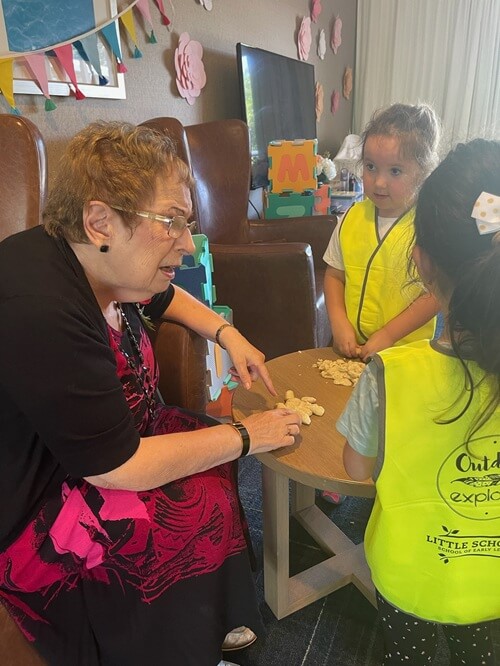
“The children are loving the visits so far,” according to Amy, campus manager for Little Scholars Parkwood. “They have developed some beautiful relationships with some of the residents and regularly discuss throughout the week their experiences with them.
“After week two, the children knew their grandfriends by name and were buzzing with excitement to see them again, which I think shows just how beautiful incorporating an intergenerational program can be!”
Professor Fitzgerald says programs like intergenerational ones further support the old proverb that it takes a village to raise a child.
“This research has the potential to make a huge impact on society, reconnecting the young and old,” she says.
“It is not just their eyes that lit up, but also their brain. There is nothing more satisfying than seeing older adults and young people connect for mutual benefit. So exciting to see how hearts are filled with joy.”
“I’m proud Little Scholars has the opportunity to assist in important research that looks at the benefits to both the young and the young-at-heart. Our little scholars are in the most important years of their life when it comes to brain development, and the lessons they learn from their grandfriends they can carry with them their entire lives,” says Jae Fraser, founder of Little Scholars.
Intergenerational relationships is something Jae is passionate about, and it’s been part of Little Scholars nearly since its inception 10 years ago.
“We’re honoured Griffith University researchers contacted us as leaders in the early education field, and we’re thrilled so many of our Little Scholars families jumped at the chance to participate. I can’t wait to see the results of this study when it concludes, and I hope it further highlights the proven positive impact of these relationships, showing how they enrich the lives of both children and older adults.”
Early childhood education has far-reaching benefits, not just for children, but for society as a whole. By investing in the early years, we create a foundation that supports the well-being of families, strengthens communities, and drives economic growth.
Here’s why:
It creates a happier and healthier workforce. Early education supports parents, reducing absenteeism and turnover by improving overall wellbeing and mental health. This leads to a more stable and productive workforce.
It establishes a future-ready workforce. Children who receive early education develop crucial social and emotional skills, preparing them to handle future complexities and challenges.
There are huge economic benefits. Early childhood education contributes significantly to the economy. It generates $313M in immediate tax revenue and an additional $495M in future tax revenue. This is because parents of children in early education can work more, and these children grow up to earn higher qualifications and wages.
It actually has the potential to reduce public spending. How? There’s a $1,194M reduction in health, welfare, and crime costs. Early education leads to lower rates of obesity and smoking, more people entering the workforce, and fewer involved in the justice system.
It can increase household Incomes. While costs are incurred in childcare fees, overall families benefit significantly, with household incomes increasing by $1,463M. Many parents can work more hours or re-enter the workforce thanks to early childhood education.
It enhances lifetime earnings. Early education boosts lifetime earnings by $997M due to higher academic achievement and qualifications.
It leads to healthier lives! Each year, 8,500 children are less likely to face obesity-related health issues, 2,300 are less likely to become smokers, and 763 are less likely to be incarcerated as adults.
It improves productivity. There’s a $319M increase in productivity from a more educated workforce. Additionally, 4,000 fewer children drop out of school each year because early education provides them with the foundational skills they need to succeed, and often leads to a lifetime love of learning.
These benefits underscore the critical importance of early childhood education for everyone. Investing in our youngest learners is an investment in our future.
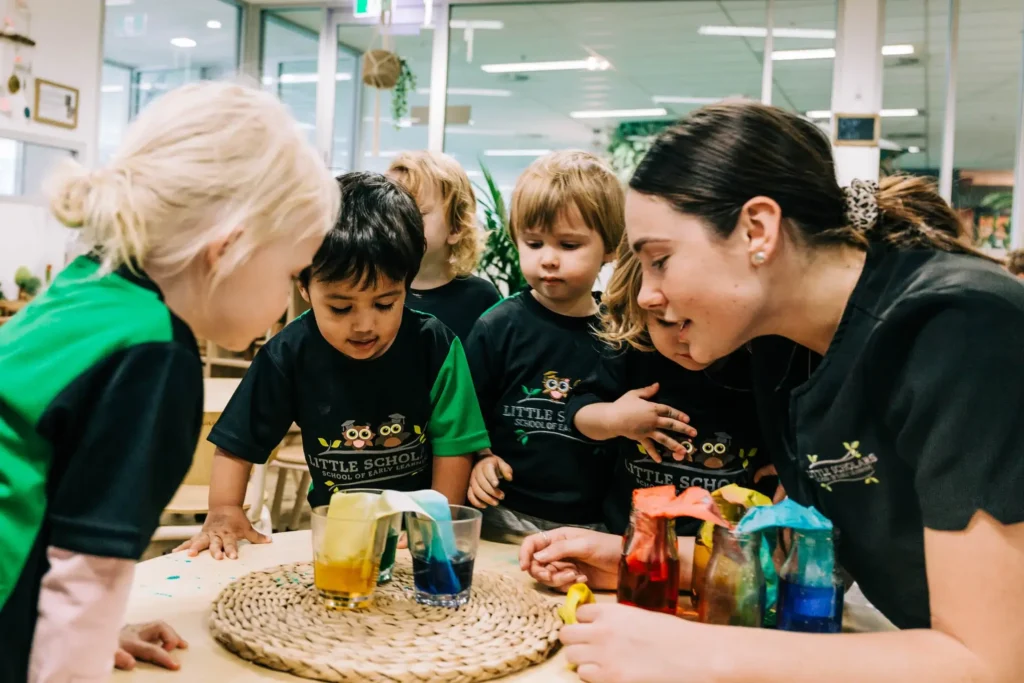
At Little Scholars, we are committed to supporting not just the incredible children we have the privilege of educating, but their families.
Through initiatives like our Family Time program, which includes haircuts, quarterly date nights, take-home meals for the children and parents. We also arrange specialist appointments on-site which include optometrist, podiatrist, speech pathologist visits, dentist, and child health nurse appointments.
We believe that by nurturing these relationships and providing high-quality early education, we can help create a brighter future for all.
Book a tour today to see firsthand how Little Scholars can support your family. Visit www.mylittlescholars.com.au to learn more.
While it feels increasingly common, when the news cycle often brings unsettling stories into our homes, it can be tough for parents to find the right approach to discuss such events with their young ones, or even know if they should. Here we share some thoughtful strategies to help you navigate these challenging conversations, ensuring you, and your little ones, feel secure and supported.
How to navigate this news with the family can depend heavily on the age and maturity of the members.
During a time in which the news may make us feel defeated and deflated, or fearful and stressed, we hope we can support parents in addressing global events sensitively and thoughtfully, especially important given that young children are always looking and listening.
Young children’s exposure to news should be limited, according to experts. This can be done by turning off the TV during news broadcasts and restricting children’s access to your social media channels to shield them from disturbing images. It’s also advisable to limit discussions about frightening events around young children, saving such conversations for after they’ve gone to bed. While some exposures may be unavoidable, these steps help protect your little ones from unnecessary distress.
For small children, they may not be able to verbalise their feelings, so in times of stress, or if you think your child may know what’s going on in the news, be attuned to any changes in mood or behaviour. These changes in your child could include:
Start by gauging what your little ones already know about a current event. For school-age children, inquire about their knowledge from school or social media. It’s important to consider the developmental stage of your child, as younger ones may struggle to distinguish fact from fantasy, typically gaining this ability around the ages of seven or eight years.
If your child shows disinterest or reluctance to discuss the event, respect their feelings and try avoid repeatedly pressing them further, but remind them you’re always there to listen or even just when they need to cuddle.
Be present for your child and prepared for questions. When addressing questions from children, it’s important to be honest yet selective about the details you share. Aim to alleviate fears and provide reassurance to your little ones because you’re their safe place. Listen attentively to their concerns, especially after distressing news events. Address any fears about personal safety by being present during this time and don’t dismiss your children’s fears and concerns.
It’s perfectly acceptable to admit if you don’t know an answer; take it as an opportunity to explore the answer together using age-appropriate resources.
Meanwhile, keep monitoring what your child is watching and limit repeated exposure to potentially distressing news, as the repeated exposure during these 24-hour news cycles can drive a child to dwell on what they’ve seen and heard.
Some adults may remember American children’s TV star from the 1970s and 80s Fred Rogers, who once shared advice that still could be applied today. He said, “When I was a boy and I would see scary things in the news, my mother would say to me, ‘look for the helpers. You will always find people who are helping.’” If children hear about a car accident, talk about the brave bystanders and paramedics who quickly arrive on the scene. If they hear about war abroad, you could about all the ways people come together to help those in need – providing aid, opening their homes, and raising money. This could and should segue into a conversation about how as a family you could help people who’ve experienced adversity or traumatic situations, like a house fire or homelessness.
Appropriate age-language is important here, because young brains just aren’t developed enough to understand some of the harsh realities of the human experience. Even something simple like using the verb ‘hurt’ rather than killed, murdered, stabbed, etc all of which are verbs that could scar young children.
Sarah Bergman, a psychotherapist with Counselling on the Coast, says parents should also be aware of their own conversations, actions and moods, because children can be very attuned to their parents. She agrees that if parents are noticing changes in their children, they should provide a little extra care and attention, but says they should mindful of giving over-the-top anxious attention as this can further little ones’ worries.
“It may just be that parents provide more presence to their little ones at this time, allowing opportunities for anything that needs to emerge and it may just be a little bit longer snuggle at bedtime, where they integrate a felt sense of warmth and safety, that all is ok in their little worlds with mum and dad as their protector,” Sarah suggests.
Finally, if you’re concerned about your child, this is a conversation to have with early childhood educators and your Little Scholars campus manager. We’re on your family’s team, so please tell them about any behavioural changes you’ve noticed, what you’ve done at home and what your wishes are for while they’re in childcare.
Our educators have been trained in trauma response and can even offer insight into your child or suggestions on how to further navigate the difficult feelings they may be experiencing.
Disasters, the media and your child
We hear a lot about how important the first five years are for children’s brain development, and it’s a time when children’s curiosity is at a lifetime high, so it’s the perfect time to embrace their curious minds by extending these interests and keeping those little minds active and absorbed, and a new study out of Queensland explores this in further detail.
Griffith University researchers recently concluded a three-year study investigating the progression of curiosity into enduring interests and its role in fostering a continuous learning culture. The study involved 57 children aged four to five from south east Queensland, participating in two-week enrichment programs covering 15 diverse topics. This research sheds light on the developmental journey of young children as they cultivate interest in various subjects.
This research looked into how young children start to take an interest in different subjects and how this interest affects their learning. The study aimed to find out the best ways to spark interest in children, how interest fits into their learning, and what effects it has.
To tackle this, the study, led by Ellie Christoffina van Aswegen, introduced special programs filled with topics aimed at getting children excited about learning. These programs included a variety of subjects not typically taught to young children but are essential for a well-rounded education. This approach is based on the idea that children should be exposed to a wide range of knowledge to help them understand new information better and build on what they already know.
The chosen subjects ranged from plants and animals to famous artworks and space exploration, divided into three sets. The first set included topics like reptiles and continents; the second set covered the human body and insects; and the third set introduced children to religions and dinosaurs, among others. These topics were selected to broaden the children’s knowledge and provide a solid foundation for further learning.
The enrichment programs were delivered with a mixed approach of direct instruction, explicit instruction, play-based learning, group reading, and take-home activity booklets.
The underlying principle of the study was that a broad knowledge base is crucial for children’s learning because it helps them connect new information with what they already know, making it easier for them to understand and learn new things.
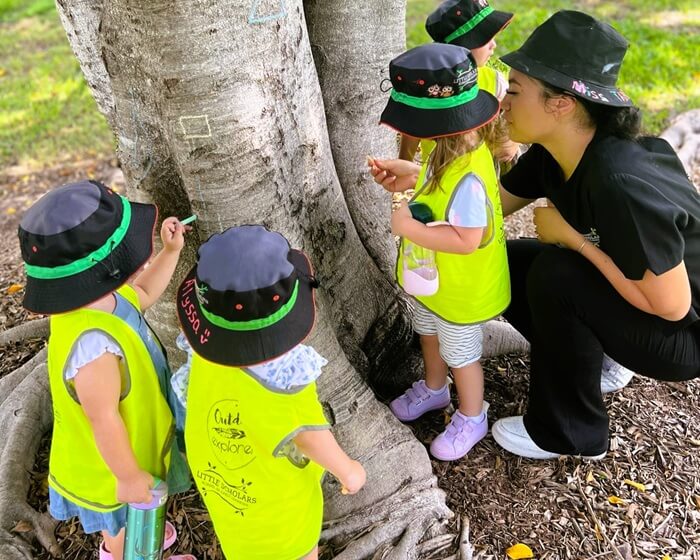
The study reviews the nuanced distinction between curiosity and interest in children, drawing on insights from Renninger and Hidi. It suggests that curiosity is the spark ignited by a specific question, a momentary engagement, as Dewey describes, that captures a child’s attention briefly. In contrast, interest is portrayed as a deeper, more sustained engagement with a subject, driven by a desire to gather extensive information and maintain engagement over time.
The research looks into the dynamics of how curiosity evolves into interest. Initially, a child’s curiosity prompts a flurry of questions about a topic. This questioning phase deepens their interest as they uncover new knowledge, fueling a continuous cycle of inquiry and discovery. Interest is described as encompassing three interconnected facets: actions, thoughts, and emotions. Together, these elements foster a rich learning environment in early childhood, where knowledge acquisition is intertwined with emotional engagement.
Researchers highlight the critical role of emotional connections and perceived competence in sustaining interest. When children develop a strong emotional attachment to a topic, their eagerness to explore and learn intensifies. Similarly, feeling adept in a certain area enhances their interest, propelling them to pursue further learning.

One example mentioned in the study was building on children’s interests of flowers. Educators led a two-minute activity during which the children pretended to be flowers. Two children showed some disengagement towards the end of the activity. Comments made by the researcher and thoughts on possible reasons for disengagement were included in notes. Each component of the session was similarly identified and analysed providing a snapshot of engagement during the session.
Before and after participating in a two-week program focused on flowers, children’s knowledge about flowers and their parts, such as stems, leaves, and roots, was evaluated. Initially, although all children were familiar with the concept of a flower, many lacked knowledge of its basic parts. However, by the end of the program, there was a significant increase in the number of children who could accurately illustrate these parts on a flower diagram. For instance, the ability to draw a stem improved from three to 17 children.
Similarly, the program enhanced children’s recognition of different types of flowers. Prior to the program, only a few children could name any flowers. Following the program, a substantial improvement was noted in their ability to identify common flowers like roses and dandelions. For example, the number of children identifying a rose increased from two to 16.
Observations of the children’s play and interactions during the program indicated a deep engagement with the topic of flowers. Activities ranged from drawing and painting flowers to hands-on exploration and pretend gardening activities. This engagement suggested a high level of cognitive involvement with the flower program.
The researchers observed data on the behavioural and emotive component of interest through video, notes, and feedback provided by both the early childhood teacher and the classroom educators.
Feedback from parents provided through a post-program questionnaire offered additional insights into the children’s growing interest in flowers. Parents reported behaviors indicating an increased awareness and curiosity about flowers in their environment, such as noticing or wanting to pick flowers. This parental feedback supported the observations made during the program, confirming a heightened interest and engagement with the subject of flowers among the children.
The researchers concluded that social interaction was key to developing interest. Social interaction, between teacher and child, their peers and at home, formed the basis of developing interest in the various topics of the enrichment program.
Each component of the program was delivered through images, interesting facts, stories, music, and drama. Researchers found engagement increased as the teacher showed more enthusiasm and modelled curiosity. The study noted that it became clear that the teacher didn’t know all the answers to children’s questions as their interest took them in a variety of directions, and the teacher became a learning partner motivated to research the topic further. The children also motivated each other to learn more, creating art, playing games, bouncing ideas off each other, solving problems and exploring nature together. Familial involvement was identified as another factor impacting curiosity and interest development in a positive way, such as parents working with children to collect or observe flowers or plants in nature to support their learning and working on take-home activity books together. The children brought in their completed take-home activity booklets, to share with the class as well as any ‘treasures’ they had found such as a feather, a flower, a leaf, etc. which stimulated conversation.
The study also examined how children emotionally connected with different subjects, aiming to spark feelings of wonder and awe. This approach occasionally led to feelings of empathy and compassion, or simply brought about joy and delight. Certain subjects allowed children to marvel at the wonders of nature, feel empathy towards animals, or experience the simple pleasure of discovering delightful things.
The study did not shy away from challenging emotions, such as the sadness children felt watching a whale get untangled from fishing nets. Children were provided a supportive environment to discuss their feelings, helping them expand their emotional vocabulary. This is important because understanding different emotions can assist children in managing their feelings better, as they learn various strategies for emotional regulation. Additionally, engaging in music, art, drama (role-play), and free play allowed children to further process their emotions, aiding their emotional growth.
The research also revealed a strong connection between emotional and cognitive engagement. Children became more inquisitive and sought additional information on topics that touched them emotionally.
At Little Scholars, our educational program, The Collective, is based on the premise that children are most successful at learning when curriculum experiences account for children’s interests, strengths, and individual needs. The Collective encompass all aspects of Little Scholars, including a collaborative approach with our children, families, educators, and community.
Our weekly programs, which can be seen in our studios, are responsive to the evolving interests and needs of the children and allow for flexibility and extended periods of play and research to test theories.
Renninger, K.A., & Hidi, S. (2017). The Power of Interest for Motivation and Engagement (1st ed.). Routledge. https://doi.org/10.4324/9781315771045
Harackiewicz, Judith M., Jessi L. Smith, and Stacy J. Priniski. (2016) Interest matters: The importance of promoting interest in education. https://journals.sagepub.com/doi/10.1177/2372732216655542
Babies are not born knowing how to control their emotions, nor are adults necessarily well-versed in how to regulate their emotions, even after decades experiencing them. While modern society is making way and space for people to feel and name emotions such as sadness, anxiety, anger, embarrassment, stress and more, some of us hadn’t learned how to allow ourselves to be vulnerable and express these emotions in a healthy way.
At Little Scholars, emotional regulation skills are as important as every other lesson children learn during their time with us. We’re hoping to break generations of cycles of mental health stigmas by teaching children to name and work through their emotions, but we also recognise this must happen at home, on the sports field, and anywhere else they may need to have access to a range of tools to cope and work through tough situations and feelings.
As parents and caregivers, we understand that not all of us were raised with the emotional intelligence to guide a young person in developing theirs. There’s also the possibility that children in our care have experienced more traumatic or negative experiences than we’ve had to deal with, so it might be something we don’t know yet how to navigate. More on that later.
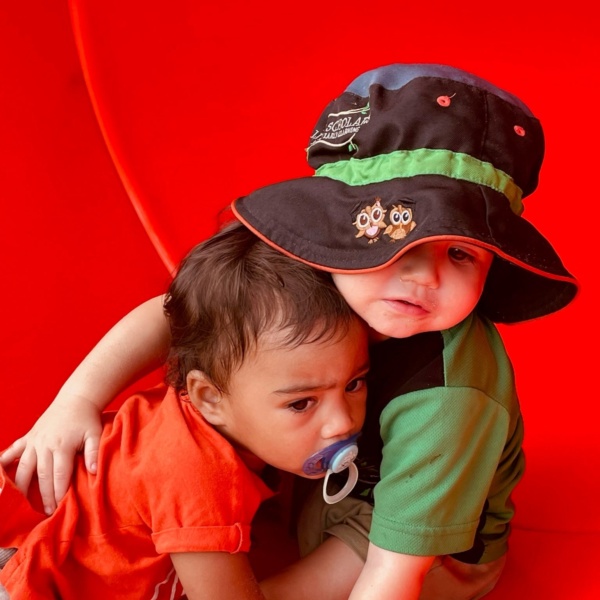
When emotional states are high, it’s helpful to recognise the behaviours we see, and the emotional states we may not see.
The behaviours can be aggression, screaming, crying, avoidance, refusal, hiding, running, threatening and loss of self-control, for example.
What we may not be seeing in our children are feelings of: nervousness, exhaustion, guilt, fear, disappointment, overwhelmed, anger, rejected, embarrassed, judged, unloved, depressed, anxious, worried, shame, disrespected, helplessness, offended, sad, and attacked, amongst other feelings.
When a child is displaying any of the above behaviours, what do you think the feeling behind it could be?
1. Stay tuned and recognise signs – Keep a close eye on behavioural cues that indicate your child is experiencing strong or challenging emotions. Be aware of these signals when they arise. Of course, the strength of the emotion is normal, it’s how they deal with it that’s important. This is a step in which you’re helping to create a safe haven for the child, one of trust and acceptance. For the adult, this is recognising and understanding that all emotions are natural and normal.
2. Turn challenges into teaching moments – See difficult situations as opportunities to connect with your child and help them learn valuable emotional regulation skills. Helping children to label their emotion encourages the regulatory process to engage and reconnect the thinking brain with their limbic system. In other words, name it to tame it!
3. Listen with empathy and validate their feelings – Before reacting with discipline, keep in mind the phrases ‘Connect before you correct‘ and ‘Stay calm and curious, not quick to anger.’ Ask open-ended questions to help your child identify and express their emotions, like “I noticed you seem to be feeling ___. Could it be that you’re feeling ___?’ or ‘I’m sorry that happened to you, you must be feeling very ___’
4. Establish boundaries – Clearly communicate expectations for behaviour, reinforcing positive actions such as using kind words and explaining consequences for inappropriate behaviour like hitting. Setting these boundaries helps maintain safety of the child and those around her/him. It’s important not to make the child feel shame, and ensure the child maintains self-dignity. ‘It’s ok to feel like that, but it’s not ok to behave like that’ or ‘we don’t deal with our emotions by ___’
5. Problem-solve together – Encourage your child to brainstorm possible solutions or strategies to improve future outcomes. Provide support tailored to their age and comprehension level, using visual aids or suggesting choices when helpful. So to restore and repair, you might explore the situation first: ‘how were you feeling when that happened?’ and ‘have you felt that way before?’ then show your child you’re in this together brainstorming ‘let’s think of what you could have done instead’ or ‘can you think of two more ways you can deal with your feelings?’ the work together to come up with solutions ‘let’s decide what you will do next time you feel like this’ or ‘do you think that ____ would be more helpful next time?’
How trauma can influence behaviour in children
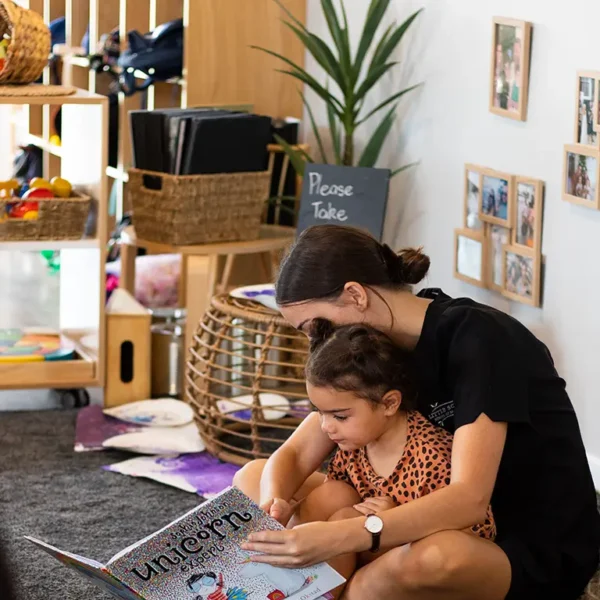
Zoe Lowe is a teacher and mentor who guides educators and parents through early education, behavioural support and trauma-informed practices. She recently spoke to Little Scholars educators at our annual Learning & Development Day.
Her talk helped our educators understand trauma-informed practice, how to recognise the different types of trauma people can experience, and how to work with children who might have experiences of trauma. In Australia, upwards of 5 million adults are affected by childhood trauma.
The types of trauma include:
· Simple trauma, which stems from often a single incident that was life threatening or have the potential to cause serious injury.
· Complex trauma involves interpersonal threat, violence and violation, in contrast to simple trauma, complex trauma involves multiple incidents and is therefore longer in duration.
· Developmental trauma is used to describe the impact of early, repeated trauma and loss which happens within a child’s important relationships, generally early in life.
Children who have experienced any of these traumas can be affected in many ways in their development, she says, because their mental capacity to learn may be eclipsed by having to cope with these negative circumstances.
“This is correlated with developmental trauma,” Zoe says. “Surviving the situation. So [a child’s] survival system becomes overdeveloped. Everything else is underdeveloped.”
“What also happens with trauma, the hippocampus, the part of the brain that’s responsible for your memory [learning and emotion] and the ability to differentiate between the past and the present. So, with persistent exposure to trauma, it can shrink in size, so it won’t pull on what it can to differentiate between the past and present, which is why our past experiences can have such a profound impact on us, even if we’re no longer in danger,” Zoe continues.
So why does this matter?
Because trauma can present itself in many ways in children. Perhaps they’re tired all the time, they startle easily, children who perceive educators or other trusted adults as angry and perceiving them as authoritarians with whom they can’t connect or feel safe, struggling to understand concepts easily, not coping well with transitions, friendship issues, over or under-eating, and, aggression.
However, she says, trauma can explain the behaviour, but it does not excuse the behaviour.
And these symptoms that can present in children may not necessarily be trauma, so Zoe warns not to be quick to diagnose children.
Whether the child has experienced an adverse life event or not, if there’s a behaviour exhibited that we don’t want to see, Zoe says this is where we question what’s behind the behaviour, and find out what a child might need to cease the behaviour.
“As educators, we are going to make a paradigm shift. We’re moving away from ‘what is wrong with you?’ to ‘what happened to you? What is this behaviour that I am seeing right now communicating to me? What need is needing to be met by me?’ says Zoe.
This shift also helps adults calm down and regulate their own reactions to the behaviour in question.
“We expect children to self-regulate, they can’t. They need co-regulation, we need to be with them, supporting them, holding space for them, and teaching them how to regulate.”
While children may not be born knowing how to regulate their emotions, at Little Scholars, we believe they deserve a safe space to learn and grow. We understand that emotional regulation skills are crucial for all aspects of life, and we’re committed to working alongside parents and caregivers to build a supportive community where every child feels empowered to express themselves healthily.
Our educators are extensively trained in recognising emotional cues and guiding children through challenging situations. We encourage you to stay tuned for further resources, and remember, you’re not alone, we’re here to support your child, your family and our greater community in creating a generation equipped with the emotional intelligence to navigate life’s ups and downs with confidence and compassion.
We’re sure approximately 96.3 per cent of parents deal with a child who, let’s say, is choosey about what they want to eat. So choosey, in fact, they may choose to eat almost nothing you put in front of them. The amount of stress that puts on parents can be surprisingly strong. After all, as adults, we eat what we want, we understand benefits and consequences of what we put in our bodies, we understand when we’re famished and when we’re just not that hungry. But for some reason, when it comes to the little humans we’ve created, their diet can become a massive focus of parenting-what-did-we-do-wrong. You want so badly to make all the right decisions in parenting, to ensure your child is well-fed from a variety of nutritious sources so they can grow to be the healthiest, best version of themselves.
So how do we handle this picky phase – (though the term phase suggests it’s a short period of time when in fact it can be years or even a lifetime of challenging food preferences)?
We brought the village together and came up with some suggestions to ease the stress mealtime puts on everyone.
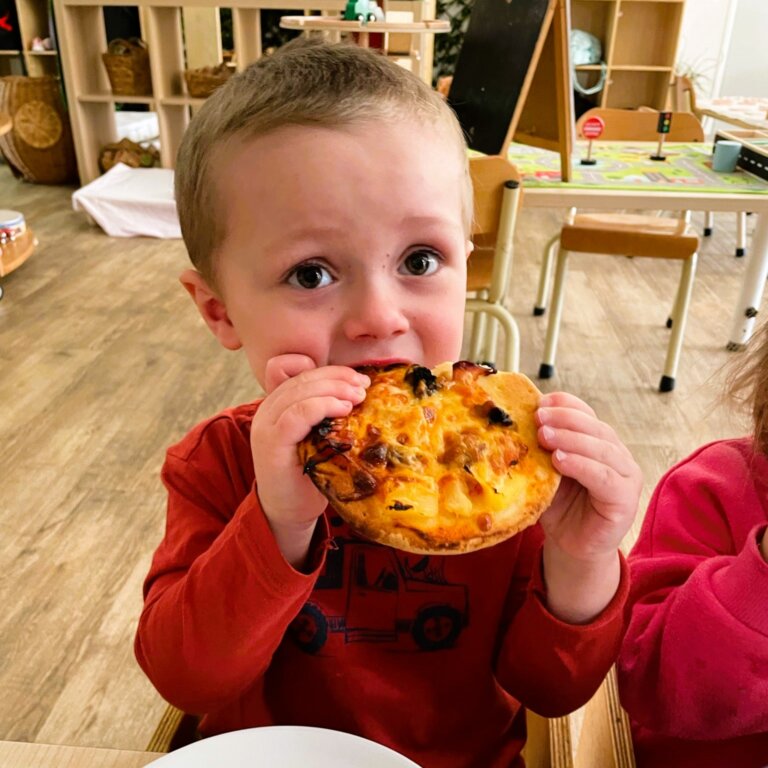

19. If you have the creativity and the time, present the food into characters, scenes or animals your child likes. Search for ideas on Pinterest or Instagram!
20. Don’t answer the question ‘what’s for dinner’. Come up with a silly answer such as “bugs and onions”, or something obvious ‘food’, but don’t give them time to dread dinner.
21. In Piaget’s developmental stages, there’s a phase known as the preoperational stage, where a child’s understanding of conservation is still developing. For example, if you pour juice from a short, wide glass into a tall, narrow one, they might believe the tall glass contains more juice because it looks “bigger,” even when they see the pouring happen. This concept can be cleverly applied to serving vegetables to children. By arranging the veggies closer together, they seem “smaller” to the child, giving the impression that they’re eating less. Conversely, spreading out items like chicken nuggets can create the illusion of a larger portion, making mealtime a bit more appealing to them
22. Everyone at the table eats the same meal, but try to include one item everyone likes. No alternatives, or if you have to, make the alternative something like veggie sticks and hummus. Eating together as a family is also a great way to bond and create lasting memories.
23. The one-bite rule: say something like, “Remember the time you didn’t think you’d like cherries, but you did? Let’s try this sweet potato now, because you might like it. Once you try it you can say, “No thank you!” but you have to at least try it! Then that food is no thank you food.”
24. The ‘silver bowl snack’ to expand their palate, one tiny taste at a time. If your child doesn’t like something, say something like, “well your tastebuds must not be grown up enough for that yet, let’s see what happens next time you try it.” Since children often want to be more “grown up” they may willingly try the offending food again the next time it was offered. If the child decides to try it, make a big deal about how grown up your child is getting.
25. Keep pre-cut vegetables and fruits in a bowl or clear Tupperware container, front and centre in the fridge and — important — then place some on a platter on the kitchen counter in your child’s line of vision all afternoon.
26. Do your children like mashed potatoes? Get more veggies in there! If the mashed potatoes turn green? Well, they’re Hulk potatoes obviously. Are they orange? Then they’re Nemo or insert-your-child’s-favourite-orange-character-here.
27. “We get our children to pick a meal they want to eat for dinner for the week and we buy the ingredients then they all get a night to cook dinner for us, makes them interested in wanting to eat the meal they make for us, and they need to choose something with a minimum of two veggies.” Jess, enrolments officer.
28. Sprinkles also go a long way. Yes, actual sprinkles, or foods that they can shake on like sprinkles. Think seasonings, herbs and chia seeds. If a child doesn’t like the food presented, ask what you can add to make it more exciting. And let them do the sprinkling. Sometimes, it really is as simple as that.
29. While it’s easy to use a smartphone or TV to occupy your child’s attention and you might even see your child mindlessly eat, that’s actually not what you want. You want children to be focused on the food, but also focused on family time and conversation.
30. Relax! Try not to put pressure on them to eat. You wouldn’t want someone constantly commenting on your plate choices and habits. Mel, operations manager of Little Scholars, said her son has been picky since he was two years old. When she spoke to a nutritionist, she said “as long as he was eating 20-25 different foods throughout the week he would be OK.” While it can feel stressful, your child is likely getting the nutrients they need, whether you’re offering fresh, frozen, tinned foods, you’re trying your best, your child is flourishing, and one day, this will just be a memory!
Let us hold your hand and help looking for a child care centre. Leave your details with us and we’ll be in contact to arrange a time for a ‘Campus Tour’ and we will answer any questions you might have!
"*" indicates required fields
Let us hold your hand and help looking for a child care centre. Leave your details with us and we’ll be in contact to arrange a time for a ‘Campus Tour’ and we will answer any questions you might have!
"*" indicates required fields
Fill in the form to join your local Pram Pals mums and bubs walk