









Preparing to welcome your baby is an exciting journey. While there’s so much to plan, joining a childcare waitlist early for premium centres like Little Scholars School of Early Learning is one important step many expectant mothers overlook. High-quality childcare spots fill up quickly, so registering your interest early for your baby’s place means peace of mind and may result in more choice when it comes time to start care. 

Why You Should Join Waitlists Early

With demand high for premium childcare centres, families often join waitlists during pregnancy to avoid long waits and limited options after birth. Getting on the waitlist early means you may have greater flexibility with start dates and days, helping you plan your return to work or lifestyle with confidence. 

Important note: Joining a waitlist does not guarantee a childcare spot. It simply registers your interest and puts your child on a list to be considered when a position becomes available. The guarantee depends on factors such as the centre’s capacity, educator-to-child ratios, and demand in your area. 

When Should You Join a Childcare Waitlist

The safest time is as early as possible — for many families, this means during pregnancy or shortly after birth. Infant and toddler spaces are often the hardest to secure in high-demand locations. Here’s a general guide: 

  • Pregnancy or birth: Ideal for high-demand centres like Little Scholars. 
  • 6–12 months before care is needed: If you’re planning your return to work or study, this is a good window to apply. 
  • At least 6 months in advance: Even in less competitive suburbs, giving yourself a buffer can make a big difference. 

What Affects Wait Times?

Wait times may depend on several factors, including: 

  • Location demand: Centres located within highly populated suburbs or major transport hubs tend to fill faster. 
  • Age of your child: Infant and toddler ratios are lower, so these rooms usually fill quickest. 
  • Centre reputation: Highly rated centres with excellent programs usually have longer waitlists.  
  • Sibling priority: Centres often prioritise families with siblings already attending. 

What Makes Our Nursery Program Unique?

At Little Scholars, our nursery program feels like a home away from home, offering: 

  • Qualified, loving educators who specialise in infant care and development. 
  • Individualised routines that follow your baby’s sleeping, feeding, and play patterns. 
  • Strong parent communication ensuring daily updates keep you connected. 

How Early Waitlist Registration May Benefit Your Family

  • More choices and flexibility in scheduling. 
  • Less stress knowing your interest is registered at your centre of choice.  
  • Opportunities to tour and meet educators before your baby arrive. 

At Little Scholars, we believe every child deserves the best start, and every parent deserves peace of mind. Registering your child on our waitlist early ensures your family is considered when a place becomes available, helping you plan with confidence.  

The safety and wellbeing of every child is the highest priority. This checklist will help you ask the right questions, know what to look for during centre visits, and support your child’s personal and emotional safety to ensure your chosen childcare centre offers a safe, nurturing experience for your little one. 

Questions to Ask Prospective Childcare Centres

Security & Access:

Is the centre secure?

Ask about sign-in/out procedures and entry controls. For example, does the centre use PIN-coded entry or other systems to ensure only authorized caregivers can pick up your child? A quality centre will have strict protocols like secure doors/gates and verified pick-up.  

At Little Scholars, safety is paramount – all centres are PIN-access only, and only pre-authorised parents/guardians can drop off and collect children.  

Hygiene & Illness Policies:

What are your hygiene practices and sick child policies?

Inquire how often toys, surfaces, and bathrooms are cleaned and how educators promote handwashing for children. Also ask about policies for managing illness (e.g. when children are sent home with fevers and how illness outbreaks are communicated). Top centres maintain rigorous cleanliness routines – e.g. frequent handwashing, sanitising of toys and surfaces, and proactive illness prevention measures to keep everyone healthy.

Supervision & Staffing:

How do you ensure proper supervision and ratios?

Verify that the centre meets or exceeds the legal educator-to-child ratios at all times, and ask how they maintain active supervision. Educators should be actively engaged, not just present – meaning they are constantly watching, listening and interacting with children to anticipate and prevent issues.  

Quality providers follow the National Quality Framework (NQF) requirements for ratios and often position staff strategically (indoors and outdoors) so every child is visible and supported. Little Scholars, for instance, adheres to NQF educator-to-child ratios at all times to ensure attentive care. 

Educator Training & Child Protection:

What are your staff vetting and child protection practices?

Ask if all staff (including assistants, casuals and volunteers) are trained in child protection and mandatory reporting of any harm. A reputable centre should have a formal child protection policy (ideally accessible on their website) and regularly train staff to recognize and respond to signs of abuse or neglect. Inquire about staff background checks beyond the mandatory Working With Children Check – for example, do they conduct thorough reference checks and ongoing screening to ensure only suitable people work with kids? Also ask if the centre has policies to prevent one-on-one isolated interactions.

Finally, find out if there is a designated Child Safety Officer or contact person whom children, staff or parents can approach with concerns – this shows the centre takes child protection seriously.

Emergency Procedures & First Aid:

How do you handle emergencies and accidents?

A good centre should have clear emergency response plans (for fires, evacuations, lockdowns, etc.) and conduct regular drills. Ask how often they practice fire/evacuation drills and how they make these drills child-friendly (some centres use mascots or games to teach emergency routines in a non-scary way). Verify that multiple staff members are certified in first aid, CPR, and anaphylaxis management at all times, and ask about the procedure if a child is injured or unwell (Do they have first aid kits readily available? Will they call you immediately? How do they record and report incidents?).

Health (Allergies & Medical Needs):

How do you manage children’s health needs, like allergies or medications?

If your child has any allergy, asthma or other medical condition, ask what precautions and protocols the centre has. Do they have individual medical management plans and risk minimisation strategies for each child with allergies/medical needs? Leading centres use tools like allergy-aware placemats or ID cards and work with families to create detailed care plans (including emergency action plans for allergic reactions). You should also ask about food safety: is the centre nut-free or egg-free if needed? Knowing that a centre takes nutrition and allergies seriously – with strict food safety guidelines and clear communication about dietary needs – will give you peace of mind.  

Emotional Wellbeing & Guidance:

How do educators support children’s emotional safety and behaviour?

Ask about the centre’s approach to guidance and discipline.. For example, how do they comfort a distressed child or handle biting, tantrums or conflict between kids? Listen for answers that highlight emotional support and redirection. Caregivers should be attuned to each child’s feelings – trained to spot signs of anxiety, tiredness or frustration – and respond with care. It’s a good sign if the centre mentions nurturing each child’s sense of belonging and having strategies for helping children feel secure (such as key educators for each child, cozy quiet areas for children to retreat to, etc.). Also, ask if they have programs or curriculum aspects that build children’s social and emotional skills. An environment where children are treated with respect and their feelings are acknowledged is crucial for emotional safety. 

Cleanliness & Safety of Environment:

How do you maintain a safe physical environment?

Inquire about how often the facilities and equipment are inspected or maintained. Does the centre conduct regular safety audits or daily hazard checks on playgrounds and classrooms? A great centre will have a schedule for routine cleaning and safety inspections. Also consider asking about sun safety policies – in Australia, centres should have a SunSmart policy (e.g. requiring hats and sunscreen for outdoor play and providing shaded areas). A diligent centre will be proud to discuss their procedures for things like safe sleep (for babies), sun protection, and general workplace health and safety compliance. 

Things to Observe During Childcare Centre Visits

When you tour a prospective childcare centre, use your eyes and instincts. Here are key safety indicators to look for on your visit: 

Clean, Hygienic Facilities:

Check that the centre looks and smells clean. Floors, surfaces, toys, and bathrooms should be well-maintained and sanitary. Look for evidence of regular cleaning – e.g. educators wiping down tables, a clean nappy-changing area (with gloves and sanitiser), and children being guided to wash hands (especially after toileting or before meals). A centre that prioritises hygiene will have protocols visibly in action (like frequent handwashing and toy sanitisation) to reduce germs. Trust your nose – a fresh, clean environment (with proper diaper disposal and ventilation) indicates good hygiene practices. 

Educator–Child Interactions:

Pay attention to how staff interact with the children in their care. Are the educators warm, attentive, and engaged on the children’s level? You should see caregivers who are actively involved in activities – chatting with kids, comforting them as needed, and actively supervising. Look for active supervision – educators scanning the room and playground, frequently counting children, and positioning themselves so they can see all kids. Positive, caring interactions (smiles, gentle tones, educators down at eye level with kids) also foster an emotionally safe atmosphere for your child.

Happy, Well-Cared-for Children:

The children at the centre should appear happy and comfortable. During your visit, note the children’s mood and engagement: are most kids actively playing or calmly involved in activities? It’s normal to see an upset child occasionally, but in a quality centre educators will address it promptly with comfort. If you see lots of crying or distressed children without comfort, that’s a concern. Ideally, you’ll get the sense that children are enjoying their day and are well cared for – smiling, laughing, or focused on play, with educators close by for support. A cheerful, relaxed vibe among the children is a great sign.

Cleanliness & Safety of Play Areas:

 As you tour, inspect the classrooms and playground for potential safety hazards. Cleanliness is one aspect, but also check safety details: are play equipment and toys in good repair? Are there child-safe features like socket covers, secure baby gates on stairs, and locked cupboards for chemicals? In the outdoor area, look for soft-fall surfaces under climbing equipment, sturdy fencing around the perimeter, and shade covers or trees for sun protection. If you can, note whether emergency information (like evacuation plans and fire extinguishers) is visible – many centres post evacuation diagrams in each room. These little details show that the centre proactively maintains a safe environment for children to explore. 

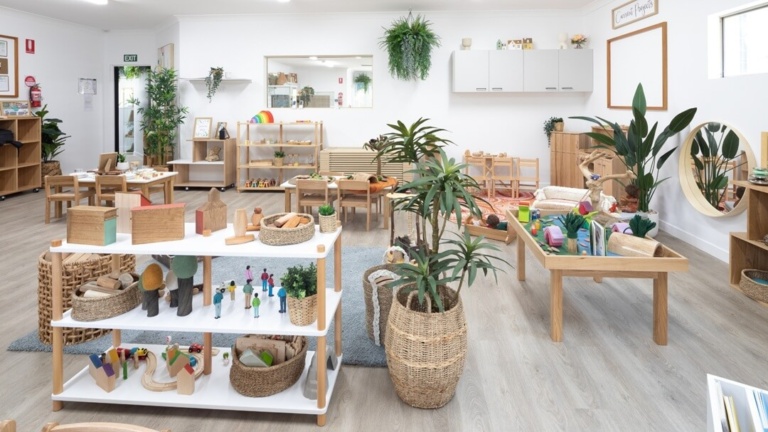
Indoor Learning Environment At Little Scholars Childcare Campus
Staff Teamwork and Attentiveness:

Observe the staffing on the day – does it appear they have enough educators in each room, and are they attentive? You might do a quick headcount of children vs. staff in a room to see if it aligns with expected ratios for that age group. Beyond numbers, look at how the team operates: are they communicating with each other about supervision (for example, one says “I’m stepping away to grab more art supplies” and another covers? Are they on the move, scanning and engaging, rather than all clustered together? High-quality centres foster a culture of vigilant supervision – educators should look alert and involved. If you visit during a transition (like lunchtime or nap time), notice if routines seem calm and well-managed (this reflects good training and adequate staffing). A smoothly run classroom with attentive staff indicates your child will be well supervised and safe. 

Overall Atmosphere:

Trust your gut on the overall feel. A centre that is open, welcoming, and transparent with parents will make you feel at ease during the visit. Notice if the director or educators willingly discuss safety topics and proudly show you around every area. Do you see evidence of a positive culture, like children’s artwork on the walls, safety posters, or a friendly rapport between staff and families at pick-up time? Little things like educators greeting children at drop-off or reminding them “Hat on for outside, let’s be SunSmart!” show a caring, safety-conscious environment.

In short, you want to see that what the centre says about safety in their policies is truly happening day-to-day: clean and secure facilities, engaged and loving caregivers, and children who appear secure and happy 

(During your visit, consider bringing this checklist along. Many parents also find it helpful to take notes right after each tour, while impressions are fresh.) 

Tips to Help Your Child with Personal Safety and Emotional Security at Childcare

Choosing a great centre is only part of keeping your child safe – as parents, we also play a big role in preparing children with the skills and confidence they need. Here are some tips to empower your child and foster a sense of security as they start childcare: 

Teach and Reinforce Personal Safety Rules:

Even from toddler age, begin teaching your child simple personal safety concepts in a non-scary way. For example, Bravehearts recommends three “body safety” rules every child should know: 

  1. “We all have the right to feel safe with people.” – No one should make them feel unsafe or uncomfortable; 
  2. It’s OK to say ‘NO’ if you feel unsafe or unsure.” – They can refuse hugs, touches, or games that don’t feel right;
  3. “Nothing is so yucky that you can’t tell someone about it.” – Emphasize that they should always tell a trusted adult if anything or anyone makes them feel scared, yucky or confused, and they won’t get in trouble for speaking up.

By reinforcing these messages regularly, you help your child understand their rights and feel confident to assert themselves. Role-play scenarios with toys (“What if someone at childcare does something that makes you uncomfortable?”) and practice using strong voices to say “No, stop!” – make it a game so your child feels proud and powerful using their safety voice. 

Use Correct Names & Discuss Boundaries:

From as early as preschool age, teach your child the proper names for all their body parts, including private parts, and talk about body boundaries. This normalises their understanding and removes shame or secrecy. Let them know that their private parts are private – no one should touch them except perhaps a doctor or caregiver helping with hygiene, and even then, it should be only in appropriate ways. Explain that safe touches (like helping with a nappy change or a gentle check-up by a doctor – and only with permission) are different from unsafe touches (any touch meant to hurt or that makes them feel bad). Encourage them that it’s always okay to say “No” or move away if someone’s touch or play makes them uncomfortable, and to tell a teacher or tell you. Keeping these talks calm and factual (not scary) will help your child feel comfortable asking questions.

By having ongoing, open conversations, you empower your child to understand consent and know that they can always come to you with anything.

Identify “Safe People” and Encourage Open Communication:

Help your child know who their trusted adults are, both at childcare and at home. At Little Scholars, educators talk with children about identifying their “safe people” – those they can go to if they feel upset or unsafe. You can do this at home by explaining, “If you ever feel sad or scared at daycare, you can tell Miss Emily (for example) and they will help you. And you can always tell Mummy or Daddy anything when you get home.” Make it a habit each day to ask open-ended questions about their time at childcare. Listen calmly and attentively to whatever they share – this builds their confidence that they can talk to you about anything.

The goal is to ensure your child never feels like they have to keep a secret. Praise them for speaking up about their feelings, and reassure them that you and their educators are there to keep them safe. Creating this open channel early on increases the likelihood that your child will speak out if something is wrong.

Foster a Consistent Routine and Goodbye Ritual:

Young children feel safer when they know what to expect. You can help by establishing a predictable morning routine and a special goodbye ritual for drop-offs. For example, arrive with a few minutes to settle your child in, then do a consistent farewell (perhaps a hug, a high-five, or a “kiss and go” routine. Always say goodbye – as hard as it can be, avoid sneaking out when your child is distracted. A proper goodbye (even if it’s tearful) builds trust, because your child learns that you won’t disappear without warning and that you will come back. Educators also encourage this; they note that children handle separation better in the long run when they see you leave confidently after a loving goodbye. Over time, your little one will come to anticipate the routine and this consistency helps them feel in control and secure.

Use Comfort Items and Transitional Objects:

Check with your centre if your child can bring a comfort object from home, especially in the early weeks. A familiar lovey – like a favourite teddy, blanket, or even a family photo in their bag – can provide great emotional support during the day. Let your child know they can ask their teacher for their comfort item if they’re missing you. Many centres encourage this, as having a bit of “home” close by can soothe separation anxiety and help a child self-settle if they feel upset. Label the item with your child’s name and explain that it’s there whenever they need a hug or a reminder of home. Such comfort items often become a trusted buddy that helps your child feel safe in a new environment. 

Build a Positive Relationship with Educators:

Children take emotional cues from their parents. When they see you showing warmth and trust toward their educators, it boosts their own sense of security with those caregivers. Take a little time at drop-off or pick-up to greet and chat briefly with the staff (“Hello! How was her morning today?” or “He’s excited to show you his dinosaur shirt!”). If your child observes you smiling, sharing information and treating the teacher as a trusted friend, they’ll feel more comfortable in the educator’s care. This also models positive social interactions for your child. When your child sees that you and their carers are “on the same team,” it reinforces their confidence that they are in a safe place with grown-ups who care about them. 

Prepare Your Child for the Childcare Routine:

Help your little one know what to expect at childcare to reduce anxiety. You can role-play parts of the day – for example, pretend “school” at home: practice hanging up a backpack, singing a “hello” song, or taking turns with toys to mimic group play. Visit the centre’s orientation or “stay and play” sessions if offered, so your child can explore the new environment with you the first time. Reading books about starting daycare or looking at the centre’s photo boards of activities can also make the unknown more familiar.

The more your child knows the routine – snack, play, nap, etc. – the more secure and in control they will feel. If possible, align some home routines to childcare’s schedule (for instance, gradually adjust nap times to match). When children can predict what will happen next, it lowers their stress and helps them feel safe and confident in the new setting.

Reinforce Safety Skills at Home in Daily Life:

Make safety habits fun parts of your child’s day so they become second nature. For example, practice good hygiene habits together (e.g. washing hands before eating). Involve your child in safety routines like tidying up toys to keep pathways clear and holding hands when crossing the road. These little practices instil a general safety awareness.

Additionally, teach your child basic information like recognizing their name and your face, and as they get older, knowing your name and phone number – important in case of any separation (for a 4-5 year old, this can be done in a playful way). While childcare centres have robust safety measures, a child who knows how to follow rules like staying with the group, not running out doors, and telling an adult if they “don’t know where Mummy/Daddy is” will be even safer.

Stay Involved and Informed:

Lastly, maintain an ongoing dialogue with your childcare provider about safety. Ask about any safety education they provide to the kids (Little Scholars bring use programs like Bravehearts’ Ditto’s Keep Safe Adventure show to teach children about personal safety in an age-appropriate way). Reinforce those lessons at home – for example, if they learned about “yes and no feelings” or “private parts are private,” continue that conversation with your child so they see a consistent message.

Keep yourself informed on the centre’s policies (read the parent handbook sections on health, emergencies and child protection) and don’t hesitate to raise questions or suggestions. When parents and educators work as partners, children benefit. By showing your child that you trust the centre yet also staying actively engaged (volunteering at events, attending parent meetings on safety topics, etc.), you reinforce to your little one that they are safe and loved in the childcare environment. And that confidence – knowing the adults in their world are looking out for them – is perhaps the greatest gift of safety you can give your child.

To learn more about the child safety practices at Little Scholars School of Early Learning, visit this article. To book a tour of one of our 17 campuses across the Gold Coast, Brisbane, Redland Bay or Ipswich, call 1300 896 139 or visit our homepage here.

Tips for parents looking for care for their child for the first time

You’re having a baby! Congratulations! It’s such a thrilling time! But it can also be intimidating, stressful and overwhelming thinking of all things you need to think about and prepare for, before your child even arrives.

Or perhaps you have that sweet child, and while many take a leave of absence from work after baby is born, at some point families have to make the decision if and when they will return to work. That’s when you have to look at early learning and care for your children. Overwhelmed? We’re here to guide you and make life just a little bit easier.

Burleigh 79
With some many childcare options, how does one choose?

There are several options. Consider what early learning services are nearby and how far you’re willing to travel to drop-off and pick-up. You could even do it during peak hour traffic to get a better idea of how long it might take to get to these locations.

Check out the websites dedicated to listing early learning services such as Starting Blocks, Australia’s free government website dedicated to early childhood, the National Children’s Education and Care Quality Authority (ACECQA) national register or sites like  Careforkids.com.au – which share services by location,  including pertinent information such as assessment and rating outcomes, what each service offers, contact information and more.

Then, visit websites and start making some calls and book tours. That will be the best way for you to get ideas on philosophies, curriculums, learning and play environments, and they can answer any questions you may have.

Waitlists - what they are and when to join them

Early learning and care providers in Australia have strict educator-to-child ratios, which is for the safety and benefit of both children and their educators, but that can mean spots fill quite quickly in each age and development learning environment, and in high-demand areas, waitlists can fill up quickly. However, don’t let us scare you, many high quality services have spaces available when you need them.

While this sector is thrilled to be able to allow more parents to continue or join the workforce, that does mean demand will be higher for quality early learning and care.

Start early. Contact the campus you’re interested in to see if there is indeed a wait list. Ideally, get names on wait lists at least six months to 12 months before you need care. Often, services will be considering what spots are available for the next year toward the end of the year – October to December. That doesn’t mean if you need care in May that you’re out of luck, but for busy services, thinking of the first of the year as a start time might be realistic. Sometimes, families get their unborn babies on wait lists just to be sure. At Little Scholars, if this is the case for your family, we’ll contact you about one month after your due date to see where your family is with thinking about care for your new addition.

Visit the service before joining the waitlist. Most early learning locations offer tours, you just need to book them in advance to avoid disruption and guaranteeing someone will be able to provide you the time you need to get a feel for the service.

Keep in contact with the service to see how your child is progressing on the wait list.

Some services offer places to families who have been on the waitlist the longest. Some may place internal families first, meaning families who already have a child in their care and are adding additional children. Some services may have a strict “first-in, best-dressed” approach. It’s worth asking what the policy is.

Pw 29
Ratios in early learning

In early learning, a “ratio” refers to the comparison between the number of educators and the number of children they are responsible for supervising, essentially showing how many children each adult is looking after at a given time; it’s a crucial aspect of ensuring children’s safety and wellbeing in an early childhood setting, with different age groups often having different required ratios depending on their developmental needs.

The ratio for our children is as follows:

  • 0-24 months – one educator for every four children or 1:4
  • 24 months and less than 36 months – one educator for every five children or 1:5
  • 36 months up to and including preschool age – one educator for every 11 children 1:11
  • Over preschool age – one educator for every 15 children or 1:15

These ratios adhere to the requirements of the National Quality Framework.

The Child Care Subsidy (CCS)

The Child Care Subsidy (CCS) is a government initiative designed to help families manage the cost of early learning. Your child’s time in care is charged as a daily fee by the service, and the government may cover a portion of this cost based on your individual circumstances. This is known as the subsidy

You can apply for the Child Care Subsidy (CCS) even before enrolling your child in early learning, in fact as long as your child has a birth certificate, you can apply. You then have 13 weeks to activate your CCS with an early learning service. If that time lapses, you can go online to reactivate it.

We have a helpful webpage dedicated to everything you may need to know about CCS!

The benefits of care for our youngest learners

The benefits of placing small children in early childhood education are numerous. Early learning can help babies develop social skills, motor skills, and cognitive abilities. Because of course, learning doesn’t start when a child begins school, it begins at birth!

Social development
Babies can begin forming connections, learning to share, and developing early communication skills in a supportive environment.

Motor development
Early learning settings provide safe opportunities for babies to explore movement, such as reaching and grasping. These experiences help strengthen motor skills, with research suggesting that babies who engage in active exploration may reach developmental milestones earlier.

Cognitive growth
Exposure to a variety of learning experiences supports cognitive development. Studies indicate that children who participate in early learning programs may develop stronger cognitive abilities compared to those who do not.

School readiness
Early learning helps children prepare for kindergarten by teaching them to follow instructions, interact with peers, and adjust to time away from their parents.

Academic success
Research shows that early education programs can contribute to improved academic achievement in children.

Little Scholars and most early learning services will suggest to parents that they enrol their children at least two days every week in care. Why? Nearly a quarter of Australian children start school without the foundational skills they need in areas like communication, social skills, emotional wellbeing, and physical health. 

Attending for at least two years, with a minimum of 15 hours per week, is linked to better literacy and numeracy outcomes that persist into adolescence. High-quality early learning also supports secure attachments with educators, helping children settle and understand routines, and engage more actively with peers. 

In our learn and play studios, At Little Scholars, we provide tailored, age-specific early learning and childcare across four key stages: nursery, toddlers, pre-kindy, and kindy. Our expertly designed programs cater to the unique needs and developmental milestones of each age group. Our children learn through play, reflected through our dedicated early learning curriculum.

Burleigh 94
Separating from your child for the first time

We understand the bonds young children have with their parents or caregivers. There is no denying that it may not be a smooth process, but we encourage parents to remember all the benefits children gain from attending early learning. Research also proves that having a child in care doesn’t negatively affect the bond with his or her main caregivers.

If you have a little ones who you think may struggle with separating from parents, check out our blog post: Tips and tricks for dealing with separation anxiety

If you as a parent are struggling with feelings of being away from your baby, we have a blog post for you in which we spoke with a clinical psychotherapist for her suggestions: Children aren’t the only ones who deal with separation anxiety

We very much welcome you to chat with us if you or your little one are or may deal with these feelings. You’re not alone and we can support you both through this transition.

If you have any questions or concerns about your child, we have an open door policy and we invite you to talk to your educator, educational leader or campus manager any time.

Little Scholars offers you and your child the very best facilities, resources and early educational, play-based programs available, which are underpinned by the early years learning framework. Our belief is that through quality education and care for children we can also encourage, assist and support the entire family.

Our dedicated team of educators are committed to the individual needs and interests of children and their families, and thus we encourage and welcome family input and involvement.

We aim to be like an extension of your family and are very relationship-driven. We support nurturing relationships between our educators and your child, the relationships your child has with the other children who attend, and we value our relationship with you as the parent and other family members. So book a tour today to get started!

Parental separation anxiety : what it is and how to deal with it

Elizabeth Stone, an award-winning essayist and journalist, once captured the essence of parenthood with a poignant quote, ‘Making the decision to have a child – it is momentous. It is to decide forever to have your heart go walking around outside your body.’ This statement resonates deeply with many parents, astutely capturing the feelings of boundless love and the inevitable vulnerability that comes with bringing a child into the world.

This overwhelming surge of emotion is particularly intense during those initial moments and first days of separation from your child, often experienced when that child is entrusted to the care of someone else for the first time. It’s a milestone filled with mixed emotions for parents – pride in their growing independence, yet a deep longing to keep them close forever.

While the focus in the first few weeks at early learning facilities is generally on the children and how they’re settling in, an often-forgotten topic is the separation anxiety parents also can feel when they drop their little ones in care for the first time.

In childcare, we offer families tips on how to help children settle in, from suggestions such as: ‘don’t sneak away’, ‘keep goodbyes short’, and ‘maintain calm and confidence’, but what if the child is just fine, but the parents are struggling from the separation?

It’s understandable. If you’re coming off maternity or paternity leave, or perhaps you’ve been the primary parent at home for the last few years, change can be profoundly hard.

Cute baby or infant with a pacifier lying on a soft rug near toys at Little Scholars Early Learning Centre.

What we’re talking about is parental separation anxiety, and it’s more common than you think.

“I experienced separation anxiety with both my children when I dropped them into care for the first time, but I was much more surprised with my feelings the second time around,” says Christina, a communications professional who has two children. “I had to go back to work much earlier the second time around, and I felt a lot of grief for not getting to continue to bond with my son the way I had been, knowing he was my last baby. I also experienced some fears around him attaching to his educators more than me.”

2016 study by Pacey UK (the professional association for childcare and early years) reported that out of 1,000 mothers, 70% of mums said they worried about the extent they would miss their children, 90% reported feeling anxious about returning to work after having a child, while nearly half of mums admitted being very anxious.

The signs of struggle in parents

How can parental separation anxiety manifest itself? Some of the more obvious signs are tears. Anxious feelings. Moodiness. While others you may not notice until they start affecting your life and mental health.

Here are some common indicators of more serious separation anxiety to be aware of:

  • Persistent worrying and imagining the worst-case scenarios
  • Elevated levels of anxiety or depression
  • Intense distress and experiencing panic attacks
  • Experiencing feelings of anger
  • Physical symptoms when apart from your child, such as headaches, nausea, or stomachaches
  • A constant desire to be aware of your child’s whereabouts at all time.

Reconciling anxious feelings

Ask yourself, what is your biggest fear or worry in separating from your child? The initial step in overcoming these feelings is to acknowledge and understand them. If you’re experiencing heightened anxiety about being apart from your child, it’s important to explore the origins of these feelings. Perhaps they stem from experiences in your life in  childhood, or birth trauma, the loss of pregnancy or another child, perinatal or postnatal anxiety/depression and existing anxiety issues, or it may simply be triggered by the act of becoming a parent.

“How does a parent reconcile these feelings of separating from their child? I think what’s important about that one is that often it’s around guilt,” says Sarah Bergman, a clinical psychotherapist at Counselling on the Coast who has more than three decades of experience in emotionally-focused therapy.

“Guilt is really an emotion that comes up when we have like an idealised sense of a situation or who we are. So we feel guilty when we don’t feel we’ve reached what we want to be reaching or we haven’t done what we want to do. I would say to explore those feelings of guilt, what they are, what you feel like you’re not doing for your child or getting right for your child.”

Sarah says those guilty feelings in parents often link back to situations in their own childhood where they felt like their own parents let them down. But the concern is also passing down those guilty or anxious feelings to your child.

“Their own wounds start to muddy the waters of the child’s experience. So the child’s just going to school, but then they feel their parents anxiety and then they also think that something’s wrong then too, which can make them anxious. So if the parents have a good look at themselves around, ‘what was it that my parents got wrong for me? or what was it that wounded me? and how does that now play across on my child?’ So the parents will often work hard to do the things that they don’t want that their children to experience themselves.”

While Sarah says often the guilty feelings stem from what they missed in their own childhood, the opposite could be true.

“Maybe [parents feel they’re] not meeting the ideals of what your parent did for you or what things that you really loved about your parent and now you feel like you’re not getting that right.”

Wherever the feelings stem from, Sarah says, parents may be trying to heal themselves through their relationship with their child. But, she says, a child doesn’t have those wounds. They don’t experience their parents in that same way that perhaps you did. So she surmises parents could be overcompensating for their own childhood pain.

educator hugging a happy toddler boy wearing a striped shirt at Little Scholars Early Learning Centre

“Those kind of parents are very anxious at feeling like they have to attend to everything with their children because they don’t ever want their children to feel the way that they did,” Sarah summarises.

Consider jotting down your feelings or discussing them with a sympathetic friend or even a colleague who could relate with what you’re currently experiencing. Regardless of how trivial or illogical they might seem, allowing yourself to express and discuss these fears can aid in releasing them.

Making the decision to have a child – it is momentous. It is to decide forever to have your heart go walking around outside your body.

Elizabeth Stone

Sarah also suggests parents educate themselves on secure attachment, a theory first proposed by the British psychologist, psychiatrist, and psychoanalyst John Bowlby. For children, secure attachment to someone like a mum or dad allows them the secure base necessary to explore, learn and relate, and the well-being, motivation, and opportunity to do so. It’s important for safety, stress regulation, adaptability, and resilience and ultimately can help produce a happy, healthy well-adjusted child.

If you are securely attached, you will feel less anxious because you will feel comfortable that you can trust, you have a positive view of other people and a positive view of self,” Sarah says. “So you think to yourself, ‘it’s okay. My child is in safe hands. They will let me know. I trust the daycare centre. And I trust myself that I’m doing the right thing by my child and it’s going to be okay and I need to go to work and this is just the way it is.’ Whereas someone who is more anxiously attached sometimes have a bit of a negative view of themself and possibly a bit of negative view of others so they don’t totally trust others, so it’s about trying to move into being more securely attached.”

She also says to have an honest conversation with educators or your campus manager.

“You know, that is actually good secure relating as well, that a parent can actually say, ‘I’m feeling a bit nervous’, or ‘I’m a bit worried about that,’ because they’re asking then, they’re not coping alone.”

Sarah recommends in that conversation, have a chat with educators or your campus manager about what might help to alleviate those anxious feelings, whether it’s a phone call or a text, a few extra pictures – whatever it is, having clear communication can help everyone.

“What helped me was an honest discussion with my son’s lead educator during a playdate. She asked me thoughtful questions about why I was having a hard time, asked how she could help alleviate those feelings for me, and was very mindful to update with lots of pictures, and even checked in on me at pick-up over the next few weeks. It was really helpful, and gave me feelings of trust in leaving my baby with her and her team,” Christina adds.

Those secure attachments we want children to have means we also want them to have bonds with others, such as loving educators.

A child who has had a secure attachment with her parent or another safe adult is more likely to be able to develop lasting successful relationships as an adult. In fact, a New York University study recently found positive, warm relationships between caregivers and children were associated with higher odds of attaining ideal heart health at multiple points across a 20-year span of adulthood, so developing these bonds is good for their health!

Part of early childhood training for educators is understand various child development theories such as attachment theory, so trust that your educators understand what secure attachments – both to parents and others children can trust – mean for children’s development and they work hard to ensure these bonds with your child.

Research has found our adult relationships are shaped by our early patterns of attachment and the ways we learn to deal with closeness and separation.

“Children are very attached to their parents and they love their parents very much. And that is who they want to be with. And if they create an attachment with someone else, that’s lovely. However, ultimately it’s important to keep in mind they will want to be with their parents,” Sarah says.

The pressure of parenting perfection

Sarah also says some of these feelings may be pressure we put on ourselves as parents.

“We don’t actually have to be perfect parents and I think a lot of people are really trying to be perfect parents and wrapping their children in bubble wrap. You just have to be good enough. I think from memory it’s only like around 60 or 70 per cent strike rate of meeting the child’s needs.”

Sarah is referring to the Winnicott theory.

“The good-enough mother is one who makes active adaptation to the infant’s needs, an active adaptation that gradually lessens, according to the infant’s growing ability to account for failure of adaptation and to tolerate the results of frustration.” – D. W. Winnicott, paediatrician and parent-infant therapist.

“We all have to learn that sometimes our needs aren’t going to be met. And that’s actually where we build resilience and we build understanding around that other people have things they need to do as well,” Sarah says. “You don’t have to drop everything to be there for your kids. It’s okay to have ruptures with your children. It’s actually okay because that is a realistic expectation on relationships. We all have ruptures and then we get to learn how to repair those ruptures. But of course, if the child’s fallen over or they’ve hurt themselves or they’re scared at night, you want your strike rate on those things needs to be closer to 100 per cent.

“But otherwise, we don’t have to be so hard on ourselves, we can get it wrong sometimes. We just go back and say, ‘Hey, I’m sorry I got that wrong.’ And then the child also learns that they’re going to get things wrong sometimes, too. They can come to their parent and say, ‘Hey, Mum, sorry about that.’”

If we can offer some advice, it’s what we also suggest to parents when children are having a hard time with separating. Find an activity you can do together outside of care hours that you can look forward to, so you can cherish your time together. Maybe after pick-up, you take your child for a walk or to the park, maybe it’s grabbing a sneaky ice cream after dinner, maybe it’s a game night or story time when you get home. Find ways to really connect with your child in the time you’re together may make the time you’re apart easier to deal with.

Sarah says mindful activities can help in easing anxious feelings. But, she says, if these feelings are taking over, it might be worth talking to a professional as soon as possible. You can talk to your GP about a referral to see a psychologist, or you can book in to a specialist practice such as Sarah’s Counselling on the Coast to have a chat with a psychotherapist.

Please remember, if Little Scholars can help in any way, we will, from offering a listening ear, to phone calls to whatever would help your family, we will. We’re not just here for children, we’re here for the whole family.

Each child comes into the world with a unique temperament, or personal way of engaging with their surroundings. One key aspect of this temperament is how a child reacts to new experiences and people they haven’t met before. While some children are naturally at ease and dive straight into unfamiliar settings, others are more reserved and require additional time and support from attentive adults to feel secure in new situations.

We’ve all encountered them, the little ones who hang back a bit, observing the world from a safe distance before stepping in. Perhaps they clam up and don’t say a word, even when they’re encouraged to say hi. Whether it’s at a family gathering, coming to Little Scholars for the day, a playdate, or even in their own home, these children often take their time to warm up to both familiar faces and new acquaintances. While it’s easy to label them as ‘shy,’ ‘reserved,’ or even ‘standoffish,’ these terms can be misleading and, at times, unfairly stigmatising. The implication with terms like these often is that there’s something wrong with the child or some problem they need to outgrow.

little scholar kid geared up with hard helmet

Understanding the nuances of a slow-to-warm-up temperament is crucial, not just for parents but for anyone who interacts with children. These children aren’t necessarily shy or unsociable; rather, they have their own unique way of engaging with the world around them. And contrary to some misconceptions, their reserved nature isn’t a sign of rudeness or obnoxiousness. These children simply need time to observe a situation, time to figure out how things work, space to decide whether they feel comfortable with someone, and respect for their right to move at their own speed. In fact, if they feel pressured to change, then they can turn into shy people, as shyness often is based in a fear of being judged negatively.

Research tells us the brain grows tells us that children learn best when they feel safe and relaxed. Feeling safe helps their brains become more flexible, making it easier for them to learn new things. On the other hand, stress and worry can make learning more difficult. So it’s important to create safe and comfortable spaces where children can focus on learning. For all the reasons above,  children who warm up to others gradually are precisely those who could benefit the most from a little extra understanding and support from parents, caregivers, and other trusted adults in their lives.

One American study evaluated the usefulness of slow-to-warm-up temperament as conceptualised by Thomas and Chess in predicting child and maternal parenting behaviors, with a particular focus on its conceptual link to child inhibition. The study included 1,072 mothers and their children in the NICHD Study of Early Child Care and Youth Development. The study found that slow-to-warm-up temperament in infancy did predict later inhibition. Specifically, ‘shy’ toddlers whose mothers are overprotective or overly forceful demonstrated more inhibition in childhood than shy toddlers whose mothers do not demonstrate such parenting styles. The study also found that maternal sensitive and stimulating/supportive parenting was associated with less shyness in early childhood for children who were slow-to-warm-up in infancy.

It also found slow-to-warm-up infants with high quality interactions with their mothers may be less likely than slow-to-warm-up infants with low quality interactions with their mothers to demonstrate inhibition in early childhood. So while it may be hard for parents who are not slow-to-warm up themselves to understand their child’s feelings, it’s important for them to understand what their child needs to feel comfortable. The style of parenting used with a slow-to-warm up child can affect them long into childhood and beyond.

So, how can we create an environment that not only respects their natural disposition but also empowers them to overcome feelings of anxiety or discomfort? How can we help them muster the courage to engage more freely with others, enriching their social experiences and emotional development?

Preparing for situations with your child

Children who are slow to warm up often feel more at ease when they know what’s coming. This could be anything from going to a friend’s birthday party to a visit to the dentist. You can help them get ready by:

  • Showing them photos or short clips of where you’re going or what you’ll be doing
  • Use pretend play to practice the activity at home before you go
  • If you can, visit the place before the actual event. That’s why Little Scholars playdates once you enrol can help your child begin to feel more comfortable with new surroundings
  • Go over the day’s plan so they know what activities are lined up and what’s expected of them. Even simple things, like changing into sport clothes before sport, or what happens at the dentist, should be mentioned
  • Consider reading books or watching videos that show similar experiences
  • Practice beforehand with role play. This helps to bring your child to that mindset before they are in that actual place, so that when the time comes, they’ve had a dress rehearsal.

Before going into a situation you suspect might be hard for your child to warm up, prepare them for what they can do when they get there by saying something like, ‘when we walk in, it may feel like a lot of people are there, when everyone comes to say hi, if you’re not ready, you can smile and wave.’

When in the moment where your child is still assessing the situation they’re in, you could say to your child something like, ‘You don’t have to answer, but if you want to, here’s a game. If you’re having a good time at this party, touch your nose, if you’re not, stomp your feet!” This helps warm the child up without feeling like they have to speak and help them get past the feeling of ‘freezing up’ and you might even get a smile out of them.

The strengths of the slow-to-warm-up child

Being someone who is a little more gradual in building comfort around others is not a negative trait, and it shouldn’t be treated as such. Children who are slow to warm up possess a unique set of strengths that make them truly special. Not only are they keen observers, picking up on nuances that might escape others, but they also demonstrate exceptional impulse control, carefully considering their actions before taking the plunge.

While they may have a selective circle of friends, their loyalty to those with whom they connect is unwavering. Their empathetic nature allows them to tune into the feelings of others, making them excellent listeners and compassionate companions.

Once they find their comfort zone, these children are every bit as joyful and adventurous as their peers. Additionally, their cautious approach often makes them excellent problem-solvers, as they take the time to assess situations thoroughly. Their introspective nature also lends itself to deep thinking, allowing them to engage meaningfully in activities and conversations.

There’s an opportunity there to lift up the cautious child as you observe them in these situations. Maybe by telling them you admire how they read the room before they move forward, or highlighting when they took a big step of approaching someone first,  then asking them how they felt afterward. This shows your child you’re always in their corner, and helps them build up those feelings of safety and confidence.

Building relationships at Little Scholars

Kristen, a lead educator in the early learner studio at Little Scholars Pacific Pines, says that building relationships through play is key, especially when a child starts with us for the first time.

“Play is the language of children,” Kristen says. “We are always on the child’s level offering support and companionship without expecting them to return or respond immediately. Through observations and learning stories we share how we celebrate even the smallest achievements such as a child engaging in a group activity alongside peers.”

Kristen says family involvement is really important, as our families know our little scholars best.

“We remember that every child is unique, and the key to helping slow-to-warm-up children is individualised attention and care. We work closely with families to bring children’s interests and special talents from home into their Little Scholars environment.”

Raylene, lead educator at our Yatala campus, agrees.

“One of the most useful, however overlooked strategies that I’ve used in my time as an educator is to build strong relationships with parents. When children see their parents positively engaging with a person, they begin to see that person as someone they too can connect with. Having a good relationship with families also provides the platform to initiate open, meaningful and welcomed communications whether it’s light social banter or a need to develop collaborative care strategies for their child.”

Ray also says it’s important for educators, parents and other people who interact with children to attune themselves to the child’s temperament.

“As educators it’s crucial to ensure that we are attuning to the children in our care at every stage of their life so they feel recognised and supported to become the capable little humans they were born to be at a pace that is natural for them.

“We can do this by being intentionally present in our interactions, which in turn gives us the opportunity to identify their emotional cues whether it’s from their words, behaviours or body language. We can continue developing this safe space for children and support them to feel seen, heard, understood and validated by ensuring we are genuinely responsive; actively listening to them and addressing their need in a way that allows them to feel content. It’s about not only recognising, but facilitating for each child as the individuals they are to build a trusting relationship and safe environment.”

Understanding and supporting children with a slow-to-warm-up temperament is a collective effort that involves parents, caregivers, and educators. At Little Scholars, we’re committed to creating an environment that respects and nurtures each child’s unique way of engaging with the world. By taking the time to understand these special little ones, we can help them flourish, turning their cautious observations into confident explorations. Rather than treat your child’s temperament as something that should be excused or apologised for, we should celebrate the strengths of these thoughtful, empathetic, and deeply introspective children, and offer them the understanding and support they deserve. After all, they might just be the careful thinkers, loyal friends, and compassionate leaders of tomorrow.

Tips for coming to Little Scholars with your little one who needs time to warm up

  • You’re bringing your child into Little Scholars for the day. The yard is already full of action, children running around, it’s noisy and might be overwhelming for a child who needs a bit of time to be comfortable.
    If possible, allow plenty of time to get there so you’re relaxed, not rushed
  • Arrive early so you and your child can be some of the first to enter the space. That will be so much better for them than arriving in a studio that is already full of children running around, making noise, possibly crowding other children
  • Let your child come in gradually, and engage slowly when they’re ready. You may sit together in the yard for a while before they decide to play
  • If an educator greets your child, don’t push your child to respond. If the educator asks a question, give your child time to respond – try not to jump in too quick to answer for them
  • It would be a good idea to talk to your child’s educator before his or her first day, away from ear shot, to let them know that your child is slow to warm and give suggestions on what seems to help.
  • Take care not to apologise for your child’s temperament. If a child always hears their parent say ‘sorry – he’s shy’, when your child hears this summary of their disposition, it could result in him or her acting in ways that confirm the expectations

Learning to write. Learning to read. Learning to count. There is a certain set of expectations of things children are expected to learn around the time they are about to start school, but what about other equally important things, things that will give children just as many future benefits, but make parents cringe? What are we talking about?

Getting messy.

Img 2711 225x300

For a number of reasons, getting messy is an important part of childhood learning and development. While many parents understand the benefits of being out in nature, they may be less comfortable with the idea of getting messy while outside. Or inside, for that matter! Some of the reasons for parental discomfort in messy play could include:

  • Cultural expectations. In many cultures, there is a strong emphasis on cleanliness and tidiness. This can lead parents to believe that messy play is somehow “wrong” or “unacceptable.”
  • Fear of germs. Some parents may be afraid that messy play will expose their children to germs and make them sick. However, it is important to remember that children’s immune systems are strong and that they need to be exposed to germs in order to build up resistance.
  • Lack of time or energy. Messy play can be time-consuming and messy, which can be daunting for parents who are already busy. However, there are ways to make messy play less time-consuming and less messy, such as setting up a designated play area or using washable materials.
  • Personal preferences. Some parents simply don’t like the idea of their children getting messy. This is a personal preference, and while there is no right or wrong answer, we encourage parents to consider the benefits of messy play before making a decision.

Messy play can help children develop their fine motor skills, problem-solving skills, creativity and sensory awareness. It can also help them learn about cause and effect, and even how to manage their emotions.

Getting outside and getting dirty

A recent study by the University of South Australia (UniSA) looked at comfort of parents and early educator when it comes to messy and risky play in early education. Dr Margarita Tsiros, Senior Lecturer in Paediatric Physiotherapy at UNISA, said that given that nearly half of all Australian children ages 0-5 are in some sort of early education setting, further education and training for both early childhood educators and parents could help overcome some of the challenges that might be linked with nature play, which often involves both getting messy and taking risks.

This study explored the perspectives of parents and early childhood educators on unstructured nature play for young children. Participants were interviewed about their views on the benefits, barriers, and facilitators of nature play, and the researchers’ findings suggest that parents and educators value the benefits of nature play for children’s physical, social, emotional, and cognitive development. However, participants also identified a number of barriers to nature play, including time constraints, lack of access to nature play spaces, and concerns about safety and mess. The study also found that adults can play a gatekeeper role in nature play, by either facilitating or restricting children’s access to nature.

The findings of this study suggest that parents and educators need additional resources and guidance on how to engage with nature play and how to overcome barriers within early childhood settings and the home environment.

Messy play is of course, not limited to playing in nature, though there are plenty of opportunities outside to get a little dirty. But messy play is everywhere, from when a baby is exploring food in those early days, learning to feed herself, learning cause and effect when dropping food, that’s just one aspect.

As well, children are creative beings, and parents can attest to the fact that their little ones are directly drawn to arts and crafts that include glitter. OK, we kid a little, but art and creativity are a large part of the childhood experience, and will likely require sweeping, wiping and washing in the end.

Messy play is of course, not limited to playing in nature, though there are plenty of opportunities outside to get a little dirty. But messy play is everywhere, from when a baby is exploring food in those early days, learning to feed herself, learning cause and effect when dropping food, that’s just one aspect.

As well, children are creative beings, and parents can attest to the fact that their little ones are directly drawn to arts and crafts that include glitter. OK, we kid a little, but art and creativity are a large part of the childhood experience, and will likely require sweeping, wiping and washing in the end.

Benefits of messy outdoor play

Specifically about messy outdoor play, a 2021 study by Melike Kandemir and Serap Sevimli-Celik, from the Department of Elementary & Early Childhood Education, Middle East Technical University, Ankara, Turkey, found that parents and educators believe that it can provide a number of benefits for children, including:

  • Opportunities for sensory exploration
  • Development of fine motor skills
  • Increased creativity
  • Improved problem-solving skills
  • Enhanced social-emotional development

The study found that teachers and parents value the benefits of outdoor play for children’s development, but that they also have concerns about safety, messiness, and lack of resources.

The study also found that teachers and parents have different views on the role of outdoor play in children’s learning. Teachers were more likely to see outdoor play as a way for children to learn about the natural world, while parents were more likely to see outdoor play as a way for children to burn off energy.

The study also found that teachers and parents are concerned about the messiness of outdoor play. They worry about children getting dirty, tracking mud into the house, or ruining their clothes.

The study concludes by arguing that there is a need to better support teachers and parents in providing opportunities for children to engage in outdoor play.

Messy play for vulnerable children

Another study looked explicitly at vulnerable children and getting messy in play.

The study, “Patterns and attributes in vulnerable children’s messy play” by Sue Gascoyne, et al., explores the patterns and attributes of messy play in vulnerable children.

The study defines vulnerable children as “children who are at risk of social, emotional, and/or developmental difficulties.” It used a mixed-methods approach, including interviews with parents and practitioners, and observations of children’s messy play.

Researchers found that vulnerable children engage in messy play in a variety of ways, but that there are some common patterns. For example, vulnerable children often use messy play to explore their emotions, to develop their relationships with others, and to learn about the world around them.

The study also found that there are some specific attributes of messy play that are particularly beneficial for vulnerable children, such as, messy play can help children to develop their sensory awareness, their problem-solving skills, and their self-confidence.

But researchers also found that vulnerable children often use messy play to express their emotions. For example, children might use messy play to express anger, sadness, or joy. As often vulnerable children are facing hardship other children might not be, this was important.

The study also found that messy play can help children to develop their relationships with others. For example, children might play together with messy materials, or they might help each other to clean up after messy play.

The study concludes by arguing that messy play is an important part of the development of vulnerable children, and that it should be encouraged.

Observing the babies experience this source of joy, excitement, relaxation and total presence, I can’t help but feel a sense of wonder and awe.

-Jodie, lead educator

Jodie Dzarir is the lead educator in the nursery studio at Little Scholars Burleigh campus. She agrees there’s a multitude of benefits when it comes to allowing children to get messy while they explore their world.

“My favourite would have to be the social and emotional development encountered, and the creative/imaginative stimulation it provides,” she says.

“Messy play allows babies the freedom to convey their emotions, experimenting different forms of self-expression. It stimulates their imagination and creativity as they engage in open-ended activities with no predetermined outcomes.

Observing the babies experience this source of joy, excitement, relaxation and total presence, I can’t help but feel a sense of wonder and awe. Witnessing their endless curiosity, laughter and the genuine connections they form with one another is heart warming,” Jodie continues.

For parents who cringe at the idea of their young child coming home filthy, she encourages an open mind and a trust in the process.

“For parents, messy play is an important part of your child’s development and can be vastly beneficial to their learning journey, as it allows them to explore, learn and develop essential skills. Rest assured, we prioritise safety and hygiene during these activities to provide a controlled and enriching experience for your child,” Jodie adds. “Investing in a few basic outfits for messy play could be one of the best purchases you make.”

Susan Cooper, group pedagogical leader for Little Scholars, agrees that messy play is an important vessel for play for young children.

Mess

I have seen through my travels how messy play can act as an emotional outlet for many children, they’re able to verbally express themselves, it’s engaging, enjoyable and most importantly fun, interactive, hands-on learning, ultimately encouraging the love for learning, says Susan.

“While we provide these experiences within our curriculum, there is an element to planning around messy play experiences, planning for management to risk, management to supervision and ensuring that children are able to engage within the experiences that is developmentally age-appropriate, meeting their needs and supporting an inclusive environment for all children.”

Although some parents may initially hesitate at the prospect of cleaning up after a lively outdoor romp or an exuberant indoor painting session, (we understand, you’re busy enough!) the abundant benefits of messy play far outweigh any temporary inconveniences. As both parents and educators, we should actively seek out opportunities to provide children with the enriching sensory experiences and learning opportunities that messy play offers.

Yes, messy play might require a deep breath followed by the use of brooms, vacuums, and mops, but let’s not forget to focus on the incredible outcomes that emerge from these seemingly chaotic moments. We wholeheartedly encourage parents and educators to embrace the magic of messy play. It’s in these moments that we witness the spark of imagination ignite, where education and career trajectories may take shape, and lifelong passions may be kindled.

Remember, every single fun and messy experience can pave the way for a world of endless possibilities. The memories created through messy play will remain etched in the hearts of children, shaping their growth and development in ways that extend far beyond the spills and splatters. Join us at Little Scholars, embrace the mess and the extraordinary potential it holds blossom before our very eyes.

References:

For parents leaving their babies or young toddlers in care for the first time, it can be a stressful experience. When the paid maternity leave ends, parents must make the decision of whether or not both parents will work outside the home. The choice to leave their young child in early learning and care can create a number of concerns, one big one being how their relationship with their young child will be affected if the parent is not spending the majority of the child’s time with them. These are valid concerns, but research has suggested infant attachment to their parents is not generally affected by being in care, so long as the parents have a strong bond with the child when they are with them.

Understanding Attachment Theory

Attachment theory was first introduced by John Bowlby, a British psychoanalyst and psychiatrist in the 20th Century. Bowlby observed that early attachments could significantly affect a child’s emotional development and adult relationships in later life. He concluded that children between six and 30 months were very likely to form emotional attachments to familiar caregivers, especially if the adults are sensitive and responsive to child communications. This led him to propose the Attachment Theory after he studied the negative impact of maternal deprivation on young children.

Mary Ainsworth, an American psychologist who worked under Bowlby early in her career, later devised an assessment technique called the Strange Situation Classification (SSC) to investigate how attachments might vary between children. Her research in Uganda, then her well-known Baltimore Study in the 1960s, in which she noticed distinct individual differences in the quality of mother-infant interactions over time, led her to categorise these different attachment styles into three types: secure attachment styles, insecure attachment styles, and not-yet attached. She found a connection between maternal sensitivity and secure attachments. Sensitive mothers were familiar with their babies, provided spontaneous and specific detail about their children, and babies of sensitive mothers cried less and felt free to explore in the presence of their mother. Generally, she concluded that babies of sensitive mothers have secure attachments.

Attachment and Caregivers

344300630 1195060771203844 4368542649275784042 N

While Bowlby’s initial findings focused on maternal deprivation, later studies have contradicted his emphasis. Schaffer & Emerson (1964) found that specific attachments started at about eight months and shortly thereafter, the infants became attached to other people. By 18 months, very few (13%) were attached to only one person, and some had five or more attachments. Rutter (1972) noted that several indicators of attachment, such as protest or distress when an attached person leaves, have been shown for various attachment figures – fathers, siblings, peers, and even inanimate objects. Weisner, & Gallimore (1977) found that mothers are the exclusive carers in only a very small percentage of human societies, and often there are a number of people involved in the care of children, such as relations and friends. Van Ijzendoorn, & Tavecchio (1987) argue that a stable network of attachment figures is more important than the number of figures.

The Positive Effects of Early Learning and Care

344290675 1878257989222068 676973973707181813 N
Some studies in the 1970s and 1980s found negative effects on young children in daycare and attachment, but arguments against those studies included that few mothers worked outside the home during those times, and the quality of the care facilities themselves were perhaps lower than you’d see today. Since then, much has changed, and research has shown many positive effects of early learning and care for young children, including social relationship development. One study conducted in Norway found that infants who were in early learning settings scored higher on tests measuring cognitive and language development than infants who were cared for at home. Another study conducted in Canada found that children who attended high-quality care were more likely to to have better cognitive and language development than those who attended lower-quality care or stayed at home. Both the Norwegian and Canadian studies highlight the importance of high-quality early learning for children’s cognitive and language development. High-quality early learning centres provide a safe and stimulating environment where children can learn and develop essential skills. They also offer opportunities for children to interact with other children and adults, helping them develop social skills and emotional intelligence. In Australian early learning settings, we follow a National Quality Standard which lays out seven quality areas on which centres should meet or exceed. The fifth quality area is ‘relationships with children’ and its intent is to promote relationships with children that are responsive, respectful and promote children’s sense of security and belonging. Relationships of this kind free children up to explore the environment and engage in play and learning. Please rest assured, when you’re leaving your child at one of our campuses, your child’s wellbeing is our number one priority. We support children to develop in a holistic manner, including socially, cognitively, physically and emotionally. If there are tears (from either of you!), we’re here for both of you, and know it means your relationship with your child is not only in tact, but flourishing. Read more:

Life is full of big changes, everyone goes through a few in their lifetime, and some of these things are in our control and some aren’t. Knowing changes are coming, whether they’re positive or negative, isn’t always easy. As change happens, your routines are disrupted and suddenly you have to adapt as you are pushed further and further out of your comfort zone. For the little people in your life, generally, when a big change happens in their home, they have little control over what’s happening, may not even understand what or why something is happening, and it can be hard.

Some examples of these life changes affecting small children could be a new sibling, parents separating, losing a family member, moving to a new house or even a new city or town. While these changes affect everyone in the house, children don’t necessarily have the coping skills yet to deal with them. Children who are new to major life changes need extra support in addressing their feelings, understanding and adjusting to change, and learning new strategies and skills along the way. As their parent, even if you’re also dealing with these changes yourself, you have to find time for your children to support them through this change. They may be small, but their feelings matter just as much as everyone else’s.

Time to prepare

If you can, give them time to prepare. Is Nana sick? Have a conversation with your children about what this could mean: her not being able to see them while she recovers. Maybe it means time in hospital and she may look different, or maybe it’ll be harder to touch her or talk to her, and maybe it means she may not survive. You may need to prepare yourself first about how you’ll have these kinds of hard conversations with them.

Is a new baby coming? Assure them this does not mean you will love them any less. Let them know that while a new baby may need more attention in the beginning, you’re always there for them and you will still have special time together. Many parents swear by having a special toy basket set up for when the baby needs to be fed, and putting these random, loose parts in the basket that can change regularly to keep them interested.

At our centres, we can arrange activities that help children understand the changes that may be happening at home.

For example, when it comes to a new sibling’s arrival:

“We have had a few new sibling arrivals, and with that we will set up some baby care stations with wraps, bottles, rattles, nappies clothes, etc,” says Skye, an educator at our Yatala campus. “We even do a little bath sensory activity, we read books on the arrival of babies at home and also find some songs about families,”

If you’re at a loss on where to start preparing, book stores and libraries these days have incredible selections of books for children to help them understand in age-appropriate ways big life changes that can affect them. Whatever the scenario, by giving them time to process and accept the change that’s coming, things may be easier when they actually do come. They may not offer up what’s happening in those busy minds and you may need to check in and ask them how they’re feeling or what they think. “I told you not long ago that Mummy and Daddy have to sell the house because we have to move to another city. What are some of the things that come to mind when you think about not living here anymore?”

275614496 336223291780551 3849579957146329139 N

Listen to concerns

Take time to listen to their concerns. Be ready to answer questions (and for most children, there will be more and more questions!) and know these questions may come up at what seems to be random times, but that goes to show they internalise change and are trying to process it maybe even more than you think! Say something like, “Moving to a new place can feel sad and scary. It’s okay to feel that way. Let’s take some deep breaths. We can get through it together.”

You may need to help them identify what their feelings are and explain what they mean: emotions such as feeling anxious, sad, scared, excited, and nervous are normal feelings and won’t last forever, and also let them know that these are feelings grown-ups feel too.

Keep routines the same (as much as possible)

Consistency and stability are just as important now as ever before. Bedtimes and mealtimes should remain consistent and are great times to connect as a family, even if the family dynamic is changing. The structure feels safe for children, so provide as much of it as possible to restore a sense of safety. Avoid a lot of big changes at once. Even if there’s a new baby coming, this may not be the time to move your child from cot to big bed if they’re already unsure of their feelings about not being your baby anymore. If Mummy and Daddy are going to live apart, help them set up their second bedroom similarly to the one they’ve known, and try to keep those routines the same, no matter what home they’re spending time in.

“When it comes to a family break, we always talk with parents encouraging them to keep the same routine at both houses, like toileting, comforters, for example,” Skye says.

Maintain connection

275510547 726306118731970 5032191400762038218 N

Another thing that should remain consistent is your child’s relationship with you. Make sure your child knows that no matter what else changes, you aren’t going anywhere, and neither is the bond you have with your child. You are always there for them, even if it’s by phone when you can’t be beside them.

Set aside even 10 minutes each day to give your child your undivided attention. Make eye contact, put the phone away, and be playful and affectionate. This will be as good for you as it is your children. If your thing together is going for a walk together, keep doing it. Being cuddled up and reading books together is a wonderful way to maintain your bond. Do an activity together that your child enjoys, whether it’s video games or kicking a ball around, playing dolls or colouring together, you may be surprised with what they’ll remember long into the future about what their time with you meant. Try to remember that a little extra attention and parent-child time reassures your child that your love will stay consistent, making it much easier to cope with changes in other aspects of life.

Tell your Little Scholars educators

Our relationships with our families are so important. We can and would like to help! Talk to your educators or campus manager about what’s going on at home. Your educator may have noticed changes in your child’s behaviour or emotions already, which has given them the heads-up something is different.

“How I notice when children are going through tough times or even have experienced a traumatic event is when they start ‘acting out,’” says Holly, an educator at our Stapylton campus. “Difficulties eating and sleeping than their usual, acting clingy more than usual, more tantrums, losing interest in activities they once enjoyed, they stop playing with their friends and aren’t socially interacting, drawings that are concerning about what is happening in their lives, regression with toileting and even going back to thumb sucking etc.”

By letting educators know what’s going on at home, they can help by ensuring your child has the attention he or she needs especially at this time, or they can help facilitate activities or learning exercises to support feelings your child may be experiencing.

“You definitely need to have built a strong and positive relationship with families in your centre, to ensure you can effectively work together,” Holly says. “Document children’s change of behaviour if you’re concerned and communicate with families about this. It also helps to provide strategies that you will implement at the centre as well as helping families with strategies for home.”

“We always give lots of extra cuddles and when we notice they are having a tough day, and encourage them to do some relaxing activities like laying on the cushions reading, playdough, sensory bottles, calming toys like fidget spinners, poppets, mini lava lamps, just things that give them some space and also some one-on-one time,” Skye says.

It’s our job to help ensure your child is spending their time with us in a warm, welcoming, supportive and caring environment in which she or he can grow socially, cognitively, emotionally, and physically, and we’re here to support your entire family. We have an open-door policy, and you’re very welcome to call or come in to talk as much as you need.

Is my child ready for school? 

So, the questions that pop up often for a parent when their little ones are in their last year of kindergarten is; is my child ready for school, or what do I need to do to make sure my child is equipped for their transition to school? These are all totally normal thoughts to have as a parent, but we can happily reassure you that at Little Scholars, we offer an extensive Transition to School Program that will give your child the life skills they need and confidence to have a successful transition to big school!

Getting ready for school - the National Early Years Learning Framework and Queensland Kindergarten Learning Guidelines

What we believe makes a successful transition to school is our Little Scholars School of Early Learning service and educators working in collaboration with local schools and our community to make sure we are assisting children and families with this transition. Our Transition to School Program is based on the National Early Years Learning Framework and Queensland Kindergarten Learning Guidelines, as well as we have wonderful early childhood teachers (also known as ECTs) who teach the children and support their learning and development hugely.

Child development and learning new skills

School readiness is about the development of the whole child – their social and emotional skills, physical skills, communication skills, and cognitive skills. For children to thrive at school, they need to learn important skills like following instructions, communicating their needs, and getting along with other children. At Little Scholars, we are truly committed to ensuring that our little scholars are supported and motivated in all aspects of their learning and development so that our children in their last year of Kindy are ready for that next stage of their lives.

Some key points involved in getting your child ready for their school transition and that make up our Transition School Program are the following:

  • Regular visits from the teachers from local schools
  • Close working relationship with all local schools
  • School excursions and visits in the last term
  • Transition statements for every child
  • Lunchbox days throughout term 4
  • Uniforms in home corner.

These are all fundamental steps we teach our children in kindergarten so that they can learn a comfortable school routine and most importantly, so they can adapt to this new transition period. At Little Scholars, we want their routine to feel as normal and as exciting as possible, rather than something daunting. It is important to support the children in every way imaginable during their Transition to School program, and the most rewarding part for us is watching our little scholars go confidently into their next chapter, blossoming and becoming a positive contribution to our futures.

Our Little Scholars’ Kindergarten studios integrate some small but very useful routines for the children which assist in getting them ready for school. We bring in programs for the children that start at 8:30 am, so we encourage you and your child to arrive before this time so they can become used to big school starts!

We focus on teaching age-appropriate independent skills in the kindergarten studio – such as packing their bag, carrying their own bag, opening lunch boxes and food containers, dressing as well as emotional regulation skills.

At Little Scholars, we offer a range of stimulating extra-curricular activities that give the children a firsthand experience into the diverse range of subjects they would learn at school. These extracurriculars include our Intergenerational program, swimming, sports and fitness program, languages program, yoga, and dance programs weekly, Lab Kids’ STEM, Bush and Beach Kinder programs, and excursions and incursions.

Preparing for school at home

Wondering what else you can do with your child at home to assist in preparing them for big school? We can help with this! You can help your child develop a basic awareness of numbers by helping around the house – they could set a table and count the plates, match socks from the clothing line, or measure ingredients for baking.

It is beneficial to read with your child as often as possible, and try talking to them about the story, point out new words and ask questions – this will help with their comprehension, vocabulary, and language skills.

Let’s say you have some free time in the afternoons, or even on the weekends, you can play games with your child like Snakes and Ladders or Go Fish! These simple games are great for practicing developing basic numeracy, turn-taking, sharing, waiting, and learning to cope with not winning.

Finally, encourage your child to have conversations with you – ask them questions, listen to their answers, and encourage them to talk about what they think and feel so they can express themselves with new friends and teachers.

We are extremely happy to have you with us, if at any time you feel there is more we can do, please let us know as we are here to encourage and support your child to learn and grow in a fun, exciting, and stimulating environment.

You pile the children into the car, late as per usual, and do the panicked drive to your local Little Scholars campus.

Upon entering your Little Scholars campus, you’re suddenly enveloped into an atmosphere of calm. There’s coffee and croissants waiting for you next to a sign-up list for take-home dinners that evening. (Do you write your name down? You bet you do!) Friendly, caring educators help lighten your load and immediately engage your children with interesting, exciting activities. Your morning stressors lighten, you stand up a little straighter and you charge confidently back out into the carpark, ready to face your busy day.

But what happens once you leave? Here’s what!

Co-curricular activities designed to excite

Little Scholars campuses have extracurricular activities like Japanese, art, cooking and sport that are perfectly positioned to help develop your little learner. They’re cognitively engaged as they learn new skills, emotionally intelligent as they negotiate relationships with peers and teachers and they’re socially satisfied by engaging, exciting and interesting lessons. There is no ‘plonking them down in front of an iPad’ to be had here – if technology is used, it’s used well. This is the campus that’s backed by pedagogical understanding of what makes children tick and how they can be challenged to be the best they can be.

Imaginative and sustainable play

Every single Little Scholars is built on the tenements of imaginative and sustainable play. There is an ethos here that encourages children to become active learners, rather than passive children who wait to be told exactly what to do. There is a culture of calculated risk here as little scholars become citizens in the world of knowledge.

A sustainable lifestyle is encouraged wherein all children learn about recycling, reusing and repurposing materials to lessen our carbon footprints and respect the beautiful world that’s around us. The buildings and landscapes themselves often inspire the children to be more and to do more in terms of sustaining an environmentally sound future.

Stress less, let us help!

That hard day at the office is a little less awful knowing that your children are happy, safe and engaged in learning.

If you want to see the Little Scholars difference for yourself, arrange to take a tour of your local campus today!
Logo
Come and see the Little Scholars difference

Let us hold your hand and help looking for a child care centre. Leave your details with us and we’ll be in contact to arrange a time for a ‘Campus Tour’ and we will answer any questions you might have!

Come and see the Little Scholars difference

Let us hold your hand and help looking for a child care centre. Leave your details with us and we’ll be in contact to arrange a time for a ‘Campus Tour’ and we will answer any questions you might have!