Childcare in Brisbane City: A Working Parent's Guide to George Street
If you work in the Brisbane CBD, childcare is really a logistics problem. The centre has to fit the shape of your day — the commute, the early start, the meeting that runs late — not the other way around. Little Scholars George Street was built for exactly that: a city campus that takes the friction out of working-parent life and gives you back the parts of the day that matter.
Here’s what you actually need to know.
Where it is, and how drop-off works
Little Scholars George Street is at Level 2, 400 George Street, in the heart of Brisbane City. It’s a seven minute walk from Roma Street Station, with on-site undercover parking and pram and bike parking if you’d rather not take the train.
The part most city parents care about most: the George Street Parent Valet. We help with drop-off and pickup at the door, so you’re not wrestling a car seat and a toddler through morning traffic. You hand over, you go, and you’re back at your desk minutes later. For a CBD commute, that’s the difference between a calm start and a stressful one.
We’re open 6:30am to 6:30pm, Monday to Friday, 52 weeks a year — hours that hold up against a real working day, not just a school one.
Brisbane City's only Exceeding NQS-rated centre
Every childcare centre in Australia is rated by ACECQA against the National Quality Standard, across seven quality areas. Most centres are rated Meeting NQS. Only around 5% of centres in Brisbane City are rated Exceeding.
Little Scholars George Street is one of them — in fact, it’s the only Exceeding NQS-rated childcare centre in the Brisbane CBD, a rating it earned in 2024.
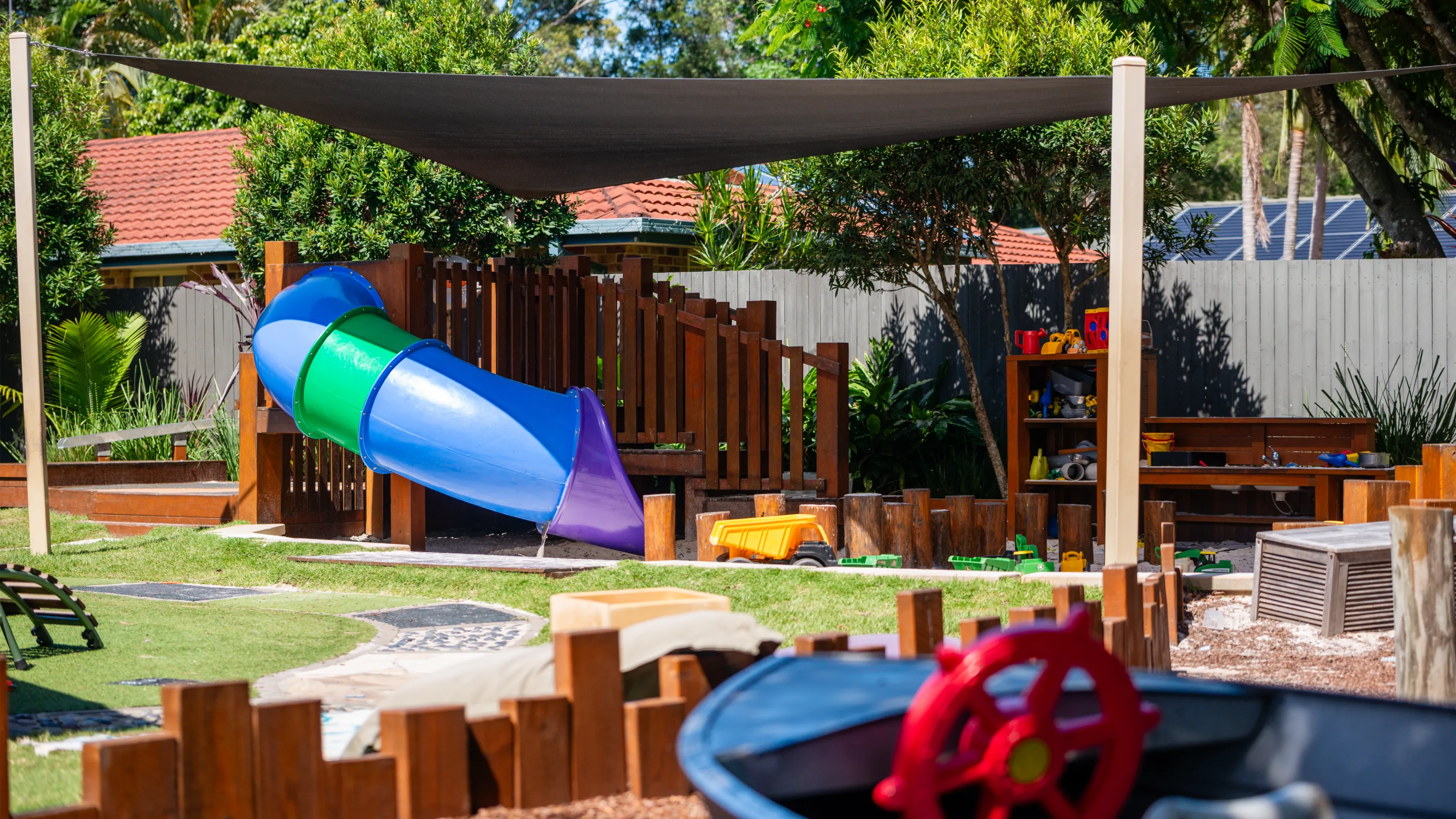
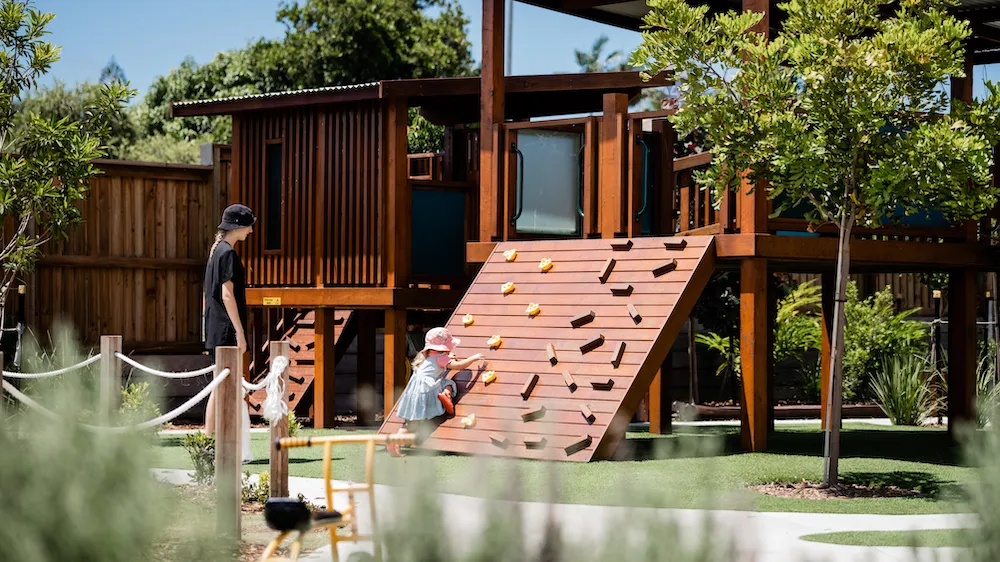
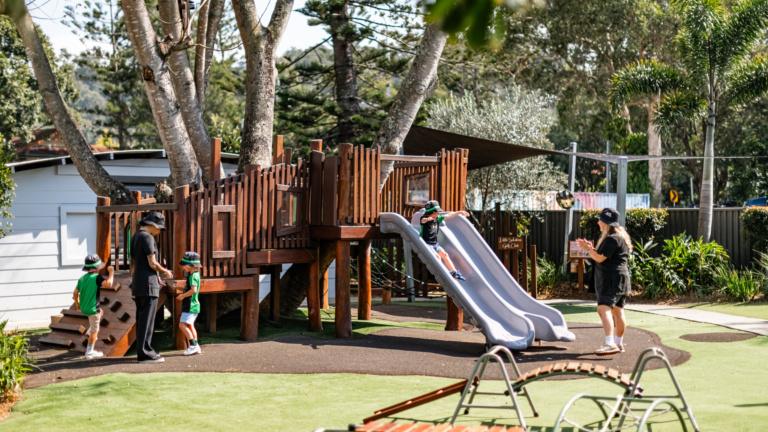
George Street has the largest indoor childcare playground in Brisbane — double-storey play forts, water play, garden beds and nature walks, a dedicated outdoor teacher, and 180-degree city views, all indoors and weatherproof. Because the centre sits in the middle of the CBD, the city itself becomes part of the program: the Queensland State Library, Brisbane Square Library, the Queensland Museum and GOMA are all within walking distance. Take a closer look inside the playground.
What's included
Little Scholars runs a Family Time Program designed around one idea: handing working parents back their evenings and weekends. At George Street, included at no extra cost, that means:
Chef-prepared Take Home Meals ready at pickup, so dinner’s already sorted
On-site haircuts, and on-site doctor, dental, allied health and specialist appointments
A daily digital portfolio through the parent app, so you can see your child’s day from your desk
An in-house chef preparing fresh, seasonal, Nutrition Australia-approved meals and snacks daily, with vegetarian and halal options
The things that usually eat a working parent’s evenings get folded into the day instead.
Who it's for
George Street serves families across Brisbane City, South Brisbane, West End, Spring Hill, Paddington and New Farm — anyone whose work or commute runs through the city. It cares for 108 children, from six weeks old through kindergarten age.
If your child is kindergarten-age, you may also be eligible for Queensland’s Free Kindy funding, which can significantly reduce your fees on top of the Child Care Subsidy
Common questions from city parents
Is there parking, or do I need to take the train?
Both work. There’s on-site undercover parking, plus pram and bike parking. The centre is also a seven minute walk from Roma Street Station for parents who commute by rail.
What is the Parent Valet?
A drop-off and pick-up service exclusive to George Street, where our team helps you hand over and collect your child at the door — built to make city mornings faster and calmer. No other CBD centre offers it.
What does Exceeding NQS mean, and is it common?
It’s the rating ACECQA gives centres that go beyond the National Quality Standard across the seven quality areas. Around 5% of Brisbane City centres hold it. George Street is the only Exceeding-rated centre in the Brisbane CBD.
What are the hours?
6:30am to 6:30pm, Monday to Friday, 52 weeks a year.
Yes. An in-house chef prepares all meals and snacks daily, with vegetarian and halal options, and chef prepared Take Home Meals are ready for families at pickup.
Which suburbs do you serve?
Families come from across Brisbane City, South Brisbane, West End, Spring Hill, Paddington and New Farm.
Can I look around before enrolling?
Yes — book a tour and see the playground, meet the team, and walk through a day at the centre.
Ready to experience the Little Scholars difference?
Come and see it. The fastest way to know whether George Street fits your family is to stand in the playground and meet the educators.
Sessional Kindergarten vs Long Day Care Kindergarten: Which Is Right for Your Family?
Choosing the right kindergarten program is an important decision for Queensland families. Many parents compare sessional kindergarten and long day care kindergarten to find the right balance of learning, flexibility, and care.
At Little Scholars School of Early Learning, our approved kindergarten programs are designed to support school readiness while fitting the needs of modern families across our campuses. Whether you are looking for a school-style session or a flexible long day care kindergarten program, we can help you understand which option may suit your child best.
Both options can provide high-quality early learning experiences. The key is choosing the kindergarten program that best suits your child’s needs and your family routine.
What Is Sessional Kindergarten?
Sessional kindergarten, sometimes called preschool or community kindergarten, usually operates during school hours and school terms only. These programs are often run by community organisations, councils, or schools and focus specifically on preparing children for the transition to primary school.
Children generally attend for shorter sessions across the week, such as a few hours per day or several days per week.
Families often choose sessional kindergarten because it offers:
A traditional school-style routine.
Structured early learning experiences.
Social opportunities with same-age peers.
A shorter introduction to formal education.
For some families, sessional kindergarten is a great fit. For others, the shorter hours and term-only schedule may not suit work commitments or family routines.
What Is Long Day Care Kindergarten?
Long day care kindergarten combines high-quality early education with the convenience of extended care hours. These programs are delivered within early learning centres and are led by qualified early childhood teachers.
At Little Scholars, our kindergarten programs are designed to support children’s learning and development while providing families with greater flexibility.
Long day care kindergarten programs typically offer:
Longer opening hours for working families.
Year-round care, including school holidays.
Play-based learning programs.
Degree-qualified kindergarten teachers.
Consistent routines and relationships.
Additional learning and enrichment opportunities.
For many Queensland families, this balance of education and flexibility makes long day care kindergarten a practical and valuable choice.
Is Long Day Care Kindergarten High Quality?
A common misconception is that kindergarten in a long day care setting is less educational than sessional kindergarten. In reality, approved kindergarten programs must meet strict standards and follow recognised early learning frameworks.
Children in long day care kindergarten programs take part in structured educational experiences that support literacy, numeracy, communication, emotional wellbeing, and social development.
At Little Scholars, our focus is on creating play-based learning environments where children build confidence, independence, and a love of learning. Our campuses are designed to support children’s growth in a warm, engaging setting that feels like a second home.
Benefits of Long Day Care Kindergarten
Consistency and continuity
One of the biggest advantages of long day care kindergarten is consistency. Children remain in the same familiar environment throughout their early learning journey, building strong relationships with educators and peers over time.
This continuity helps children feel safe, secure, and confident as they prepare for school.
Flexible hours for families
Many families juggle work, commuting, and busy schedules. Long day care kindergarten provides extended hours that support working parents while ensuring children continue learning throughout the day.
Instead of arranging multiple drop-offs, pickups, or extra care arrangements, families can access education and care in one place.
Play-based learning for school readiness
Quality kindergarten is about much more than letters and numbers. Children learn best through meaningful play experiences that encourage curiosity, creativity, communication, and problem-solving.
Our educators plan experiences based on children’s interests and developmental stages, helping build:
Long day care settings allow educators to build close, ongoing partnerships with families. Daily conversations and longer hours create more opportunities to share updates, celebrate milestones, and work together to support each child’s development.
Sessional vs Long Day Care
There is no one-size-fits-all answer. The best choice depends on your child’s personality, your family routine, and the type of support you need.
Sessional kindergarten may suit families who:
Prefer shorter, school-style hours.
Have flexible schedules.
Want term-only attendance.
Long day care kindergarten may suit families who:
Need extended care hours.
Want consistency throughout the year.
Value convenience alongside quality education.
Prefer one familiar environment for learning and care.
Both pathways can help children thrive when the program is high quality and aligned with a child’s individual needs.
Choosing the right program
When comparing kindergarten options, the most important factors are:
At Little Scholars School of Early Learning, we believe every child deserves an inspiring early learning experience that prepares them not just for school, but for life.
Explore Little Scholars kindergarten
Our kindergarten programs are designed to support children’s growth, confidence, and school readiness in a warm and engaging environment. With campuses across Queensland, Little Scholars offers families a flexible early learning option that combines education, care, and convenience.
Whether you are exploring sessional kindergarten alternatives or looking for a long day care kindergarten program, our team is here to help you find the right fit for your family. Book a tour at your nearest Little Scholars campus to learn more about our approved kindergarten programs.
The 3-Day Guarantee Explained. What Actually Changes for Gold Coast Families in 2026.
A rule change that came into effect on 5 January 2026 means Gold Coast families can access subsidised childcare three days a week — without proving they work, study, or volunteer a single hour.
5 min read
Updated April 2026
72subsidised hours per fortnight — guaranteed
~$39est. weekly cost for 3 days (family on $80K, Gold Coast avg fee)
$17K+potential annual saving vs. full fees, same family
If you've been putting off childcare because the cost felt out of reach — or because you weren't working enough hours to qualify for a meaningful subsidy — this one's worth reading carefully. The 3-Day Guarantee is the biggest structural shift to childcare subsidies since 2018. It doesn't just tweak the numbers. It changes who can access affordable care entirely.
What is the 3-Day Guarantee, exactly?
Put simply: from 5 January 2026, every family that is eligible for the Child Care Subsidy (CCS) is guaranteed a minimum of 72 subsidised hours of childcare per fortnight — no questions asked about whether you work, study, train, or volunteer.
Before this change, the Activity Test determined how many subsidised hours you could access. Families who weren't working enough were capped at just 24 subsidised hours per fortnight — three days worth of care, but paid at rates with minimal subsidy beyond that lower tier.
The 3-Day Guarantee removes that floor for the first 72 hours. You get them automatically. If you work more, your entitlement can still increase above that — but those three days are locked in regardless.
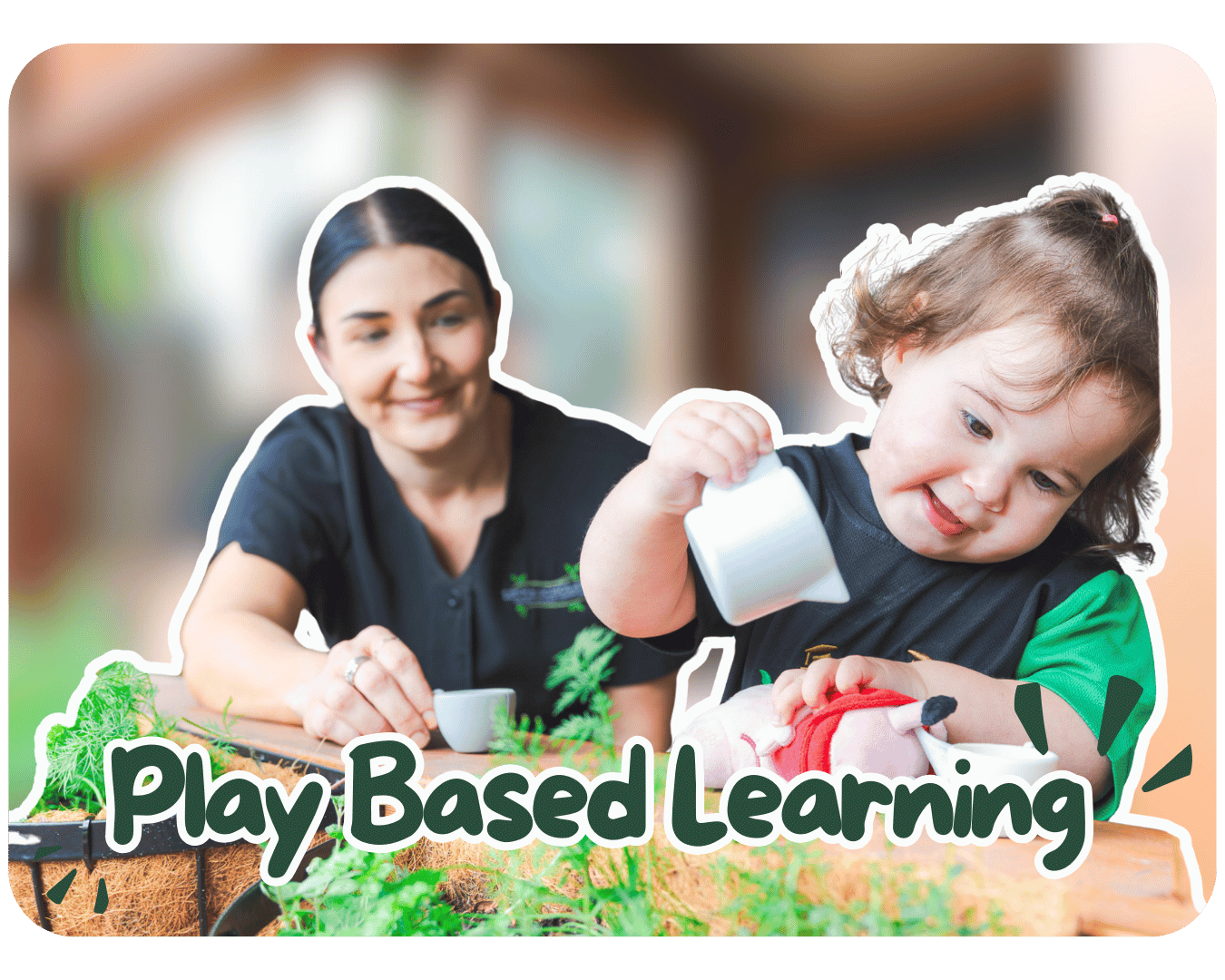
Play-based learning at Little Scholars — where every day builds something that lasts.
The key change in one sentence
Before 5 January 2026, low-activity families could only access 24 subsidised hours per fortnight. Now every eligible family gets at least 72 — triple the previous minimum.
Who qualifies?
The 3-Day Guarantee applies to you if you're already eligible for the Child Care Subsidy. That means meeting the standard CCS criteria:
Australian residency
You or your child must be an Australian citizen, permanent resident, or holder of a specified visa.
Immunisation
Your child must be up to date on the Australian Immunisation Register (or hold an approved exemption).
Approved care service
Your child attends an approved provider like Little Scholars. All 17 of our campuses qualify.
If you're already receiving CCS, the 3-Day Guarantee applied to your account automatically from 5 January 2026 — no new application required. If you haven't yet applied for CCS, you'll need to do that through myGov before the subsidy kicks in.
What does it actually cost? The Gold Coast numbers.
The Gold Coast average daily childcare fee sits at around $131 per day, based on CareforKids data. Here's what three days per week looks like at different income levels under 2025–26 CCS rates.
Household Income
CCS Rate
Govt pays (per day)
You pay (per day)
Your cost: 3 days/wk
Up to $83,280
90%
~$117.90
~$13.10
~$39/wk
$100,000
~80%
~$104.80
~$26.20
~$79/wk
$130,000
~65%
~$85.15
~$45.85
~$138/wk
$160,000
~50%
~$65.50
~$65.50
~$197/wk
Above $530,000
0%
$0
$131.00
$393/wk
Estimates based on Gold Coast avg daily fee of $131 and 2025–26 CCS rates. Get a personalised figure → use our CCS Calculator
More than subsidy. It's access.
For a family on $80,000 choosing three days of care, the difference between the old system and the 3-Day Guarantee can be more than $17,000 per year in subsidised hours they previously couldn't access without meeting the Activity Test.
That's the part worth sitting with. Not just a reduction in what you pay per day — but access to days of care that simply weren't available to you before, at meaningful subsidy rates.
What happens if you do work or study?
The Activity Test hasn't been scrapped — it's still relevant if you want more than 72 hours of subsidised care per fortnight. Think of the 3-Day Guarantee as a floor, not a ceiling.
Activity Test tiers from 5 January 2026
0–7 hours of activity per fortnight → 72 subsidised hours guaranteed (the 3-Day Guarantee)
8–16 hours per fortnight → up to 72 subsidised hours (the guarantee covers this tier fully)
17–47 hours per fortnight → up to 100 subsidised hours per fortnight
48+ hours per fortnight → up to 120 subsidised hours per fortnight
If you're working full-time, the Activity Test still works in your favour for additional hours. But if you're between jobs, studying part-time, caring for another family member, or simply at home with your child — the 3-Day Guarantee means childcare is now genuinely accessible without proving your worth to a government system first.
What do Gold Coast families need to do right now?
If you're already on CCS:
Nothing. The 3-Day Guarantee applied to your account automatically from 5 January 2026. No re-application or re-confirmation needed.
If you haven't applied for CCS yet:
Apply through myGov as soon as possible. Once approved, you'll have access to the guaranteed 72 hours immediately. Our team can walk you through the process — just get in touch.
If you're currently paying full fees because you weren't meeting the Activity Test, it's worth reviewing your subsidy entitlement now. Many Gold Coast families will find they're eligible for significantly more support than they assumed.
Use our CCS Calculator to get an estimate based on your household income and the number of days you're considering. It takes about 60 seconds.
Common questions from Gold Coast families
Does the 3-Day Guarantee apply to all childcare types?
It applies to centre-based daycare — the kind offered at Little Scholars. It does not currently apply to family daycare or in-home care in the same way. Always check with Services Australia for the most current eligibility rules.
My child is only two — do they qualify?
Yes. The 3-Day Guarantee applies from birth to the age your child starts school, as long as you meet the standard CCS eligibility criteria. The child's age is not a limiting factor for the guarantee itself.
Can I split the 72 hours across different days?
The 72 hours is a per-fortnight entitlement that applies to your family regardless of which approved service your child attends. You can use it across up to three days per week — or spread it differently depending on your session hours.
Is the 3-Day Guarantee permanent?
It is government policy as of January 2026. Like all subsidy settings, it could change in future federal budgets. We'll keep this page updated as any changes are announced.
Do Little Scholars campuses have availability?
Availability varies by campus and age group. With 17 campuses across the Gold Coast, Brisbane, Ipswich, and Redland Bay, we'd encourage you to enquire early — especially for the under-2 rooms. Contact your nearest campus →
Little Scholars School of Early Learning
Find out what the 3-Day Guarantee means for your family.
Our team can walk you through exactly what you're entitled to — and check availability across our campuses on the Gold Coast, Brisbane, Ipswich, and Redland Bay.
17 campuses across South East Queensland · 1300 896 139
Subsidy figures based on 2025–26 CCS rates published by Services Australia and the Department of Education. Gold Coast average daily fee of $131 sourced from CareforKids.com.au. Out-of-pocket estimates are indicative only and based on the hourly rate cap; actual costs may vary depending on your provider's fees and individual circumstances. Always verify your CCS entitlement via Services Australia or a registered CCS adviser.
Childcare costs are one of the most searched — and most misunderstood — topics for families with young children in Redland Bay. The headline fee feels scary. The subsidy system feels complicated. And most of the information out there is either national averages that don't apply locally, or government fact sheets that need a spreadsheet to decode. This post does the maths for you — using real Redland Bay fees, real 2025–26 CCS rates, and real out-of-pocket costs across a range of income levels. No jargon. No guesswork.
1What childcare actually costs in Redland Bay in 2026.
Based on data from CareforKids and Toddle, the average daily fee for long day care in Redland Bay sits at $148 per day for a standard 10-hour session in 2026 — $149/day for babies, $148 for toddlers, and $147 for kindergarten-age children.
That's higher than the Queensland state average of $131/day, and above the Gold Coast and Ipswich averages too. Fewer centres serving a growing population is the main driver. It's part of why Little Scholars runs two campuses in Redland Bay — giving local families more than one option close to home.
How Redland Bay compares — average daily fee, SEQ 2026
Redland Bay
$148/day
Brisbane metro
$139/day
Gold Coast
$131/day
Ipswich
$127/day
Source: CareforKids, Toddle (2026). QLD state average ~$131/day. Individual centre fees vary.
2The one thing most Redland Bay families don't realise about their subsidy.
The Child Care Subsidy doesn't apply to your full daily fee. It applies to whichever is lower: your actual fee, or the government's CCS hourly rate cap of $14.63/hr for 2025–26. On a standard 10-hour day that cap works out to $146.30.
Redland Bay's average of $148/day is $14.80/hr — $0.17 above the cap. That means every Redland Bay family pays a fixed above-cap gap of $1.70 per day that no level of subsidy can cover. On three days a week that's $5.10 per week, or $255 per year. It won't break your budget, but it's worth building into your numbers.
In plain English: Your CCS is calculated on $14.63/hr, not $14.80/hr. The $0.17 difference — $1.70/day — comes out of your pocket at every income level. Want to see your exact weekly cost? Use our free CCS Calculator →
3Your CCS percentage — how it's calculated.
Your subsidy rate is determined by your combined household adjusted taxable income. It starts at 90% for families earning up to $85,279, decreasing by 1% for every additional $5,000 earned above that threshold.
Family income
CCS rate
CCS per hour
Gap per hour
Daily out-of-pocket
Up to $85,279
90%
$13.17
$1.63
$18.00
$120,000
83%
$12.14
$2.66
$28.30
$140,000
79%
$11.56
$3.24
$34.10
$160,000
75%
$10.97
$3.83
$40.00
$180,000
71%
$10.39
$4.41
$45.80
$220,000
63%
$9.22
$5.58
$57.50
Gap per hour = ($14.63 – CCS per hour) + $0.17 above-cap. Multiply by 10 for daily gap. 2025–26 CCS rates, effective 7 July 2025. Your exact rate depends on your confirmed income estimate with Services Australia. Calculate yours here.
4What four real Redland Bay families pay each week at Little Scholars.
Here's what different household incomes actually translate to in weekly childcare costs — based on three days a week at Little Scholars Redland Bay, using the $148/day average and 2025–26 CCS rates.
Family A — $80,000
One income, or returning to work part-time
CCS rate90%
Government pays per day$130.00
Your daily gap fee$18.00
You pay — 3 days/week~$54
Family B — $120,000
Dual income, first child starting care
CCS rate83%
Government pays per day$119.70
Your daily gap fee$28.30
You pay — 3 days/week~$85
Family C — $140,000
Two professionals, planning for kindy next year
CCS rate79%
Government pays per day$113.90
Your daily gap fee$34.10
You pay — 3 days/week~$102
Family D — $180,000
Higher-earning household, two incomes
CCS rate71%
Government pays per day$102.20
Your daily gap fee$45.80
You pay — 3 days/week~$137
Based on $148/day at Little Scholars Redland Bay. CCS applied to the $14.63/hr hourly rate cap; above-cap gap of $1.70/day is included in all daily gap figures. Before 5% annual withholding reconciliation. Indicative only. Get your exact figure here.
At 90% CCS, the government covers $130 of your $148 daily fee. Three days a week at Little Scholars costs a family on $80,000 around $54 — not $444.
5How days and income combine — full weekly reference.
Whether you're looking at two days around the school run or five full days while you return to work, here's the complete picture across income levels for Little Scholars Redland Bay.
Family income
CCS %
2 days/wk
3 days/wk
4 days/wk
5 days/wk
$80,000
90%
~$36
~$54
~$72
~$90
$100,000
87%
~$41
~$62
~$82
~$103
$120,000
83%
~$57
~$85
~$113
~$142
$140,000
79%
~$68
~$102
~$137
~$171
$160,000
75%
~$80
~$120
~$160
~$200
$180,000
71%
~$92
~$137
~$183
~$229
$220,000
63%
~$115
~$173
~$230
~$288
All figures are weekly out-of-pocket after CCS, based on $148/day and the 2025–26 $14.63/hr rate cap. 5 days/week requires 48+ hours/fortnight of recognised participation (work, study, volunteering). Indicative only.
6Second child under 5? Your subsidy rate goes up.
If you have a second child aged 5 or under enrolled at Little Scholars, they attract a higher CCS rate of up to 95% for families earning under $143,273. This applies whether both children are at the same campus or different ones.
At $148/day and 95% CCS, your second child's daily gap drops to roughly $9.10 — about $27 a week for three days. If you're weighing up the cost of dual enrolment, that number is usually the one that changes people's minds.
95%Max CCS for a second child under 5 — families earning under $143,273
~$27/wkOut-of-pocket for second child, 3 days at Little Scholars ($148/day avg)
7If your child turns 4 this year, Free Kindy changes the numbers entirely.
Queensland's Free Kindy program provides eligible children with 15 hours per week of fee-free kindergarten for up to 40 weeks a year. For 2026, that's children born between 1 July 2021 and 30 June 2022. Both Little Scholars campuses in Redland Bay are approved providers — meaning your child can access Free Kindy at Little Scholars as part of their normal day.
In practice, CCS is applied first to reduce your gap fee. Free Kindy then covers a significant portion of what's left during the 15 kindy program hours each week. For families on lower-to-mid incomes, combining both programs can bring the weekly cost of a two-day kindy enrolment very close to zero during term.
Free Kindy is not income-tested. Even families who earn too much to qualify for CCS still receive the Queensland Government's Free Kindy benefit — if your child is the right age, you're eligible regardless of household income. See how Free Kindy works at Little Scholars →
8What's included in the fee at Little Scholars Redland Bay.
When you're comparing childcare fees, it's worth knowing what's actually included. At Little Scholars, your daily fee covers access to our curriculum — a play-based, educator-led program delivered across every room from Nursery and Infant Care through Toddler, Junior and Senior Kindy, and Kindergarten. It's built on the Early Years Learning Framework and delivered by qualified early childhood teachers and educators.
Redland Bay children also have access to our Outdoor Explorers (Bush Kinder) program — nature-based learning that takes the classroom outside and builds confidence, curiosity, and resilience in young children. It's one of the things families tell us they didn't expect and end up valuing most.
Little Scholars is family-owned, with 17 campuses across South East Queensland. The people making decisions about how your child's day runs are the same people who started this. That matters when things come up — and they always do when you've got a toddler.
9Two campuses in Redland Bay. Book a tour at either.
Little Scholars has two campuses serving Redland Bay families — one on Main Street and one on Collins Street. Both run the same programs. Book a tour at whichever works better for your commute or school run.
10The cost is sorted. Getting a place is the harder part.
Redland Bay has grown by over 2,000 residents since the 2021 Census, adding approximately 53 more children under five to the local demand pool. Current data shows around 1.8 children under five per licensed childcare place in the area — supply is tight and it's not getting looser.
Knowing what you'll pay matters. But honestly, knowing there's a place available matters more. Families who join Little Scholars' Redland Bay waitlists often do so six months to a year in advance — some before their baby is born. The subsidy paperwork takes an afternoon. Finding the right centre with an actual vacancy takes a lot longer.
If this post has made the cost feel more manageable than you expected, the best next step is to book a tour at one of our Redland Bay campuses, see the space, meet the team, and get your name down. The numbers will follow.
11The short version.
Redland Bay's average daily fee is $148/day— above the SEQ average, reflecting limited local supply. Little Scholars has two campuses in the area.
Because $148/day is above the CCS hourly rate cap ($14.63/hr), all families pay a fixed above-cap gap of ~$1.70/day regardless of their income or subsidy rate.
At 90% CCS (incomes under $85,279), three days a week at Little Scholars costs approximately $54 per week — not $444.
A second child under 5 attracts up to 95% CCS for families earning under $143,273 — their daily gap drops to around $9.10.
Eligible 4-year-olds can access Free Kindy at Little Scholar — stacking on top of CCS to dramatically reduce term-time costs. Not income-tested.
Supply in Redland Bay is tight. Book a tour before you finalise anything else.
📍 What Childcare Really Costs — Little Scholars South East Queensland Series
Use our CCS Calculator to see your real weekly cost — then come and see Little Scholars Redland Bay for yourself. Both campuses have a Book a Tour form right on the page.
Little Scholars School of Early Learning — 17 campuses across Gold Coast, Brisbane, Ipswich & Redland Bay
Average daily fee of $148 sourced from CareforKids.com.au and Toddle (2026). CCS rates and hourly rate cap ($14.63/hr) sourced from the Department of Education and Services Australia (2025–26). Weekly out-of-pocket figures are indicative only, before the 5% annual CCS withholding reconciliation, and do not constitute financial or legal advice. Individual centre fees vary — contact Little Scholars directly for current pricing.
Preparing to welcome your baby is an exciting journey. While there’s so much to plan, joining a childcare waitlist early for premium centres like Little Scholars School of Early Learning is one important step many expectant mothers overlook. High-quality childcare spots fill up quickly, so registering your interest early for your baby’s place means peace of mind and may result in more choice when it comes time to start care.
Why You Should Join Waitlists Early
With demand high for premium childcare centres, families often join waitlists during pregnancy to avoid long waits and limited options after birth. Getting on the waitlist early means you may have greater flexibility with start dates and days, helping you plan your return to work or lifestyle with confidence.
Important note:Joining a waitlist does not guarantee a childcare spot. It simply registers your interest and puts your child on a list to be considered when a position becomes available. The guarantee depends on factors such as the centre’s capacity, educator-to-child ratios, and demand in your area.
When Should You Join a Childcare Waitlist
The safest time is as early as possible — for many families, this means during pregnancy or shortly after birth. Infant and toddler spaces are often the hardest to secure in high-demand locations. Here’s a general guide:
Pregnancy or birth: Ideal for high-demand centres like Little Scholars.
6–12 months before care is needed: If you’re planning your return to work or study, this is a good window to apply.
At least 6 months in advance: Even in less competitive suburbs, giving yourself a buffer can make a big difference.
What Affects Wait Times?
Wait times may depend on several factors, including:
Location demand: Centres located within highly populated suburbs or major transport hubs tend to fill faster.
Age of your child: Infant and toddler ratios are lower, so these rooms usually fill quickest.
Centre reputation: Highly rated centres with excellent programs usually have longer waitlists.
Sibling priority: Centres often prioritise families with siblings already attending.
What Makes Our Nursery Program Unique?
At Little Scholars, our nursery program feels like a home away from home, offering:
Qualified, loving educators who specialise in infant care and development.
Calm, purpose-built environments designed for comfort and sensory exploration.
Individualised routines that follow your baby’s sleeping, feeding, and play patterns.
Strong parent communication ensuring daily updates keep you connected.
How Early Waitlist Registration May Benefit Your Family
More choices and flexibility in scheduling.
Less stress knowing your interest is registered at your centre of choice.
Opportunities to tour and meet educators before your baby arrive.
At Little Scholars, we believe every child deserves the best start, and every parent deserves peace of mind.Registering your child on our waitlist early ensures your family is considered when a place becomes available, helping you plan with confidence.
Everything Australian families need to know about the new 3 Day Guarantee and more affordable childcare in 2026
A brighter future for families is on the way. Starting 5 January 2026, the child care subsidy 2026 changes will introduce the new 3 Day Guarantee, giving CCS eligible families access to three full days (36 hours) of subsidised childcare per week – no matter how many hours you work or study.
At Little Scholars, we know how important affordable, flexible care is for families, and we’re here to help you understand what these changes mean for you.
What Is the 3 Day Guarantee?
The 3 Day Guarantee is part of upcoming changes to the Child Care Subsidy (CCS). It removes the strict work and study requirements previously tied to accessing subsidised hours of care according to the Department of Education.
Here’s what families can expect from 2026:
No minimum activity hours required to access three days of subsidised care per week
Up to 100 subsidised hours per fortnight for families who meet the activity test
100 hours guaranteed for families caring for First Nations children
This means more affordable care, more flexibility, and more opportunities for your child to thrive in early learning.
For many families, these changes will mean thousands of dollars in savings each year. But beyond the financial relief, it means every child has the opportunity to access quality early education – the foundation for lifelong learning, confidence, and wellbeing.
Why Choose Little Scholars for Your Child’s Care?
With your three guaranteed days of subsidised care, your child will experience the very best in early education across our purpose-built campuses.
Nature play and outdoor learning
Children connect with the natural world through exploration and play.
Extra-curricular programs for every interest
Bush, Beach, and Pram-kinder programs, music, dance, sport, soccer, swimming, gardening and more.
University-qualified educators & kindergarten program
Innovative learning with STEM and WonderNest Virtual Reality
At Little Scholars, children engage with STEM learning (science, technology, engineering, and mathematics) through hands-on, play-based experiences. Alongside our brand-new, Australian-first, WonderNest Virtual Reality program, opening new worlds of discovery and learning for kindergarten children in 2026.
A warm, family-first environment
Every child is more than just a number, they are part of our family. We provide a safe, nurturing, and supportive environment where children feel valued, celebrated, and encouraged to be themselves.
Our educators take the time to understand each child’s unique personality, interests, and learning style. This personalised approach to childcare ensures that every child feels a sense of belonging while developing confidence and independence.
Families choose Little Scholars because we combine high-quality early learning programs with a genuine family-first philosophy. From the moment you step into our campuses, you’ll see children thriving in a space that feels like home – where safety, wellbeing, and happiness come first.
Enrolments for 2026 Are Now Open
With the 3 Day Guarantee set to launch in 2026, we anticipate an incredible level of interest and demand across our campuses. If you are a current family and your current CCS entitlement is less than 72 hours per fortnight, please speak with your Campus Manager to learn more about the 3 Day Guarantee and how to optimise your Child Care Subsidy. If you are looking to enrol your child, you can book a tour at your local Little Scholars Campus or chat with our enrolments team on 1300 896 139 to see how your family could benefit from the CCS changes.
So you’ve decided to send your child to early learning – how exciting!
For first-time parents, preparing for this new chapter involves more than just packing a backpack, it means understanding key essentials like the Child Care Subsidy (CCS). Navigating the CCS can seem daunting, but fear not! We’ve written a comprehensive guide to help demystify the process to help you understand how to maximise this support for your family’s benefit.
Here in this CCS explainer, we will lay out everything you need to know about and to apply for CCS, making it easier for you to support your child’s educational adventure.
What is the child care subsidy (CCS)?
Did you know you can apply for the Child Care Subsidy (CCS) before you enrol your child in early learning?
Wait, what’s CCS? The Child Care subsidy is assistance to help families with the cost of childcare. Your child’s day in early learning is payable by a daily fee charged by the centre. The government may cover some of this fee, depending on your individual circumstances. This is what is referred to as the ‘subsidy’.
You may be eligible for the Child Care Subsidy if you meet a number of factors. The Child Care Subsidy (CCS) changed in July 2024 for families earning under $533,280. The percentage of CCS will vary depending on your family’s income, and the income limit to receive the maximum allowed CCS will increase as well. For families whose income is up to $83,280, you could receive up to 90% from the CCS toward your child’s daily fee.
If you have two or more children in care, subsequent children are eligible for a higher subsidy than the first child. For families who earn a total income of up to $141,321, those children will receive 95% from CCS off your daily fee.
Child Care Subsidy (CCS) Requirements
There are several requirements to qualify for the Child Care Subsidy. You may qualify if:
• You or your partner care for the child a minimum of two nights / fortnight
• You or your partner are responsible for childcare fees
• The child meets immunisation requirements
• You use an approved child care service like Little Scholars!
Once you’re ready for your child to go into early learning, you can apply for CCS!
How CCS works
The CCS works on three factors:
• Your total combined family income
• The service type. This can be long day care, or outside-hours care such as vacation care
• How much ‘work-related’ activity you and your partner undertake each fortnight This includes paid work, volunteering, study and other activities as determined by education.gov.au. Job hunting, studying, starting a new business, volunteering and travel time – among others – are all eligible activities that will allow you to claim subsidised hours of care.
Our website has a handy calculator you can use to get an idea of how much CCS you’ll receive.
When to apply for CCS
Apply for CCS via your MyGov Account, which is linked to Centrelink.
We recommend you do this as soon as you know when you might be sending your little one into early education and care, so it’s all set up and ready to go for your child’s first day. Don’t necessarily wait until you’ve enrolled with an early learning campus, because the entire process may take between four and six weeks, and if it’s not set up when you begin care, you may be paying full fees until it’s all complete.
Once your spot is booked in, confirm your Complying Written Agreement (CWA). When a CWA enrolment notice is created by the campus manager, there are two steps that need to be completed by the family:
1. You will be notified by email that the CWA is ready for you to agree to. A reminder will be sent via email should you not sign within 48 hours
2. Confirm your child’s government enrolment via MyGov. If you do not agree to the government enrolment, CCS cannot be paid.
Documents you may need
During your Child Care Subsidy claim via MyGov, expect Services Australia to request a variety of documents to verify your eligibility. These may include financial details like bank account information, tax file numbers, and insights into your assets. Academic records, work-related documents like tax returns or pay slips, details about your living situation, relationship specifics, any international residence proofs such as visas, documentation regarding your children, and any relevant medical records are also crucial. Now that you know what to expect, we’d suggest these are prepared in advance to streamline your claim process.
Finally, we know change can be scary, overwhelming or confusing, as much for our parents as our little ones. We’re here for you from the day you book your tour to the day your child finishes their last day of kindergarten. We can absolutely help you navigate the CCS and other documents you need to help your child become a little scholars. Reach out to your campus manager, admin or any of the leadership team for guidance or further questions.
Tips for parents looking for care for their child for the first time
You’re having a baby! Congratulations! It’s such a thrilling time! But it can also be intimidating, stressful and overwhelming thinking of all things you need to think about and prepare for, before your child even arrives.
Or perhaps you have that sweet child, and while many take a leave of absence from work after baby is born, at some point families have to make the decision if and when they will return to work. That’s when you have to look at early learning and care for your children. Overwhelmed? We’re here to guide you and make life just a little bit easier.
With some many childcare options, how does one choose?
There are several options. Consider what early learning services are nearby and how far you’re willing to travel to drop-off and pick-up. You could even do it during peak hour traffic to get a better idea of how long it might take to get to these locations.
Check out the websites dedicated to listing early learning services such as Starting Blocks, Australia’s free government website dedicated to early childhood, the National Children’s Education and Care Quality Authority (ACECQA) national register or sites like Careforkids.com.au – which share services by location, including pertinent information such as assessment and rating outcomes, what each service offers, contact information and more.
Then, visit websites and start making some calls and book tours. That will be the best way for you to get ideas on philosophies, curriculums, learning and play environments, and they can answer any questions you may have.
Waitlists - what they are and when to join them
Early learning and care providers in Australia have strict educator-to-child ratios, which is for the safety and benefit of both children and their educators, but that can mean spots fill quite quickly in each age and development learning environment, and in high-demand areas, waitlists can fill up quickly. However, don’t let us scare you, many high quality services have spaces available when you need them.
While this sector is thrilled to be able to allow more parents to continue or join the workforce, that does mean demand will be higher for quality early learning and care.
Start early. Contact the campus you’re interested in to see if there is indeed a wait list. Ideally, get names on wait lists at least six months to 12 months before you need care. Often, services will be considering what spots are available for the next year toward the end of the year – October to December. That doesn’t mean if you need care in May that you’re out of luck, but for busy services, thinking of the first of the year as a start time might be realistic. Sometimes, families get their unborn babies on wait lists just to be sure. At Little Scholars, if this is the case for your family, we’ll contact you about one month after your due date to see where your family is with thinking about care for your new addition.
Visit the service before joining the waitlist. Most early learning locations offer tours, you just need to book them in advance to avoid disruption and guaranteeing someone will be able to provide you the time you need to get a feel for the service.
Keep in contact with the service to see how your child is progressing on the wait list.
Some services offer places to families who have been on the waitlist the longest. Some may place internal families first, meaning families who already have a child in their care and are adding additional children. Some services may have a strict “first-in, best-dressed” approach. It’s worth asking what the policy is.
Ratios in early learning
In early learning, a “ratio” refers to the comparison between the number of educators and the number of children they are responsible for supervising, essentially showing how many children each adult is looking after at a given time; it’s a crucial aspect of ensuring children’s safety and wellbeing in an early childhood setting, with different age groups often having different required ratios depending on their developmental needs.
The ratio for our children is as follows:
0-24 months – one educator for every four children or 1:4
24 months and less than 36 months – one educator for every five children or 1:5
36 months up to and including preschool age – one educator for every 11 children 1:11
Over preschool age – one educator for every 15 children or 1:15
The Child Care Subsidy (CCS) is a government initiative designed to help families manage the cost of early learning. Your child’s time in care is charged as a daily fee by the service, and the government may cover a portion of this cost based on your individual circumstances. This is known as the subsidy.
You can apply for the Child Care Subsidy (CCS) even before enrolling your child in early learning, in fact as long as your child has a birth certificate, you can apply. You then have 13 weeks to activate your CCS with an early learning service. If that time lapses, you can go online to reactivate it.
The benefits of placing small children in early childhood education are numerous. Early learning can help babies develop social skills, motor skills, and cognitive abilities. Because of course, learning doesn’t start when a child begins school, it begins at birth!
Social development Babies can begin forming connections, learning to share, and developing early communication skills in a supportive environment.
Motor development Early learning settings provide safe opportunities for babies to explore movement, such as reaching and grasping. These experiences help strengthen motor skills, with research suggesting that babies who engage in active exploration may reach developmental milestones earlier.
Cognitive growth Exposure to a variety of learning experiences supports cognitive development. Studies indicate that children who participate in early learning programs may develop stronger cognitive abilities compared to those who do not.
School readiness Early learning helps children prepare for kindergarten by teaching them to follow instructions, interact with peers, and adjust to time away from their parents.
Little Scholars and most early learning services will suggest to parents that they enrol their children at least two days every week in care. Why? Nearly a quarter of Australian children start school without the foundational skills they need in areas like communication, social skills, emotional wellbeing, and physical health.
Attending for at least two years, with a minimum of 15 hours per week, is linked to better literacy and numeracy outcomes that persist into adolescence. High-quality early learning also supports secure attachments with educators, helping children settle and understand routines, and engage more actively with peers.
In our learn and play studios, At Little Scholars, we provide tailored, age-specific early learning and childcare across four key stages: nursery, toddlers, pre-kindy, and kindy. Our expertly designed programs cater to the unique needs and developmental milestones of each age group. Our children learn through play, reflected through our dedicated early learning curriculum.
Separating from your child for the first time
We understand the bonds young children have with their parents or caregivers. There is no denying that it may not be a smooth process, but we encourage parents to remember all the benefits children gain from attending early learning. Research also proves that having a child in care doesn’t negatively affect the bond with his or her main caregivers.
We very much welcome you to chat with us if you or your little one are or may deal with these feelings. You’re not alone and we can support you both through this transition.
If you have any questions or concerns about your child, we have an open door policy and we invite you to talk to your educator, educational leader or campus manager any time.
Little Scholars offers you and your child the very best facilities, resources and early educational, play-based programs available, which are underpinned by the early years learning framework. Our belief is that through quality education and care for children we can also encourage, assist and support the entire family.
Our dedicated team of educators are committed to the individual needs and interests of children and their families, and thus we encourage and welcome family input and involvement.
We aim to be like an extension of your family and are very relationship-driven. We support nurturing relationships between our educators and your child, the relationships your child has with the other children who attend, and we value our relationship with you as the parent and other family members. So book a tour today to get started!
Welcoming a new addition to your family is an extraordinary blessing. Along with the joy and love that fills your home, there are practical matters to consider, such as childcare. When you entrust your precious little ones into the hands of capable, nurturing early childhood educators, it’s an investment into their growth, development, and well-being.
Investing in quality childcare is more than just a financial decision; it’s about providing your child with an enriching environment that promotes their cognitive, social, and emotional development. Recognising this important investment, parents often wonder, “Is childcare tax deductible?”. We understand that childcare can be a significant portion of the family budget, which is why many families are interested in learning about the financial aids, tax benefits and deductions associated with childcare in Australia.
So, Is Childcare Tax Deductible in Australia?
The short answer is no, childcare is not tax-deductible in Australia. The Australian Taxation Office (ATO) does not view childcare as a work-related expense. This is because the decision to incur childcare costs does not come directly from the necessities of an individual’s job but from personal circumstances. Even though many parents need to arrange childcare to maintain their employment, the ATO has made it clear that it does not qualify as a deductible expense.
While this might initially seem disheartening, it’s important to remember that there are various financial support options available to families, such as the Child Care Subsidy, to help offset these costs. The Australian Government recognises the importance of accessible, high-quality childcare and offers a range of subsidies and benefits to eligible families.
Understanding Government Assistance with Childcare Costs
While childcare costs may not be tax-deductible in Australia, families aren’t left to shoulder these expenses alone. The Australian Government has a number of financial aid initiatives in place to support parents and guardians with their childcare fees.
Child Care Subsidy
The Child Care Subsidy (CCS) helps families with the costs of approved childcare. The subsidy amount depends on the family’s income, the hourly rate cap based on the type of approved childcare, and the hours of activity the parents engage in. To be eligible, parents must meet residency requirements, and the child must be 13 or under and not attending secondary school. Applications for the CCS can be made online through myGov, linking to Centrelink.
Parenting Payment
The Parenting Payment is an income support payment for parents or guardians to help with the costs of raising children. It is available to single parents with at least one child aged under 8, or partnered parents with at least one child aged under 6. Eligibility criteria also include income and assets tests. To apply, individuals should create a Centrelink account through the Department of Human Services.
Family Tax Benefit
The Family Tax Benefit is a payment to help eligible families with the cost of raising children. It is made up of two parts – Family Tax Benefit Part A, which is paid per child, and Family Tax Benefit Part B, which is paid per family. The eligibility and payment amounts depend on the family’s income, the number of children and their ages, and other factors. Applications can be completed online through myGov by linking to Centrelink.
Tips to Manage Childcare Costs Effectively
Childcare costs can be a significant part of a family’s budget, but with some careful planning and effective strategies, they can be managed more efficiently. Here are a few tips to help you navigate through this important investment in your child’s future:
Research all options: Take the time to research all the different childcare providers in your area, including their fee structures and what’s included in the cost. This will give you a clear understanding of the value you’re getting for your money.
Understand the government assistance available: As we’ve discussed, there are several government subsidies and payments available to families to assist with childcare costs. Make sure you understand each of these and the eligibility criteria to ensure you’re taking full advantage of the assistance available to you.
Plan your budget: Once you have an idea of the childcare costs and the assistance available, you can factor these into your budget. This will allow you to allocate funds effectively and be prepared for any potential changes in your financial situation.
Communicate with your early education provider: Open communication with your early education provider can be beneficial. They can provide you with insights and suggestions based on their experience and may be able to offer flexible solutions that can help manage costs.
Seek financial advice if necessary: If you’re finding it challenging to manage your budget with childcare costs, consider seeking advice from a financial counsellor or advisor. They can provide strategies and tips to manage your finances more effectively.
Remember, investing in your child’s early education is a significant decision, and every dollar spent contributes to their growth and development. By staying informed and planning ahead, you can ensure you’re making the most of your investment.
How Little Scholars Supports Families
At Little Scholars, we understand the financial commitments that come with providing your child with high-quality care and education. We believe that each child deserves the best start in life, regardless of their family’s financial situation, and we work diligently to uphold this principle in all aspects of our work.
If you have any questions regarding our childcare fees or if you’d like to learn more about our campuses, please do not hesitate to reach out to us. We’re more than happy to arrange a tour or discuss the individual needs of your family.
When choosing a childcare centre for your little one, it can be exciting yet overwhelming at the same time. There are endless options out there, but the question we often hear is, where do I even begin? Well, at Little Scholars, we’re here to guide you through with our professional childcare expertise and we guarantee after this, you will feel at utmost ease when it comes to choosing the right childcare centre for your child.
We promise if you consider the below key points, it will make your decision process a whole lot simpler because once you know what it is you are looking for, you will start to get an understanding of which of your requirements each childcare centre tick off or perhaps ‘don’t’ tick off.
How to choose a childcare centre
We would suggest thinking about the following key points when choosing a childcare centre:
1. Qualified and Trustworthy Staff
It’s essential to ensure that the childcare provider has a team of qualified and experienced staff who can provide a safe and nurturing environment for your child. Look for staff with relevant qualifications, certifications, and experience in early childhood education.
2. Focus on Education and Learning
A good childcare centre should offer a well-rounded curriculum that includes learning opportunities throughout the day. Look for a centre that offers a balance of academic and non-academic activities, such as art, music, and physical exercise, to promote cognitive, social, and emotional development.
3. Emphasis on Social Skills and Interaction
Social interaction is critical for children’s growth and development. Look for a childcare centre that promotes social skills development and offers opportunities for children to engage in group activities, such as circle time, story time, and free play.
4. Play and Exploration
Play is a crucial component of early childhood development. Look for a childcare centre that provides plenty of opportunities for children to play, explore, and have fun. The centre should offer age-appropriate games, toys, and learning tools that stimulate children’s creativity and imagination.
5. Philosophy on Education
Every childcare provider has its own philosophy on education. It’s important to find a centre that shares your values and beliefs on how children learn and develop. Look for a provider whose philosophy on education aligns with your own and offers an environment that supports your child’s learning and growth.
6. Age-Appropriate Resources
Children of different ages have different needs and interests. Look for a childcare centre that offers age-appropriate games, toys, and learning tools that cater to your child’s developmental stage and learning style.
7. Positive Atmosphere
A positive atmosphere is essential for a child’s emotional well-being. Look for a centre that feels warm, welcoming, and cheerful. The centre should be clean, well-maintained, and have a pleasant and safe environment for children to learn and play.
8. Safety and Security
Safety and security are paramount when it comes to selecting a childcare centre. Look for a centre that has adequate safety measures, such as a secure entrance, fenced outdoor play area, and policies for illness and emergencies.
9. Parental Involvement
Parental involvement is crucial in a child’s development. Look for a childcare centre that encourages parent-teacher collaboration and provides opportunities for parental involvement, such as parent-teacher conferences, family events, and volunteer opportunities.
10. Flexibility
Flexibility is another crucial factor to consider when selecting a childcare provider. Look for a centre that can accommodate your schedule and budget. The centre should offer flexible hours, payment plans, and holiday arrangements to suit your needs.
The Best Childcare Advice
If we could give you some valuable (and helpful) advice when choosing a childcare provider, it would be to not just think about what is best for your child now – but think about the needs of your now AND the needs they will have in the future.
Do some research on the learning programs and extracurricular programs the childcare centres offer so you are totally aware of what learning opportunities your child is offered in order to learn and grow to their fullest potential. These programs will inspire and teach your child daily, so it is pivotal to find the best programs for your child.
At Little Scholars, we offer an early learning curriculum that allows every child to experience a world of creative engagement through movement, play and physical activities. Our extracurricular programs are a key focus, and all activities are conducted by expert teachers and educators children expect from childcare and early education.
One of our most adored programs by parents (and children) is Bush Kinder and you will find that most parents these days want their child to be outdoors in the natural environment. This, however, is only just a taste of what Little Scholars programs offers, but as childcare experts, we truly understand that each child is unique and thrives differently, so you need to ensure the programs really suit your child’s needs individually. We would really emphasise taking note of what programs these Early Learning Centres offer will really help shape your decision.
Have Questions Ready
When interviewing potential childcare centres, it is important to ask how they meet the children’s changing developmental needs in their care or offer enrichment programs for different age groups. Ask how they create positive learning environments for the children and do they create positive social interactions between students.
You can never ask too many questions when it comes to interviewing your childcare providers because we know how IMPORTANT this decision is. This is the second place in which your child is going to spend a big majority of their time, apart from home, so there is a lot to ask in order to feel like you are making the ‘right’ decisions and feel secure.
Remember: The Child Comes First!
Of course, when it comes to choosing an early learning centre, you want what is best for your child. You want them to be in an environment where they are comfortable, safe, and stimulated. You want them to be in an environment where they will learn and grow, and an environment where they will thrive and be inspired daily. So, one last piece of advice we could give you is to involve your child in the choosing process!
Seeing as they are going to be spending so much time with their childcare provider, it is important they meet the educators and explore the environment before you make your final decision so you can see your child is genuinely happy and comfortable in this environment. This will work out in the long run and will make choosing the right early learning centre journey a whole lot smoother for not just your child, but the family.
We hope our expert guide has helped give you some direction on what to consider when choosing the right early learning centre. We truly know how IMPORTANT it is to find the right environment for your child and hope to have given you comfort when making these final decisions. Get in touch to find out more about our programs and how they might be a fit for you and your family. We would love to learn more about your future Little Scholar.
Let us hold your hand and help looking for a child care centre. Leave your details with us and we’ll be in contact to arrange a time for a ‘Campus Tour’ and we will answer any questions you might have!
"*" indicates required fields
Come and see the Little Scholars difference
Let us hold your hand and help looking for a child care centre. Leave your details with us and we’ll be in contact to arrange a time for a ‘Campus Tour’ and we will answer any questions you might have!
"*" indicates required fields
Pram Pals
Fill in the form to join your local Pram Pals mums and bubs walk